
Key Highlights
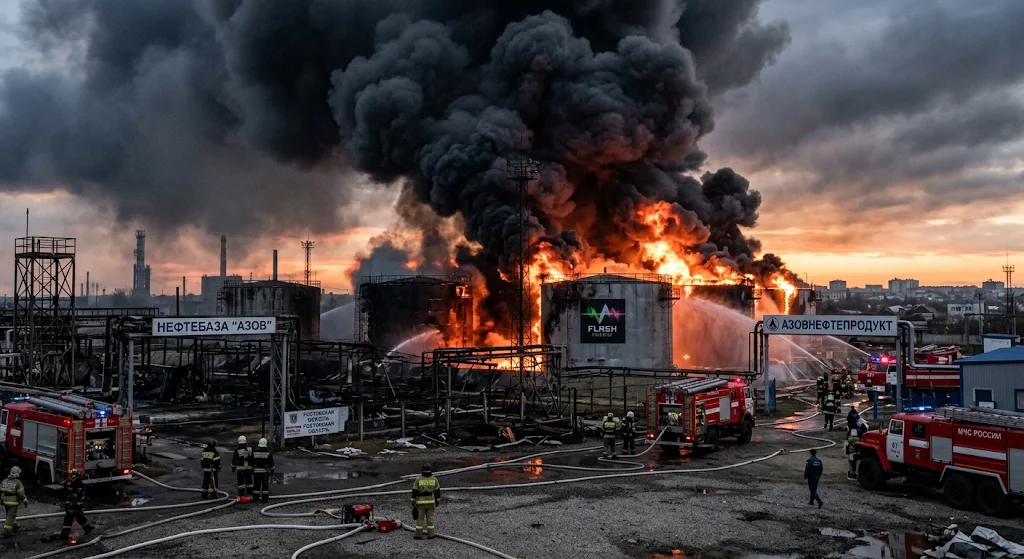
- Incident:A significant fire erupted at an oil depot in Azov, Russia, following a drone strike.
- Injuries:At least three individuals were reported injured due to the incident.
- Impact:The fire threatens regional fuel supply chains and military logistics.
AZOV, RUSSIA — A major fire broke out at fuel infrastructure in the southern Russian port city of Azov early Monday morning following an overnight drone strike, according to regional officials and open-source intelligence reports.
Rostov Region Governor Yury Slyusar confirmed that the attack sparked fires across four industrial facilities in Azov, leaving at least three men injured. While local authorities declined to name the exact sites damaged, monitoring channels and open-source analysts reported that a major blaze erupted near two petroleum product storage facilities close to the Azov seaport—including the Flash Energy oil depot, which houses 10 storage tanks with a combined capacity exceeding 6,500 cubic meters.
Eyewitness footage circulating on social media showed towering flames and thick plumes of black smoke rising into the pre-dawn sky as emergency crews worked to contain the fires. Russian air defense units reportedly intercepted drones across multiple districts in the Rostov region overnight, including over Rostov-on-Don, Taganrog, Azov, Neklinivka, and Millerivka. In the Millerivka district settlement of Rogalyk, falling drone debris ignited three private homes and damaged a gas pipeline.
Situated on the left bank of the Don River roughly 16 kilometers from the Sea of Azov, the city serves as a key logistics and energy hub and has been repeatedly targeted in long-range drone operations. Fuel storage facilities in Azov and neighboring Taganrog were previously struck during a large-scale drone raid in July, and an optical-mechanical defense plant in the city was hit in September.
The latest incident comes just hours after Ukrainian President Volodymyr Zelensky stated that sustained strikes against Russian energy assets have neutralized 55% of Russia's oil refining capacity, framing the campaign as a direct response to Moscow's ongoing bombardment of Ukraine's power grid ahead of winter.
Energy analysts note that repeated disruptions to southern Russian storage and distribution hubs risk straining domestic fuel supply chains and military logistics across the region. While Russia's Ministry of Defense claimed its air defense networks destroyed dozens of incoming unmanned aerial vehicles overnight, the persistent vulnerability of critical industrial infrastructure underscores the expanding reach of Kyiv's long-range strike capabilities.
Published by Banx Network. This article is part of the Banx decentralized media programme, powered by the BXE token on the XRP Ledger.