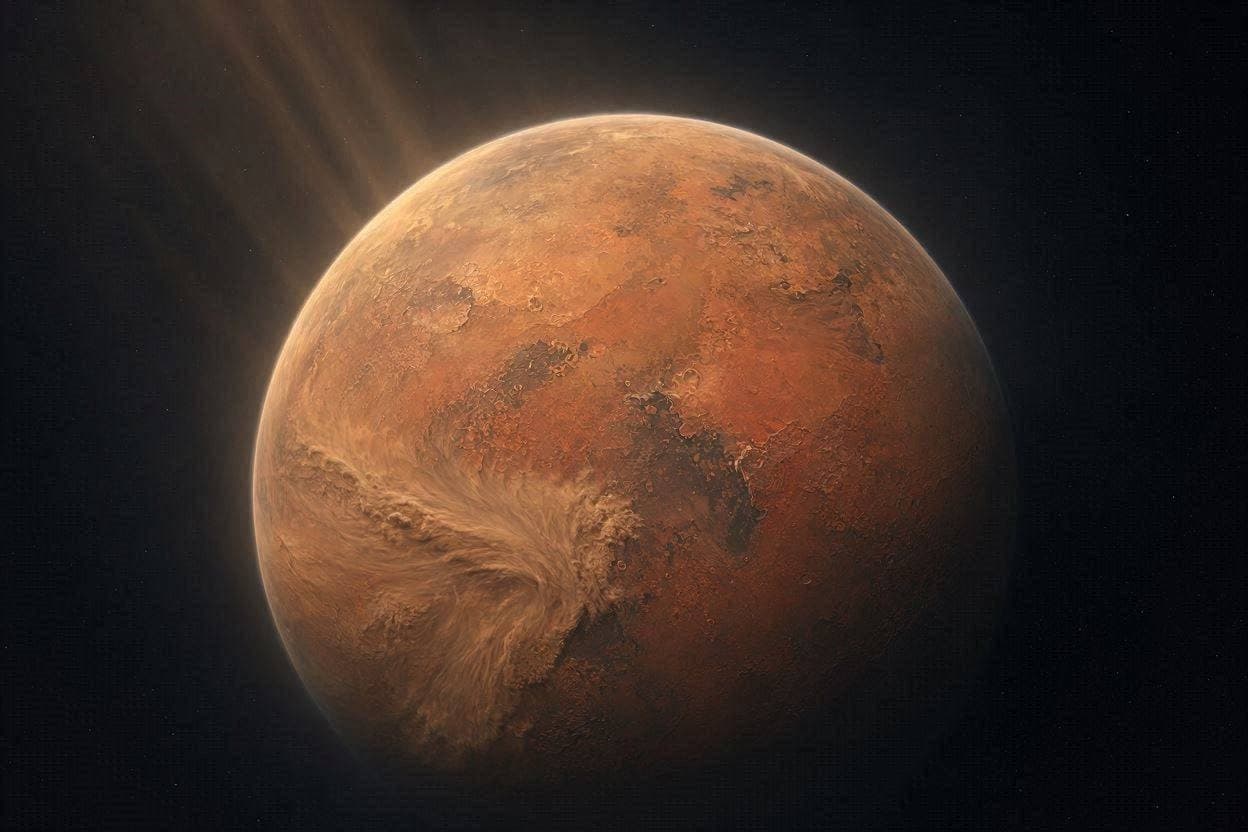
Mars is a planet of extremes, where thin air and red dust define the landscape. But beyond its visible features, the Red Planet is subject to powerful forces from space. Solar storms, bursts of radiation and charged particles from the Sun, regularly bombard Mars. Recent studies suggest that local weather phenomena, specifically global dust storms, can significantly amplify the impact of these solar events. This interaction reveals a dynamic relationship between planetary atmosphere and stellar activity, offering insights into the challenges of future human exploration.
Body: Solar storms release high-energy particles that can strip away atmospheric gases and disrupt electronic systems. On Earth, our thick atmosphere and magnetic field provide robust protection. Mars, however, lacks a global magnetic field and has a much thinner atmosphere. When a solar storm hits, the effects are more pronounced. Researchers have found that when these storms coincide with global dust events, the atmospheric response is intensified.
Dust storms on Mars lift fine particles high into the atmosphere, changing its electrical properties and temperature structure. This altered state makes the upper atmosphere more susceptible to ionization by solar particles. The dust acts as a catalyst, enhancing the absorption of energy and leading to greater atmospheric loss. This synergy between weather and space weather creates a compound effect that is greater than the sum of its parts.
Understanding this mechanism is crucial for planning manned missions to Mars. Astronauts will need protection not just from solar radiation directly, but from the secondary effects amplified by dust. Habitats and suits must be designed to withstand these heightened conditions. Predictive models that account for both solar cycles and Martian weather patterns will be essential for ensuring crew safety.
The findings also help explain the historical evolution of Mars’ atmosphere. Over billions of years, the combination of solar stripping and dust-driven amplification may have contributed significantly to the loss of water and air. This process transformed Mars from a potentially habitable world into the cold, dry desert we see today. Studying it helps us understand the lifecycle of planets and the factors that sustain or destroy atmospheres.
Data from orbiters like NASA’s MAVEN (Mars Atmosphere and Volatile EvolutioN) mission have been instrumental in these discoveries. By monitoring atmospheric density and composition during dust storms and solar events, scientists can correlate changes and build accurate models. This continuous observation provides a real-time laboratory for studying planetary physics.
For climatologists, the interaction offers a parallel to Earth’s own complex systems. While our planet is protected, studying Mars helps refine our understanding of how atmospheres respond to external stressors. It highlights the delicate balance required to maintain a stable environment capable of supporting life.
Closing: The amplification of solar storms by Martian dust storms is a reminder of the interconnectedness of cosmic and planetary forces. As we prepare to visit the Red Planet, we must respect its volatile nature. Understanding these dynamics is not just scientific curiosity; it is a prerequisite for safe and successful exploration.
AI Image Disclaimer: Visuals in this article are AI-generated representations of Martian landscapes and atmospheric phenomena, intended to illustrate the concepts of dust storms and solar interaction.
Sources: NASA MAVEN Mission Geophysical Research Letters Space.com University of Colorado Boulder
Published by Banx Network. This article is part of the Banx decentralized media programme, powered by the BXE token on the XRP Ledger.