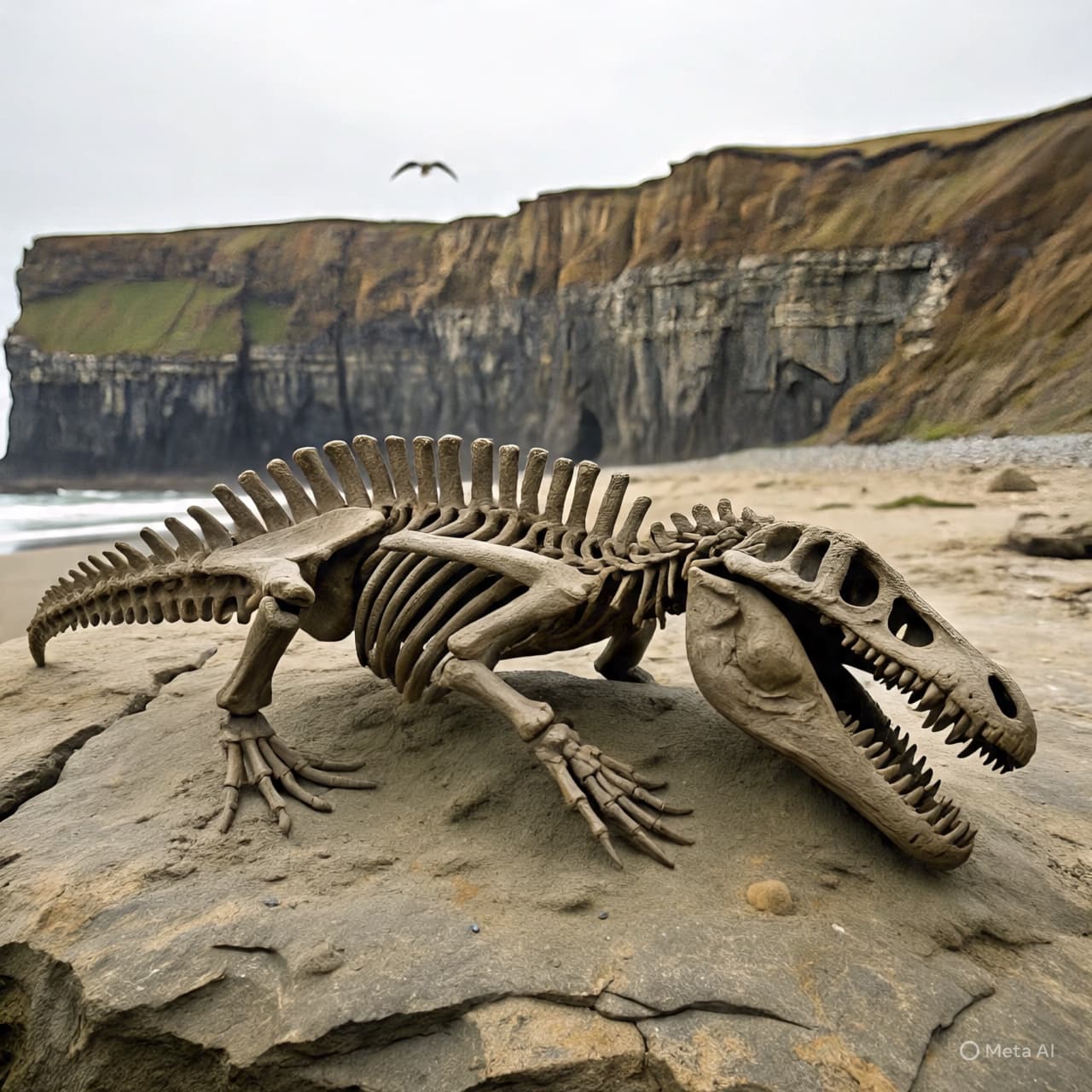
The sea has its own long memory — and every so often it decides to share a forgotten chapter, etched not in words but in bone. Along the Jurassic Coast of southern England, erosion and time have conspired like slow storytellers, revealing a nearly intact skeleton whose curved shapes and sharp edges seem almost lyrical, as if echoing a primordial poem. This fossil is no mere relic; it is a bridge to a chapter of life that has whispered just beyond our reach for millions of years.
In late paleontology reports, scientists have formally described a new species of ichthyosaur, a marine reptile that once navigated the ancient oceans of the Early Jurassic. This creature, now named Xiphodracon goldencapensis — literally “Sword Dragon of Golden Cap” — hails from a world nearly 190 million years past, long before humans breathed the air and stood upon these same cliffs. At roughly the size of a dolphin and preserved with remarkable detail, its skull boasts a long, sword-like snout and large eye sockets — shapes that speak of hunting fish, squid, and survival in a vast and changing ocean.
What makes this discovery especially resonant is not just its completeness but the gap it begins to fill in the ichthyosaur family’s story. Thousands of ichthyosaur bones have been found along these fossil-rich shores since the early days of paleontology. Yet this particular specimen — unearthed in 2001 near Golden Cap and only now fully studied — comes from a time slice known to researchers as the Pliensbachian, a span that has yielded comparatively few examples of the group. Xiphodracon is unique, a singular voice from that epoch offering clues about how ancient marine reptile lineages shifted through evolutionary change.
The animal’s anatomy hints at a life both ferocious and fragile: a blade-like nose for swift pursuit, beaten yet preserved bones suggesting wounds, perhaps from a larger predator, and evidence that even the mightiest sea travelers of its age faced peril. In this interplay of strength and vulnerability, Xiphodracon invites us to imagine the ancient seas not as distant abstractions, but as realms teeming with drama, adaptation, and survival.
As researchers prepare to display this specimen at the Royal Ontario Museum, its journey from cliff to collection to scientific literature illustrates the patient unfolding of understanding. What was once a fragmentary hope in rock has become a lens onto evolution’s subtle shifts. Even now, as this Sword Dragon rests in glass-lit galleries, its presence continues to shape how we see evolution — not as a linear thread, but as an ocean of intersecting currents, where each discovery is a beacon for future exploration.
In the end, the Sword Dragon’s tale reminds us that the Earth’s deep past is not a silent void, but a mosaic of stories waiting to be decoded, one fossil at a time.
AI Image Disclaimer (rotated wording) “Visuals are created with AI tools and are not real photographs.”
Credible sources found on this topic:
SciTechDaily Times of India NDTV ITV News AFP / Geo.tv
Published by Banx Network. This article is part of the Banx decentralized media programme, powered by the BXE token on the XRP Ledger.