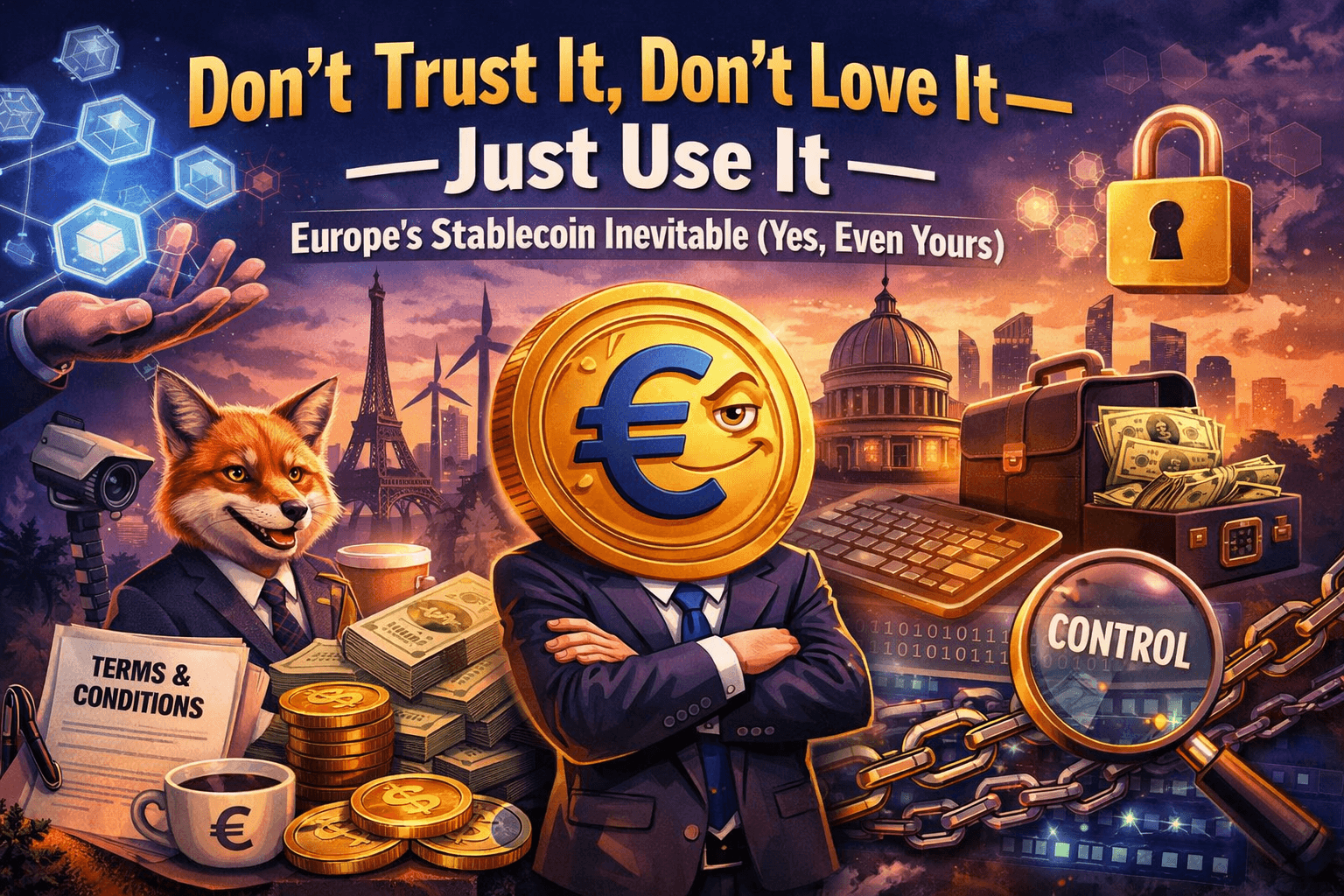
The Euro Stablecoin in a Bank Suit — Unloved, Untrusted, Unavoidable
Stablecoins are a bit like contact lenses in the ’90s: first creepy, then annoying, then suddenly everyone’s wearing them. When DZ Bank teams up with DekaBank to build a euro-based stablecoin, public reaction is predictable—raised eyebrows, crossed arms, and a quiet “yeah, no thanks.”
Banks. Tokens. Blockchain. For many people, that combo feels less like innovation and more like something you shouldn’t touch without gloves.
To be fair, the skepticism isn’t imaginary.
Stablecoins were invented because people didn’t trust banks. Now banks are explaining why this stablecoin is different. That’s a bit like a fox hosting a seminar on chicken safety. Technically sound. Emotionally… complicated.
Trust Is Not a Smart Contract
The biggest weakness of bank-issued stablecoins isn’t the tech. The tech works. The blockchain crunches numbers, the token moves smoothly, the whitepaper looks great in PDF form.
The problem is human psychology.
Cash is anonymous, stubborn, and deeply unbothered by policy updates. A stablecoin, by contrast, feels like money with terms and conditions. Potentially traceable. Potentially freezable. Potentially polite right up until it isn’t.
People don’t fear the coin itself. They fear what might be switched on later. Programmable money. Usage restrictions. Moral filters. Today these are “features.” Tomorrow they’re “updates.” Fear doesn’t need certainty—possibility is enough.
A Killer Use Case Nobody Asked For
Then there’s the everyday question: why would I use this?
Payments are already fast. Cards work. Instant transfers exist. Cash still buys coffee without requiring a wallet update. Against that backdrop, a bank stablecoin can feel like a hyper-intelligent fridge that does everything—except keep food colder than the old one.
For banks and institutions, it’s a different story. Efficiency is attractive. Settlement speed is exciting. Automation is beautiful. For normal people, it’s just… abstract.
And Yet: It’s Still Coming
Here’s the uncomfortable truth: despite all objections, there is no realistic path around stablecoins.
Global finance is moving toward tokenized settlement. Industry wants 24/7 transactions. Capital markets want atomic delivery versus payment. Supply chains want programmable money flows. This isn’t ideology—it’s infrastructure.
So the real question isn’t whether stablecoins arrive, but who builds them. Unregulated offshore issuers? Or regulated European institutions playing under transparent rules?
Trust Is the Real Product
In the end, blockchain won’t decide adoption—people will.
Stablecoins only become socially viable if they’re perceived as tools, not levers of control. That means clear limits, transparent governance, real choice, and the continued existence of boring old cash.
Technology can be deployed. Trust has to be earned.
If banks understand that, the stablecoin won’t be loved. But it will be tolerated.
And in finance, tolerance is often the first step toward inevitability.
Published by Banx Network. This article is part of the Banx decentralized media programme, powered by the BXE token on the XRP Ledger.