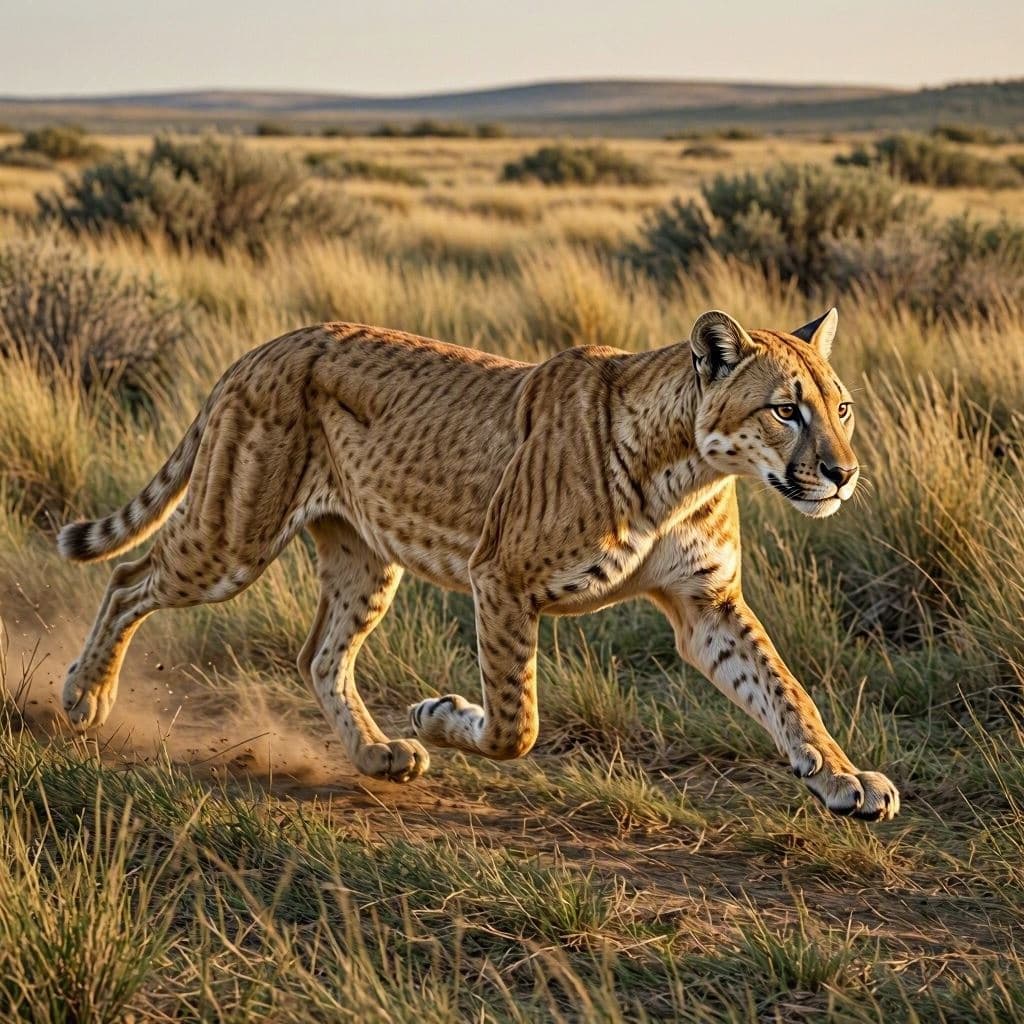
For decades, the fossilized bones of a swift predator roamed by North America’s ancient plains were classified with confidence: Miracinonyx, the "American cheetah." It was believed to be a close relative of the modern African cheetah, sharing its slender build and speed-adapted anatomy. However, science is a self-correcting journey, and new DNA evidence has rewritten this chapter of natural history. The creature was not a cheetah at all, but a distinct lineage of cougar-like cats. This revelation reminds us that appearances can be deceiving, and that truth often lies hidden in the molecular code rather than the shape of a bone.
The misidentification stemmed from convergent evolution, a phenomenon where unrelated species develop similar traits to adapt to similar environments. Just as sharks and dolphins share streamlined bodies despite different ancestries, the American "cheetah" evolved long legs and a flexible spine for chasing prey across open grasslands. These physical similarities led paleontologists to assume a close genetic relationship with Acinonyx jubatus, the true cheetah. It was a logical conclusion based on the morphological evidence available at the time.
Recent advances in ancient DNA extraction techniques have allowed scientists to peer deeper into the past. By analyzing genetic material preserved in fossil remains, researchers compared the genome of Miracinonyx with that of modern big cats. The results were surprising: the American predator was more closely related to the cougar (Puma concolor) than to the cheetah. This finding places it firmly within the Puma lineage, diverging millions of years ago from its African counterpart.
This correction does not diminish the fascination with the animal but rather enriches our understanding of feline evolution. It suggests that the ability to run at high speeds evolved independently in different cat lineages, a testament to the power of natural selection. The American "cheetah" was a unique experiment in speed, tailored to the specific ecological niches of Pleistocene North America. Its extinction, along with many other megafauna, remains a subject of ongoing study.
The discovery also highlights the limitations of relying solely on skeletal morphology. Bones tell a story of function, but DNA reveals the story of ancestry. As technology improves, more reclassifications are likely, refining the tree of life. This dynamic nature of scientific knowledge is not a weakness but a strength, allowing for continuous improvement and deeper insight. It encourages humility and openness to new evidence.
For the public, this update offers a fresh perspective on prehistoric life. The image of the "American cheetah" chasing ancient horses across the continent remains vivid, but now it carries a new identity. It was a cousin of the cougar, a ghost of the Puma lineage that once ruled the plains. This nuance adds depth to our appreciation of biodiversity and the complex web of evolutionary relationships.
As researchers continue to unlock the secrets of ancient genomes, more surprises may await. The story of the American "cheetah" is a reminder that science is never finished. It is a continuous dialogue with the past, where each new discovery invites us to look again, think deeper, and understand more fully the intricate history of life on Earth.
New DNA analysis reveals that the extinct "American cheetah" was actually a cougar-like cat, correcting a long-standing misclassification and highlighting the role of convergent evolution in shaping predatory anatomy.
AI Image Disclaimer: The images referenced in this piece are AI-created visualizations meant to evoke the setting, not direct documentation of the scientific data.
Sources: Nature Ecology & Evolution Smithsonian Magazine National Geographic Live Science
Published by Banx Network. This article is part of the Banx decentralized media programme, powered by the BXE token on the XRP Ledger.