The night sky has long inspired questions that stretch beyond generations. Each distant point of light carries mysteries shaped over billions of years, and with every new discovery, humanity gains another glimpse into the vast architecture of the universe.
Astronomers have announced the discovery of magnetic fields surrounding several exoplanets, marking an important milestone in the study of worlds beyond our solar system. Researchers say the findings could significantly improve understanding of planetary evolution and habitability.
Exoplanets are planets that orbit stars outside our solar system. Thousands have been identified over the past few decades, yet determining whether these distant worlds possess magnetic fields has remained a major scientific challenge.
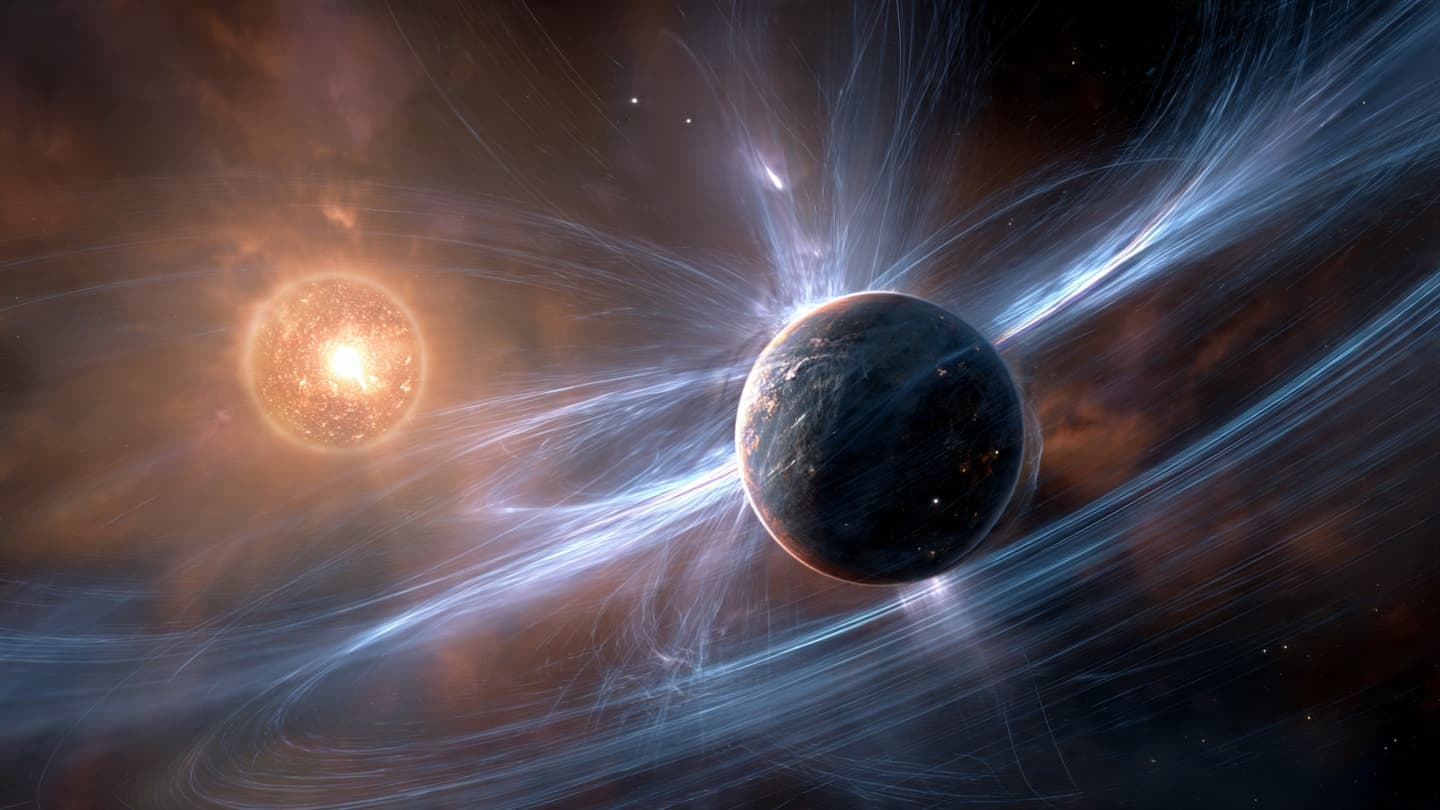
The recent discovery was made using advanced observational techniques that detected interactions between exoplanets and their host stars. Scientists observed radio signals believed to be associated with planetary magnetic activity, offering indirect but compelling evidence of magnetic fields.
Researchers emphasize that magnetic fields play a critical role in protecting planetary atmospheres from intense stellar radiation. On Earth, the magnetic field shields the planet from charged particles emitted by the Sun, helping preserve conditions favorable for life.
Without such protection, atmospheres may gradually erode, exposing planetary surfaces to harmful radiation. For this reason, astronomers consider magnetic fields an important factor when evaluating the potential habitability of distant worlds.
The discovery also provides new opportunities for comparative planetary science. By studying magnetic environments across different planetary systems, scientists hope to better understand how planets form, evolve, and interact with their surrounding space environments.
Future observatories, including next-generation radio telescopes and space missions, are expected to refine these observations further. Researchers anticipate that improved instruments will reveal additional details about exoplanet interiors and atmospheric dynamics.
As humanity continues exploring the cosmos, discoveries such as these bring distant worlds into sharper focus, reminding us that the universe still holds many unanswered questions waiting to be explored.
AI Image Disclaimer: The astronomical illustrations accompanying this article were generated using artificial intelligence to visualize distant planetary systems based on scientific descriptions.
Sources: Reuters, Nature Astronomy, European Southern Observatory, NASA
Published by Banx Network. This article is part of the Banx decentralized media programme, powered by the BXE token on the XRP Ledger.