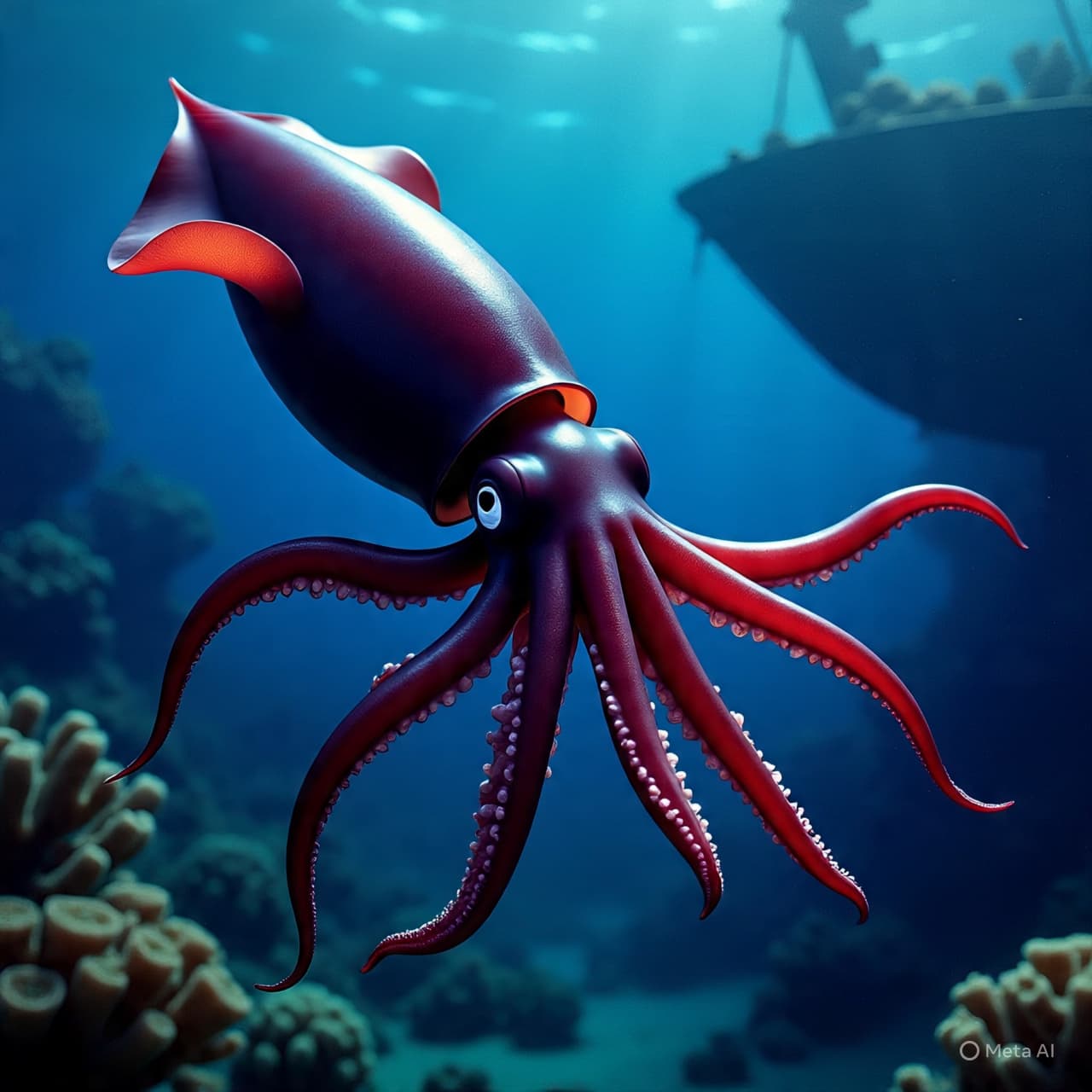
In the silent depths of the ocean, where sunlight never reaches and life moves with slow grace, an enigmatic creature drifts between mystery and myth. Known to some as the vampire squid from hell, Vampyroteuthis infernalis is neither vampire nor typical squid — yet it carries within its cells an extraordinary record of evolutionary history. Recently, scientists have finally decoded this creature’s huge genome, a monumental achievement that sheds light on how the remarkable diversity of cephalopods came to be.
At more than 11 billion base pairs, the vampire squid’s DNA is roughly four times larger than the human genome — and is now the largest cephalopod genome ever sequenced. This immense genetic blueprint reveals not just an abundance of material, but a deeply preserved structure that connects this deep-sea dweller to ancient cephalopod ancestors.
Despite belonging to the group that includes octopuses, the vampire squid’s chromosomes remarkably resemble those of squids and cuttlefish. This chromosomal architecture — retained from a long-ago common ancestor — suggests that early cephalopods had a more squid-like genetic layout before octopuses evolved major reorganizations in their DNA. The vampire squid thus stands as a “genomic living fossil”, helping scientists trace a missing chapter in cephalopod evolution stretching back some 300 million years.
To reach this breakthrough, international researchers collected tissue from a vampire squid caught as bycatch during a Pacific research voyage and used advanced sequencing technology to unravel its long, repetitive genome. While much of the DNA consists of sequences that do not code for proteins, its conserved structure has proved invaluable in comparing lineages across modern cephalopods.
Octopuses, on the other hand, have much smaller and highly rearranged genomes — a result of chromosomal fusions and reshuffling that likely accompanied adaptations such as arm specialization and shell loss. The vampire squid’s genome, by contrast, remains largely intact from an earlier form, offering a glimpse of what the common ancestor of squids and octopuses might have looked like deep in evolutionary time.
Beyond evolutionary insights, the findings illuminate how large genomes can expand without losing structural coherence. In many organisms, rapid genome growth is tied to disruptive mutations or instability. Yet the vampire squid seems to have navigated genomic expansion while preserving ancient patterns — a testament to the diverse paths evolution can take.
This landmark sequencing project not only redefines our understanding of a mysterious deep-sea species, but also strengthens the broader narrative of life’s evolutionary tapestry. In an oceanic world still largely unexplored, the vampire squid’s DNA now stands as a genetic archive — telling a story of ancient splits, hidden connections, and the intricate dance of biology across eons.
AI Image Disclaimer “Visuals are created with AI tools and are not real photographs.”
Sources Scientists finally sequence the vampire squid’s genome and reveal evolutionary insights. Discoveries on the vampire squid’s ancient genomic structure and evolutionary link. Sequencing details and evolutionary implications of the vampire squid genome.
Published by Banx Network. This article is part of the Banx decentralized media programme, powered by the BXE token on the XRP Ledger.