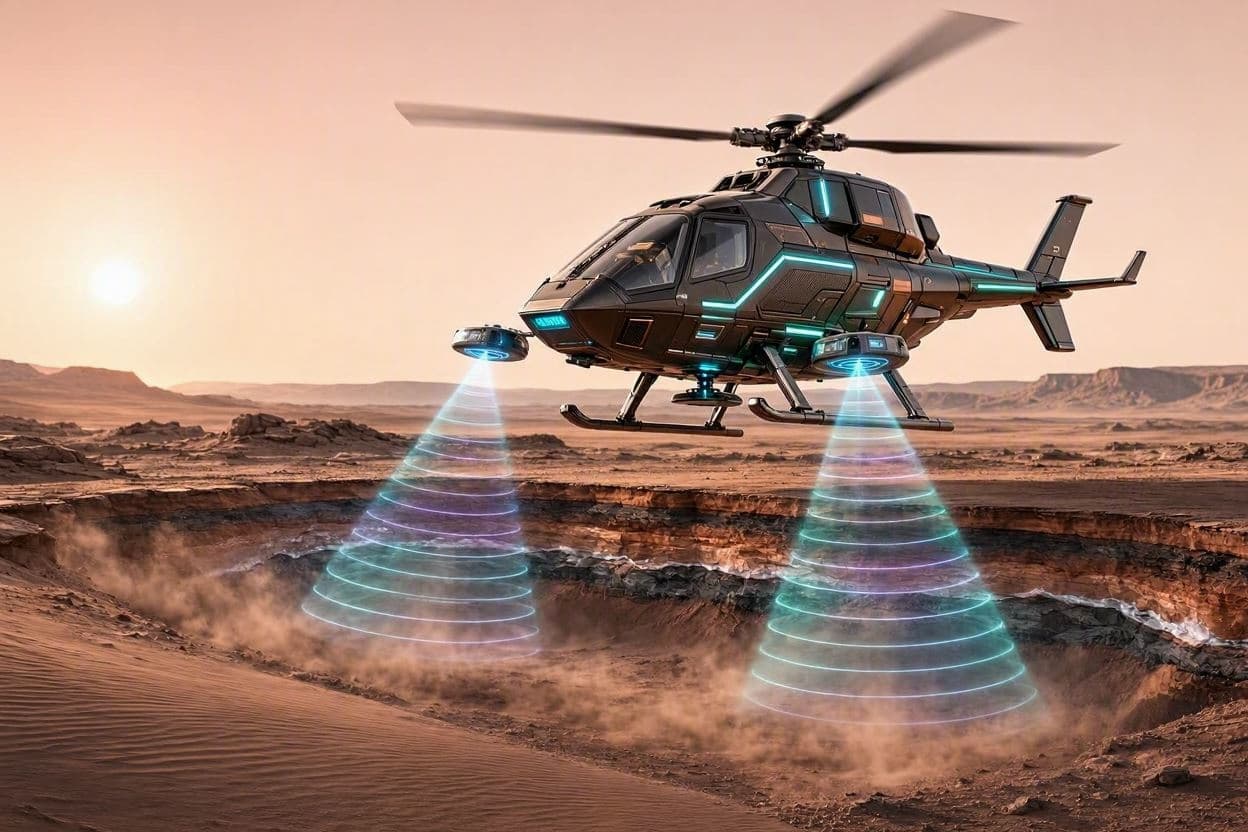
The red dust of Mars has long settled over the legacy of Ingenuity, the small helicopter that proved flight was possible on another world. Now, a new generation of rotorcraft is preparing to take to the Martian skies, carrying not just cameras but a profound new sense of touch. These upcoming "Skyfall" helicopters are being equipped with advanced antenna systems integrated with ground-penetrating radar, a technological leap that promises to reveal what lies beneath the surface. This evolution invites reflection on how our tools shape our understanding, turning a blind planet into an open book. It is a moment where sight gives way to insight.
The primary challenge of Mars exploration has always been its opacity; we can see the rocks and the ridges, but the subsurface remains a mystery. The new antenna upgrade allows the helicopters to send radio waves into the ground, detecting layers of ice, rock, and potential aquifers hidden from view. Waves seek truth. Depth holds secrets.
Unlike previous missions that relied on stationary landers or slow-moving rovers, these helicopters can cover vast distances quickly, creating a high-resolution map of the subsurface across diverse terrains. Mobility aids discovery. Speed expands scope.
The integration of ground-penetrating radar into such a small platform is a feat of engineering miniaturization. It requires balancing power consumption, weight, and data transmission capabilities, ensuring that the helicopter remains agile while performing complex scientific tasks. Balance ensures function. Miniaturization aids reach.
For scientists, this technology offers a new way to search for signs of past life, which may be preserved in underground environments protected from harsh surface radiation. The hope is to find biosignatures that have eluded surface-only missions. Protection preserves history. Subsurface holds hope.
The mission also serves as a testbed for future human exploration, identifying safe landing zones and resource deposits that could support astronauts. By mapping the ground below, we prepare the way for those who will walk upon it. Mapping aids safety. Preparation ensures success.
As the launch window approaches, the anticipation builds for what these flying eyes might uncover. The hope is that the data returned will rewrite our understanding of Martian geology and hydrology. Data changes perspective. Understanding brings clarity.
Upcoming Mars helicopters are being upgraded with ground-penetrating radar antennas to explore the subsurface of the Red Planet. This technology aims to map hidden ice and geological structures, aiding both scientific discovery and future human missions. The hope is for significant findings regarding Martian water resources.
AI Image Disclaimer: The visual elements accompanying this report are AI-generated interpretations designed to reflect the technological and exploratory context of the story.
Sources: NASA Jet Propulsion Laboratory Space.com IEEE Spectrum The Verge
Published by Banx Network. This article is part of the Banx decentralized media programme, powered by the BXE token on the XRP Ledger.