The day feels fixed, a steady twenty-four hours that we divide into meetings and meals and moments of rest. But physicists measure time differently, counting days in milliseconds, and they have known for decades that Earth's rotation is not perfectly constant. The planet speeds up, slows down, and the reasons have been a puzzle—linked to the atmosphere, the oceans, and something far deeper that we cannot see. A new study from Canadian researchers has now identified a gravitational tug-of-war thousands of kilometers beneath our feet, one that quietly lengthens and shortens our days.
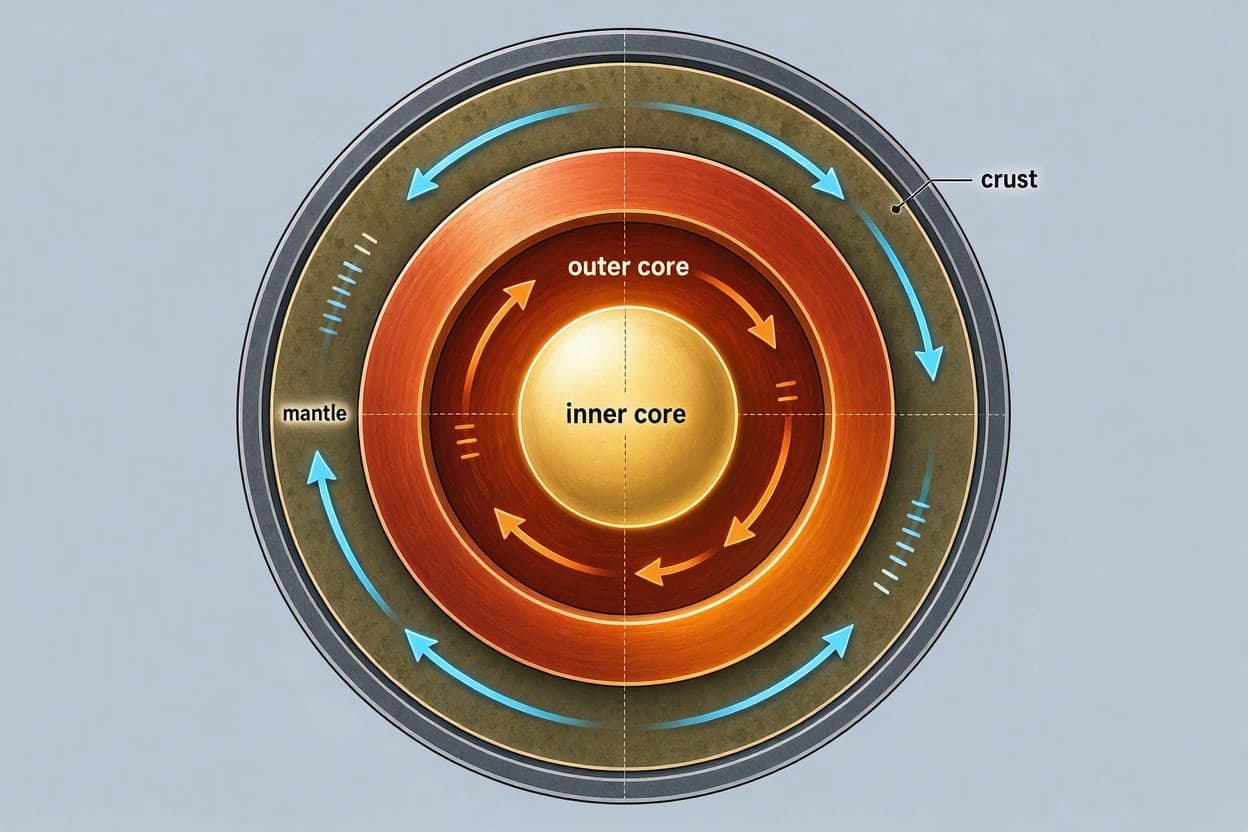
The research, published in Nature and led by Huifeng Zhang and Mathieu Dumberry at the University of Alberta, examined how angular momentum is exchanged between Earth's core and its mantle—the rocky shell that includes the crust and extends about 3,000 kilometers down . For roughly 30 years, scientists have known that the rotation of the liquid core speeds up over a few decades, then slows down, while the mantle compensates in the opposite direction to conserve angular momentum . That exchange can change the length of a day by a few milliseconds. But the mechanism behind the exchange remained unclear.
Zhang and Dumberry developed a model to test different combinations of forces that could couple the core to the mantle . They considered three possibilities. Gravitational torque arises from the pull between dense regions of the inner core and dense regions of the mantle. Electromagnetic torque comes from the magnetic field generated by the flowing outer core attracting iron-rich parts of the mantle. Mechanical torque is created by the flow of the molten outer core pushing against bumps and bulges at the core-mantle boundary, like a river flowing around rocks .
Their model best matched the observed record of day-length changes when gravitational torque was the dominant force . But it had to be balanced by the electromagnetic and mechanical torques pushing in the opposite direction—a geophysical tug-of-war. "Before we obtained the result, we didn't know they are competing with each other," Zhang said .
The findings offer more than an explanation for a millisecond-scale mystery. They provide a way to probe Earth's deep interior, a region that cannot be observed directly. The inner core, the model suggests, "deforms viscously" on a time scale of about 10 years, and its shape is not perfectly spherical . The gravitational torque arises because the inner core's dense regions are attracted to the mantle's dense regions, but the westward flows of the outer core pull it out of alignment, before gravity slowly draws it back .
Understanding these deep forces may help geophysicists interpret other observations, including the inner core's rotation and the shape of the boundary between core and mantle . For now, the study adds a new layer to our understanding of the planet we live on—a reminder that even the most familiar things, like the length of a day, are shaped by forces we are only beginning to comprehend.
A new study in Nature identifies a gravitational tug-of-war between Earth's inner core and mantle as the primary driver of millisecond-scale changes in the length of a day. The research offers new insights into the planet's deep interior dynamics.
AI Image Disclaimer: The images in this article are AI-generated and are for illustrative purposes only. They do not depict actual geological structures.
Sources: Nature, Phys.org, University of Alberta, Interesting Engineering, Universe Space Tech
Published by Banx Network. This article is part of the Banx decentralized media programme, powered by the BXE token on the XRP Ledger.