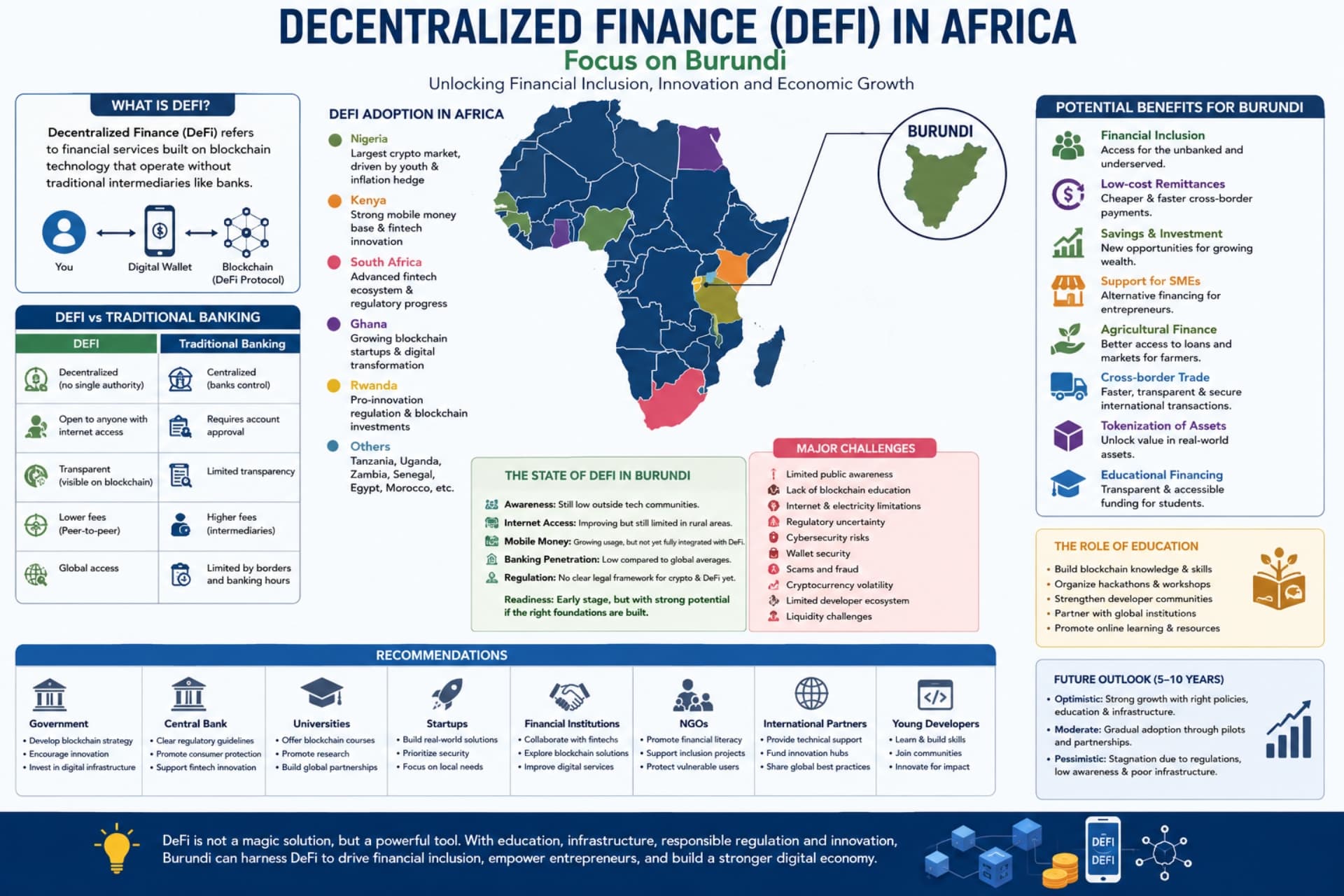
Decentralized Finance in Africa: Can DeFi Unlock Financial Inclusion and Economic Growth in Burundi?
Across Africa, millions of people remain underserved by traditional financial institutions despite the rapid growth of digital technologies. While mobile money has transformed payments in many countries, access to affordable savings, investments, loans, and international financial services remains limited for a significant portion of the population. This challenge has fueled growing interest in Decentralized Finance (DeFi)—a blockchain-based financial ecosystem that enables people to access financial services without relying on traditional banks or other centralized intermediaries. Unlike conventional banking, where financial institutions manage customer funds and approve transactions, DeFi operates through smart contracts—self-executing programs deployed on blockchain networks. These applications allow users to save, borrow, lend, trade digital assets, and transfer value directly from one wallet to another, often with greater transparency and accessibility. Although DeFi adoption remains at an early stage in many African countries, its potential to improve financial inclusion has attracted increasing attention from entrepreneurs, developers, policymakers, and investors. Burundi, where banking penetration remains relatively low but mobile phone usage continues to expand, could eventually benefit from this technological shift if the necessary foundations are established. Concerning the Current State of DeFi in Africa, this has become one of the world's fastest-growing digital finance markets. While DeFi adoption varies significantly across countries, several nations have emerged as regional leaders. Nigeria remains Africa's largest cryptocurrency market, driven by a young population, entrepreneurial culture, high inflation, and strong demand for affordable cross-border payments. Kenya has built on its globally recognized mobile money ecosystem to encourage digital financial innovation. South Africa has developed one of the continent's most mature fintech sectors, while Ghana and Rwanda continue investing in digital transformation and startup ecosystems. Several factors explain this growing interest in DeFi across Africa.
1. Smartphone Adoption Affordable: smartphones have enabled millions of Africans to access blockchain wallets and decentralized applications without requiring traditional banking infrastructure. 2. Mobile Money Success Services such as mobile money have familiarized users with digital financial transactions, making blockchain-based financial applications easier to understand and adopt. 3. Financial Inclusion According to international development organizations, a significant proportion of adults in Sub-Saharan Africa still lack access to formal banking services. DeFi offers an alternative path by allowing anyone with internet access and a digital wallet to participate in financial activities. 4. International Remittances Africa receives billions of dollars in remittances every year. Traditional money transfer services often charge relatively high fees. Blockchain-based payment systems have the potential to reduce transaction costs while improving settlement speed. 5. Youth Entrepreneurship Africa has one of the world's youngest populations. Many young entrepreneurs are building blockchain startups focused on payments, lending, agriculture, education, and digital identity.
How is it in Burundi? Compared with leading African blockchain markets, Burundi remains in the early stages of blockchain awareness and DeFi adoption. Knowledge of blockchain technology is still limited outside small technology communities. Many citizens associate cryptocurrencies primarily with speculative trading rather than broader financial innovation. Internet connectivity has improved over recent years but remains uneven, particularly in rural areas. Reliable electricity and affordable internet access continue to be important challenges. Banking penetration remains relatively low compared with global averages, although mobile money services have expanded access to digital payments. These services demonstrate that Burundians are increasingly comfortable using mobile technology for financial transactions. Digital literacy also varies significantly across the country. While younger populations are generally more familiar with smartphones and digital services, broader education on blockchain security, digital wallets, and decentralized applications remains limited. The regulatory environment is another important factor. Like many countries, Burundi continues to evaluate how cryptocurrencies and blockchain technologies should be regulated. Greater regulatory clarity could encourage innovation while protecting consumers from fraud and financial crime. Overall, Burundi possesses several ingredients that could support future DeFi growth, but broader adoption will likely depend on improvements in digital infrastructure, education, regulation, and public awareness.
Potential Benefits of DeFi for Burundi:
.Financial Inclusion:
One of DeFi's strongest advantages is its ability to provide financial services to individuals who lack access to traditional banks. Anyone with a smartphone and internet connection can potentially access decentralized financial applications.
.Lower Remittance Costs:
Many Burundians living abroad send money home. Blockchain-based payment networks could reduce transfer fees and improve transaction speed compared with traditional remittance channels.
.Savings and Investment Opportunities:
DeFi platforms may offer new ways for individuals to save digital assets or participate in decentralized investment opportunities. However, users should understand the associated risks before participating.
.Support for SMEs:
Small and medium-sized enterprises often struggle to obtain financing. Emerging decentralized lending models could eventually provide additional financing options alongside traditional banking.
.Cross-Border Trade:
Businesses engaged in regional trade may benefit from faster international payments and reduced transaction costs through blockchain-based settlement systems.
.Tokenization of Real-World Assets:
Tokenization enables physical assets—including agricultural products, real estate, or infrastructure—to be represented digitally on a blockchain. This could expand investment opportunities and improve transparency.
.Agricultural Finance:
Agriculture remains central to Burundi's economy. Blockchain solutions could improve supply chain transparency, facilitate agricultural financing, and support digital marketplaces connecting farmers with buyers.
.Educational Financing:
Educational institutions could eventually explore blockchain-based scholarship management, tuition payments, and transparent funding mechanisms for students.
Major Challenges:
Despite its promise, DeFi also faces substantial obstacles:
1. Limited Public Awareness: Many people remain unfamiliar with blockchain technology or misunderstand how decentralized financial systems operate.
2. Lack of Blockchain Education:
Universities and technical institutions currently offer limited blockchain-focused education, resulting in a shortage of skilled developers.
3. Infrastructure Constraints:
.Reliable internet:
connectivity and stable electricity remain essential for widespread DeFi adoption.
.Regulatory Uncertainty:
Businesses are often hesitant to invest where legal frameworks remain unclear.
.Cybersecurity Risks:
Users are responsible for protecting their private keys and digital wallets. Mistakes can result in permanent loss of funds.
.Scams and Fraud:
Fraudulent investment schemes frequently misuse blockchain terminology. Public education is critical to distinguish legitimate innovation from scams.
.Cryptocurrency Volatility:
Many cryptocurrencies experience significant price fluctuations, creating financial risks for users.
Limited Developer Ecosystem:
Burundi currently has a relatively small blockchain developer community compared with regional leaders. Liquidity Challenges Some decentralized markets lack sufficient liquidity, affecting pricing efficiency and transaction execution.
Can DeFi Succeed in Burundi?
The answer depends less on technology itself than on the broader ecosystem supporting its adoption. Several sectors appear particularly promising: . Cross-border payments . Agricultural finance . Educational financing . SME financing . Digital identity . Supply chain management
However, sustainable success will require several conditions: .Improved internet . .infrastructure. .Clear and balanced regulation. .Strong consumer .protection. .Public education. .Growth of local .blockchain startups. .Collaboration between government, universities, and the private sector. Rather than replacing traditional banking, DeFi is more likely to complement existing financial services by expanding access and encouraging innovation.
Recommendations:
Government of Burundi, Develop a national blockchain strategy. Encourage responsible innovation, Support digital infrastructure investments. Central Bank, Establish clear regulatory guidelines. Promote consumer protection. Encourage fintech experimentation through regulatory sandboxes. Universities, Introduce blockchain and Web3 courses. Support blockchain research. Partner with international institutions. Blockchain Startups Build solutions addressing local economic challenges. Prioritize security and user education. Focus on practical use cases rather than speculation. Financial Institutions, Explore partnerships with fintech companies. Investigate blockchain applications for payments and compliance. NGOs: Promote digital financial literacy, Support inclusion projects targeting underserved communities. International Partners: Provide technical assistance, Support startup incubators, Invest in digital infrastructure and education. Young Developers: Learn blockchain programming, Participate in hackathons, Contribute to open-source projects, Build locally relevant decentralized applications,
The Role of Education:
Education is arguably the single most important factor for responsible DeFi adoption. Blockchain technology introduces new concepts—including wallets, smart contracts, private keys, decentralized applications, and tokenization—that require careful understanding. Governments, universities, technology hubs, and private organizations should organize: Blockchain workshops University partnerships Developer bootcamps Hackathons Online certification programs Community meetups
These initiatives can cultivate a skilled workforce capable of building secure, innovative blockchain solutions tailored to Africa's unique challenges.
Future Outlook:
Over the next five to ten years, Burundi could follow several possible paths. In an optimistic scenario, improved internet access, supportive regulation, increased education, and growing entrepreneurial activity could foster a vibrant blockchain ecosystem serving agriculture, education, finance, and trade. A moderate scenario would involve gradual adoption through pilot projects and partnerships with regional blockchain companies. A pessimistic scenario could result if infrastructure limitations, regulatory uncertainty, and low public awareness continue to hinder innovation. Countries such as Nigeria, Kenya, Rwanda, Ghana, and South Africa demonstrate that strong digital ecosystems emerge through sustained investment in education, infrastructure, entrepreneurship, and policy—not technology alone.
Burundi has an opportunity to learn from these experiences and adapt successful approaches to its own economic context.
Conclusion:
Decentralized Finance is not a universal solution to Africa's financial challenges, nor should it be viewed as a replacement for traditional banking systems. Nevertheless, it represents an important technological innovation with the potential to expand financial inclusion, improve payment efficiency, stimulate entrepreneurship, and support broader economic development.
For Burundi, the road to meaningful DeFi adoption will require more than blockchain technology. It will depend on investments in digital infrastructure, clear regulatory frameworks, stronger cybersecurity awareness, high-quality education, and collaboration among government institutions, financial organizations, universities, startups, and international partners. If these foundations are established, DeFi could become a valuable component of Burundi's digital economy—helping connect more citizens to modern financial services while encouraging responsible innovation and sustainable economic growth.
Published by Banx Network. This article is part of the Banx decentralized media programme, powered by the BXE token on the XRP Ledger.