There is a way of knowing that comes not from a single measurement but from the accumulation of many, each one pointing in the same direction. For more than three decades, scientists have been searching for what they call climate "fingerprints"—specific patterns of change that can be traced to a particular cause. A new review of that research has concluded that the evidence is now overwhelming: greenhouse gas emissions are driving changes throughout Earth's climate system, and the fingerprints are everywhere we look.
The review, published in the journal WIREs Climate Change, synthesizes findings from dozens of studies conducted since the early 1990s. Each study examined a different aspect of the climate system—temperature, precipitation, ocean heat content, sea ice extent, atmospheric circulation—and asked whether the observed changes matched the pattern expected from greenhouse gas emissions. The answer, consistently, has been yes. The pattern is not random. It bears the distinct signature of human influence.
The fingerprint method works by comparing observed changes against the predictions of climate models. If greenhouse gases are the primary driver, certain patterns should emerge: the lower atmosphere should warm while the stratosphere cools, polar regions should warm faster than the tropics, and nights should warm more than days. These are not arbitrary expectations; they are physical consequences of how greenhouse gases trap heat. And they are precisely what the observations show.
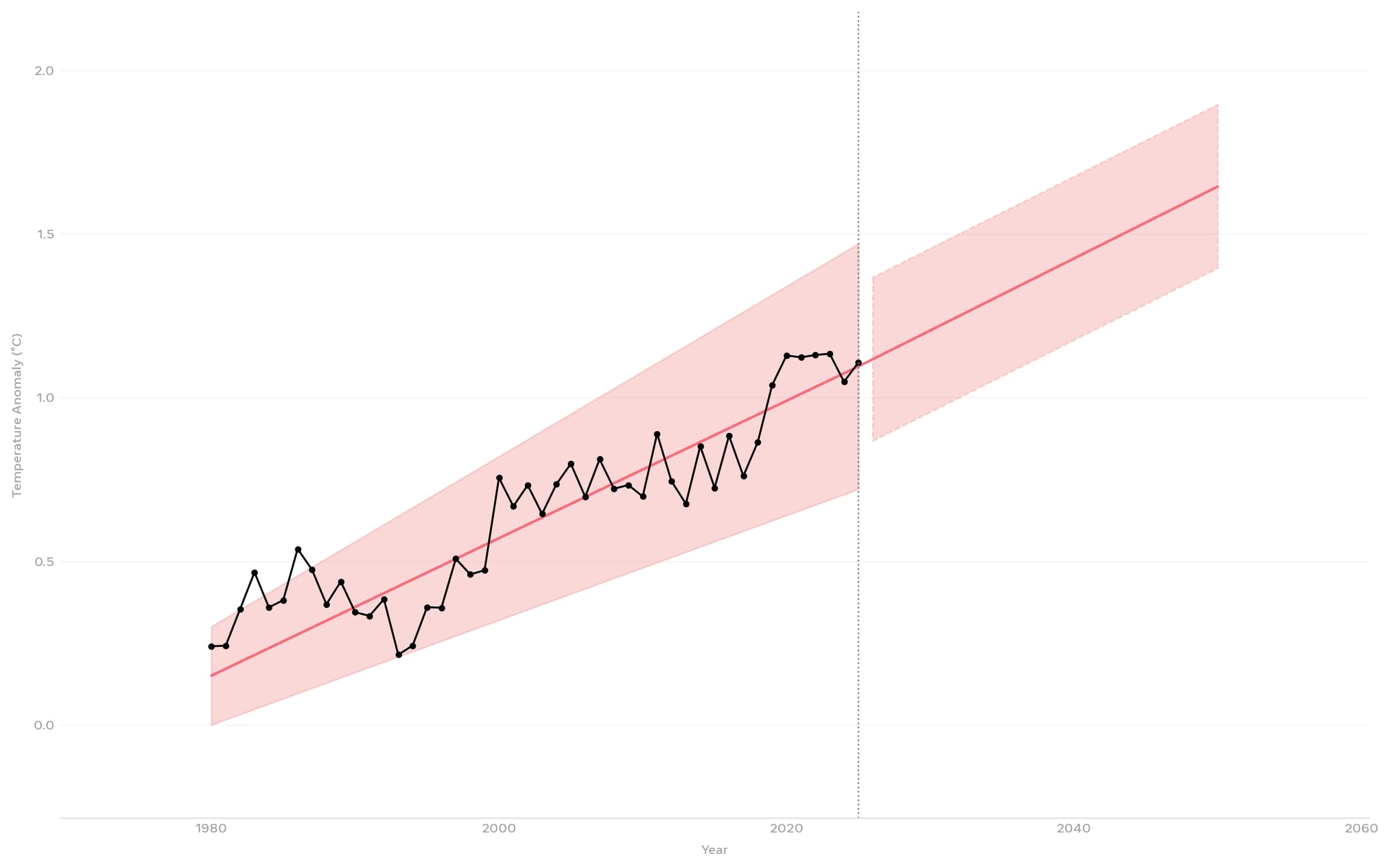
The review documents how these fingerprints have become clearer over time. Early studies in the 1990s could identify a human signal in global temperature, but the evidence was subject to uncertainty. As records lengthened and models improved, the signal strengthened. By the 2000s, researchers could attribute warming to human activity with increasing confidence. Today, the fingerprints are detectable in virtually every component of the climate system—in the oceans, which absorb more than 90 percent of the excess heat; in the melting of glaciers and ice sheets; in the rising sea levels; in the shifting patterns of rainfall and drought.
What distinguishes this review is its breadth. It does not rest on a single line of evidence but on many, each reinforcing the others. The consistency across different variables, different regions, and different research groups is itself a form of evidence. When independent analyses using different methods reach the same conclusion, the conclusion becomes difficult to dismiss.
The review also addresses common criticisms. Some have argued that natural variability—volcanic eruptions, solar cycles, ocean oscillations—could explain the observed changes. The fingerprint research has tested this. Natural factors produce patterns that differ from those observed. When models include only natural forcings, they cannot reproduce the warming of the past century. When they include greenhouse gases, they can.
The conclusion of the review is not merely that climate change is real, or that it is caused by humans. It is that the evidence has reached a point where the attribution is no longer a matter of serious scientific debate. The fingerprints are there, in the data, in the patterns, in the physical world. They have been accumulating for decades. And they point to a single conclusion: the climate is changing, and we are the cause.
AI Image Disclaimer: The images in this article are AI-generated and are provided for illustrative purposes only.
Sources:
· WIREs Climate Change · IPCC Assessment Reports · NASA Goddard Institute for Space Studies · NOAA National Centers for Environmental Information
Published by Banx Network. This article is part of the Banx decentralized media programme, powered by the BXE token on the XRP Ledger.