

Key Highlights
- Incident:A U.S. military strike in the eastern Pacific kills two and leaves six missing.
- Context:The strike is part of a controversial maritime interdiction campaign.
- Legal Concerns:Critics question the legality of military actions against civilian vessels.
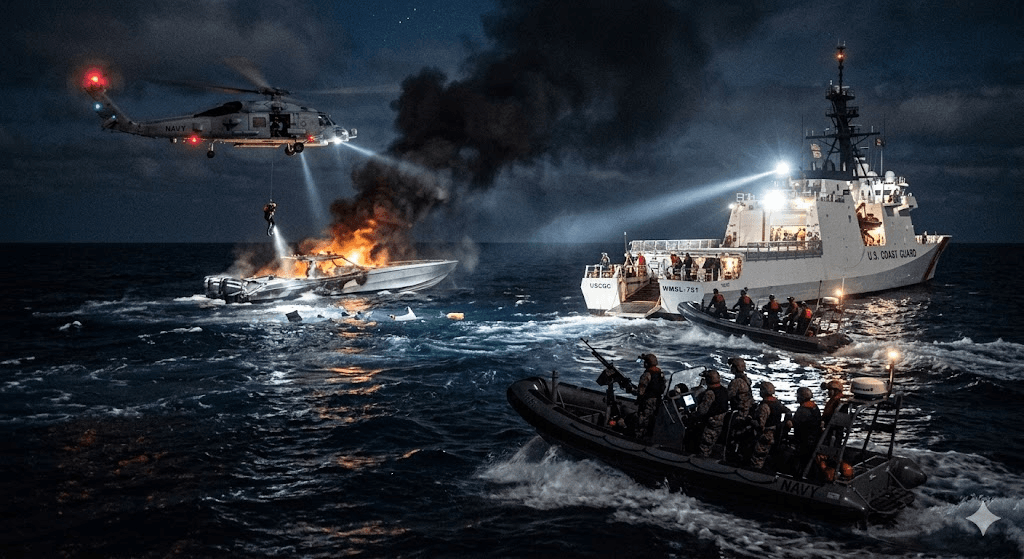
A U.S. military strike targeting a suspected drug-smuggling vessel in the eastern Pacific Ocean has left two people dead and six others missing at sea, as confirmed by the Defense Department. This incident marks a significant escalation in a controversial maritime interdiction campaign that has been ongoing for several months. The strike occurred along known smuggling routes in international waters, raising questions about the legality and ethics of such military actions.
According to statements from U.S. Southern Command (SOUTHCOM), the operation focused on a fast-moving boat suspected of transporting narcotics. The strike is part of a broader initiative that has reportedly resulted in over 210 fatalities since September under the current administration's targeted boat-strike policy. This alarming statistic highlights the increasing militarization of U.S. counter-narcotics efforts.
Declassified aerial footage released on social media platform X shows the moments leading up to the strike. The video captures the vessel speeding across the water before being hit by a projectile, which caused it to explode and ignite. Two individuals on board were killed instantly, while six others survived the initial blast but are now unaccounted for. SOUTHCOM officials have activated search-and-rescue protocols in coordination with the U.S. Coast Guard, but it remains uncertain if any survivors have been located.
Despite the dramatic nature of the operation, the Pentagon has not provided immediate evidence confirming that the destroyed vessel was actively engaged in drug trafficking at the time of the attack. This lack of transparency has fueled criticism from legal scholars and lawmakers who question the justification for using lethal force against civilian-style vessels in international waters without a formal declaration of war.
The ongoing campaign represents a significant shift in U.S. counter-narcotics strategy. The White House has defended the use of lethal maritime strikes, asserting that the U.S. is in a state of "armed conflict" with Latin American drug cartels. Administration officials argue that destroying smuggling vessels is essential to curbing the flow of narcotics into American communities and addressing the ongoing overdose crisis.
However, this strategy has faced intense scrutiny. Critics point out that most illicit fentanyl entering the U.S. does so through land-based ports of entry along the Mexican border, rather than via open-ocean speedboats. This raises questions about the effectiveness of maritime strikes in combating the drug crisis.
The latest strike comes amid increasing pressure from Congress, with lawmakers demanding the Pentagon release unedited video footage from previous operations. Reports have surfaced alleging that U.S. forces conducted follow-up strikes on survivors clinging to wreckage after initial attacks. While the White House has defended these actions as self-defense, legal experts warn that targeting defenseless survivors could violate maritime law.
In response to these concerns, the Pentagon's inspector general's office has initiated a self-funded evaluation to assess whether military operations adhere to the established Joint Targeting Cycle. However, this review is limited to tactical and administrative aspects, leaving the broader question of international legality unaddressed. As the debate continues, the implications of these military actions on U.S. foreign policy and international law remain significant and contentious.
Published by Banx Network. This article is part of the Banx decentralized media programme, powered by the BXE token on the XRP Ledger.




