KATHMANDU / BEIJING — Catastrophic flash floods triggered by a massive glacial collapse swept across the Nepal-Tibet border, leaving hundreds dead, over 1,400 people missing, and desperate survivors trapped on rooftops awaiting aerial rescue.
The disaster struck early Wednesday morning along the Himalayan frontier near Nepal's Rasuwa district and Tibet's Gyirong county. A massive section of a high-altitude glacier sheared free, sending millions of tons of ice, rock, and mud roaring into the river systems below. The impact was so intense that global seismic monitors initially misidentified the event as a 5.2-magnitude earthquake. Within minutes, a wall of water surged down the LhendeKhola and BhoteKoshi rivers, obliterating entire mountain settlements, key highway links, and local hydropower infrastructure.
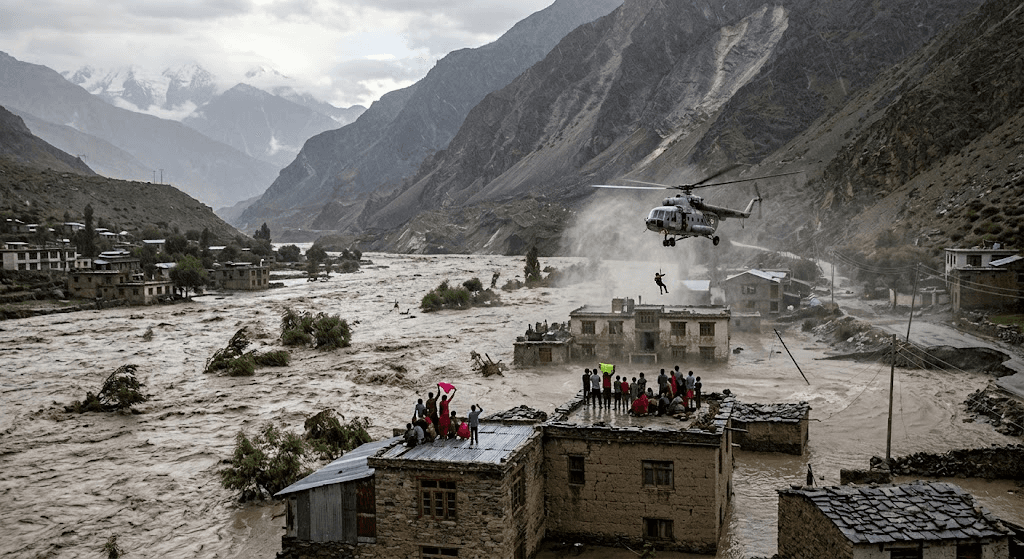
As violent torrents engulfed lower-lying homes, residents fled to upper floors and rooftops in a frantic bid for survival. Eyewitnesses described seeing families swept away in seconds, while survivors held on to chimney stacks and roof framing as thick sludge submerged entire streets below. "This flood took everything, but my son and I climbed the rooftop of a house and survived," recounted one survivor from Nuwakot district. Emergency teams from the Nepalese military and Chinese border forces deployed rescue helicopters to winch stranded residents from rooftops and extract victims from knee-deep mud.
The human toll has surged past 390 confirmed fatalities, with authorities warning that numbers will rise sharply as remote areas are reached. More than 1,400 individuals remain unaccounted for, including hundreds of foreign trekkers and pilgrims visiting the region. Critical transport corridors remain completely severed, and damaged communication lines continue to complicate coordinated relief efforts.
Climate scientists noted that the disaster underscores the growing instability of high-altitude Himalayan glaciers, which are warming at nearly double the global average rate. International aid organizations and government disaster teams have mobilized emergency food, medical supplies, and temporary shelters as search operations continue around the clock.
Published by Banx Network. This article is part of the Banx decentralized media programme, powered by the BXE token on the XRP Ledger.