
Key Highlights
- David Schwartz, Chief Architect of XRP Ledger, shares insights on $XRP.
- Schwartz emphasizes user empowerment and low transaction costs.
- The XRP Ledger operates as a utility, not a profit mechanism.
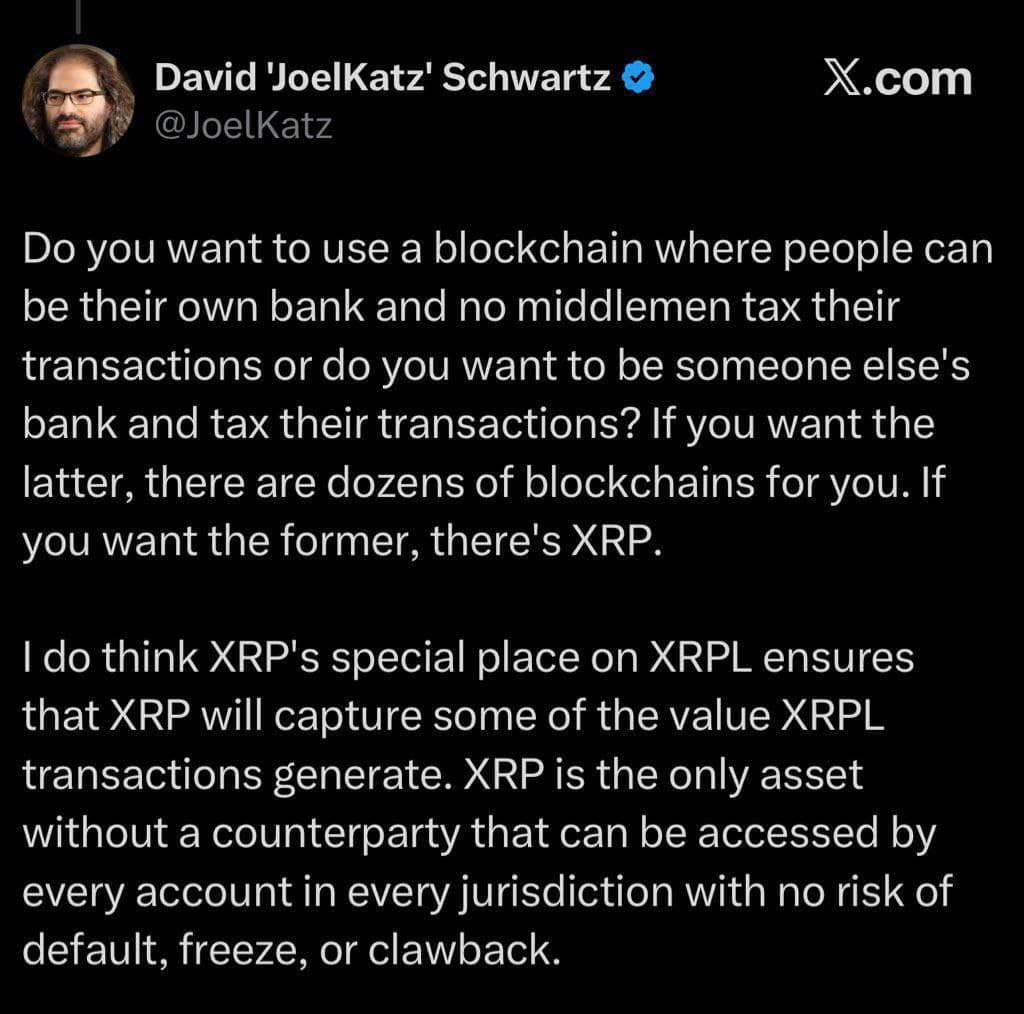
David Schwartz, the Chief Architect behind the XRP Ledger (XRPL), has recently sparked significant discussion within the cryptocurrency community by articulating a fundamental philosophy that distinguishes $XRP from other digital assets. In a thought-provoking post on X (formerly Twitter), Schwartz posed a critical question to his followers: "Do you want to use a blockchain where people can be their own bank and no middlemen tax their transactions? Or do you want to be someone else’s bank and tax their transactions? If you want the former, there’s $XRP.” This statement serves as a profound exploration of the ethical and architectural principles that underpin the XRP Ledger.
The core of Schwartz’s argument revolves around a stark contrast in the operational models of various blockchain systems. He delineates between the $XRP model, which is user-centric, and the traditional models prevalent in many other cryptocurrencies. The XRP Ledger is designed as a utility, focusing on empowering users rather than generating profits for validators. Transaction costs on the XRPL are minimal and are burned, meaning they do not benefit any miner, staker, or middleman. This structure allows users to function as their own banks, free from the transaction taxes imposed by intermediary-centric models.
In contrast, Schwartz highlights the operational framework of most Proof-of-Work (PoW) and Proof-of-Stake (PoS) blockchains, where transaction fees serve as rewards for miners or validators. This creates a scenario where these operators act as middlemen, effectively taxing every transaction. While such a model is necessary for maintaining security in these systems, it contradicts the vision of a decentralized and frictionless payment network that the original cryptocurrency movement aimed to achieve.
Schwartz’s insights underscore the XRP Ledger’s commitment to speed, efficiency, and low costs, which are essential for its role as a global payment rail. The absence of inflationary mining or staking rewards reinforces the notion that the XRPL is an infrastructure designed for the movement of money, rather than a scheme to enrich a select group of intermediaries. This unique approach ensures that users can transfer significant amounts of value quickly and at minimal cost, which is crucial for establishing a truly global, bank-free financial ecosystem.
The implications of Schwartz's message resonate deeply within the crypto community, particularly among those who prioritize self-sovereign financial utility over models that reintroduce central intermediaries. His assertion serves as a guiding principle for individuals seeking to operate independently within the financial landscape. The conclusion is clear: for those who aspire to be their own banks, free from the burdens of intermediary taxation, the XRP Ledger stands out as the definitive choice in the evolving world of cryptocurrency.
Published by Banx Network. This article is part of the Banx decentralized media programme, powered by the BXE token on the XRP Ledger.



