Key Highlights
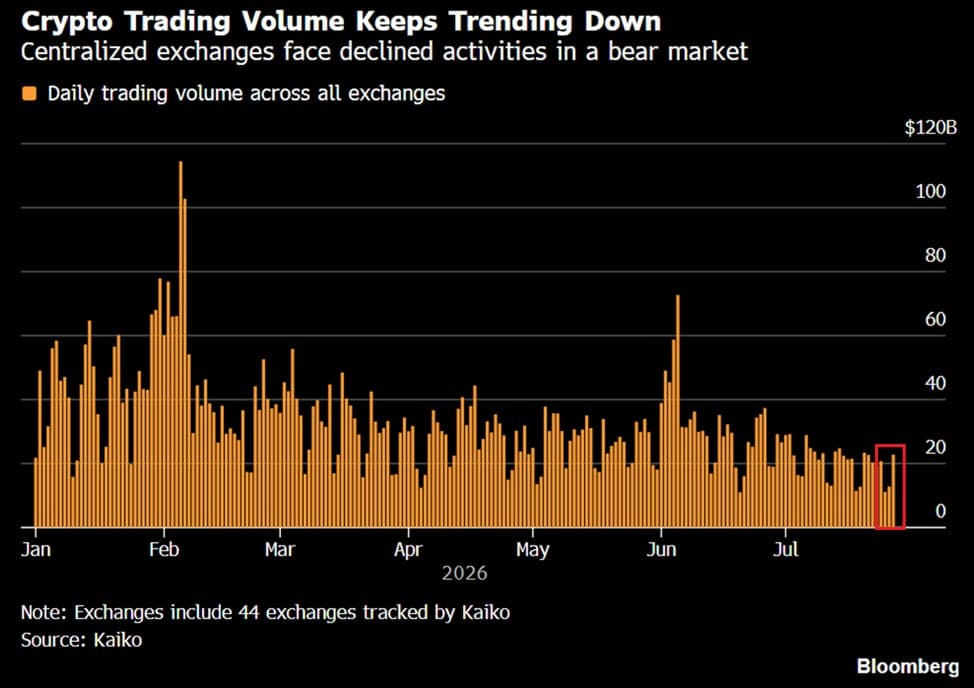
- Trading volumes have fallen to $15 billion, the lowest this year.
- Institutional investors are reducing short-term trading frequency.
- Upcoming policy developments may influence market sentiment.
Cryptocurrency trading activity has slowed considerably, with data tracking major centralized exchanges showing daily spot trading volumes declining to approximately $15 billion, the lowest level recorded this year. This downturn represents a significant drop from peak trading activity earlier in 2026 and reflects changing market conditions across the digital asset industry.
Trading volume is one of the most closely watched indicators of market participation. Higher volumes generally indicate increased investor activity, stronger liquidity, and greater price discovery, while lower volumes often suggest that investors are waiting for clearer economic or regulatory signals before making major investment decisions. The current decline in trading activity raises questions about the future dynamics of the cryptocurrency market.
Several factors may be contributing to the weaker trading activity observed in recent weeks. Many institutional investors have already established long-term positions through regulated investment products such as spot Bitcoin ETFs, which has reduced the frequency of short-term trading. Additionally, retail participation has moderated following earlier periods of heightened market volatility, as many individual investors appear to be adopting a wait-and-see approach.
Macroeconomic uncertainty continues to influence investor behavior across both cryptocurrency and traditional financial markets. Factors such as interest rate expectations, inflation trends, geopolitical developments, and global economic conditions remain important drivers affecting market sentiment. As these elements evolve, they could further impact trading volumes and investor strategies.
Despite the current slowdown in exchange volumes, analysts note that declining spot activity does not necessarily indicate weakening long-term adoption of cryptocurrencies. Increasing institutional custody, tokenization projects, blockchain payment infrastructure, and regulated investment products may shift activity away from traditional retail trading while supporting broader ecosystem growth. This suggests that while short-term trading may be down, the overall market infrastructure is strengthening.
Historically, extended periods of reduced trading volume have often preceded significant market movements. As liquidity contracts, unexpected regulatory announcements, institutional investment, or macroeconomic events can trigger larger-than-normal price swings because fewer active traders are available to absorb market changes. Investors are advised to remain vigilant as these dynamics unfold.
Market participants are also closely monitoring upcoming policy developments, including cryptocurrency legislation and central bank decisions, which could influence market sentiment during the second half of the year. These factors could serve as catalysts that restore higher trading volumes in the months ahead.
While short-term activity has slowed, the digital asset industry continues to expand through institutional adoption, tokenization initiatives, and blockchain infrastructure development. The interplay of these factors will be crucial in determining the future trajectory of cryptocurrency trading activity and market engagement.
Published by Banx Network. This article is part of the Banx decentralized media programme, powered by the BXE token on the XRP Ledger.