

Key Highlights
- Magnitude:A 7.1-magnitude earthquake struck Kyushu, Japan, on July 28, 2026.
- Damage:Significant structural damage reported, including a mall collapse.
- Response:Emergency services and government officials mobilized for rescue operations.
A powerful 7.1-magnitude earthquake rocked Japan's southern island of Kyushu on the afternoon of July 28, 2026, causing widespread destruction and prompting tsunami warnings. The earthquake struck Kumamoto Prefecture at 4:27 p.m. local time, with a shallow depth of approximately 10 kilometers. The Japan Meteorological Agency (JMA) reported that the tremor reached a maximum intensity of 7 on the Japanese seismic scale in Uki City and Hikawa, indicating severe shaking that rendered movement nearly impossible.
In the immediate aftermath, the JMA issued a tsunami advisory warning of potential waves up to 1 meter (3.3 feet) along the coastlines of the Ariake and Yatsushiro seas. Coastal residents were urged to evacuate to higher ground, but fortunately, the advisory was lifted about two hours later as no significant waves were observed.
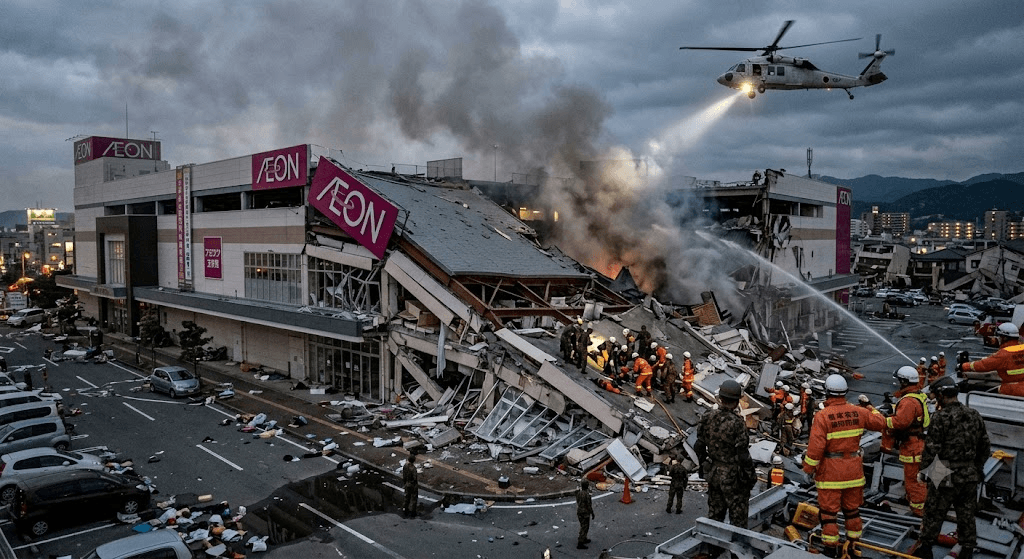
The town of Kashima experienced the most severe damage, where the second floor of the Aeon Mall Kumamoto collapsed. Eyewitnesses reported a loud explosion followed by a plume of dark smoke, leading to fears that a considerable number of shoppers and employees were trapped or presumed dead inside the wreckage. Emergency services were quickly dispatched to the scene to conduct rescue operations.
In addition to the mall collapse, numerous residential homes were reported as collapsed across the prefecture. In Yatsushiro, a factory chimney fell, trapping nine workers, while a cargo train derailed and overturned at Yatsushiro Station, further complicating rescue efforts. Historical sites were also affected, with centuries-old stone walls at Kumamoto Castle crumbling, sending clouds of dust into the air.
The earthquake caused significant utility disruptions, leaving nearly 48,000 households without power in Kumamoto. Transportation systems were severely impacted, with JR Kyushu suspending all rail operations, including the high-speed Shinkansen bullet trains. Aso Kumamoto Airport also temporarily closed its runways for safety inspections.
The region's semiconductor industry, crucial to Japan's economy, felt the tremors as well. Major companies like TSMC, Sony, and Fujifilm evacuated workers from their facilities to assess potential damage to high-precision machinery. Fortunately, the Nuclear Regulation Authority reported no abnormalities at the nearby Sendai and Genkai nuclear power plants, alleviating concerns about nuclear safety.
In response to the disaster, Japanese Prime Minister Sanae Takaichi convened an emergency task force in Tokyo to coordinate relief efforts. "We will make every effort to carry out emergency disaster response measures, with rescue and lifesaving operations led by local police and fire departments as our top priority," she stated during a press briefing.
Self-Defense Forces have been deployed to assist local rescue teams, and as night falls, meteorologists are warning residents to prepare for potentially dangerous aftershocks in the coming week, as well as a heightened risk of landslides due to the region's current high temperatures.
Published by Banx Network. This article is part of the Banx decentralized media programme, powered by the BXE token on the XRP Ledger.




