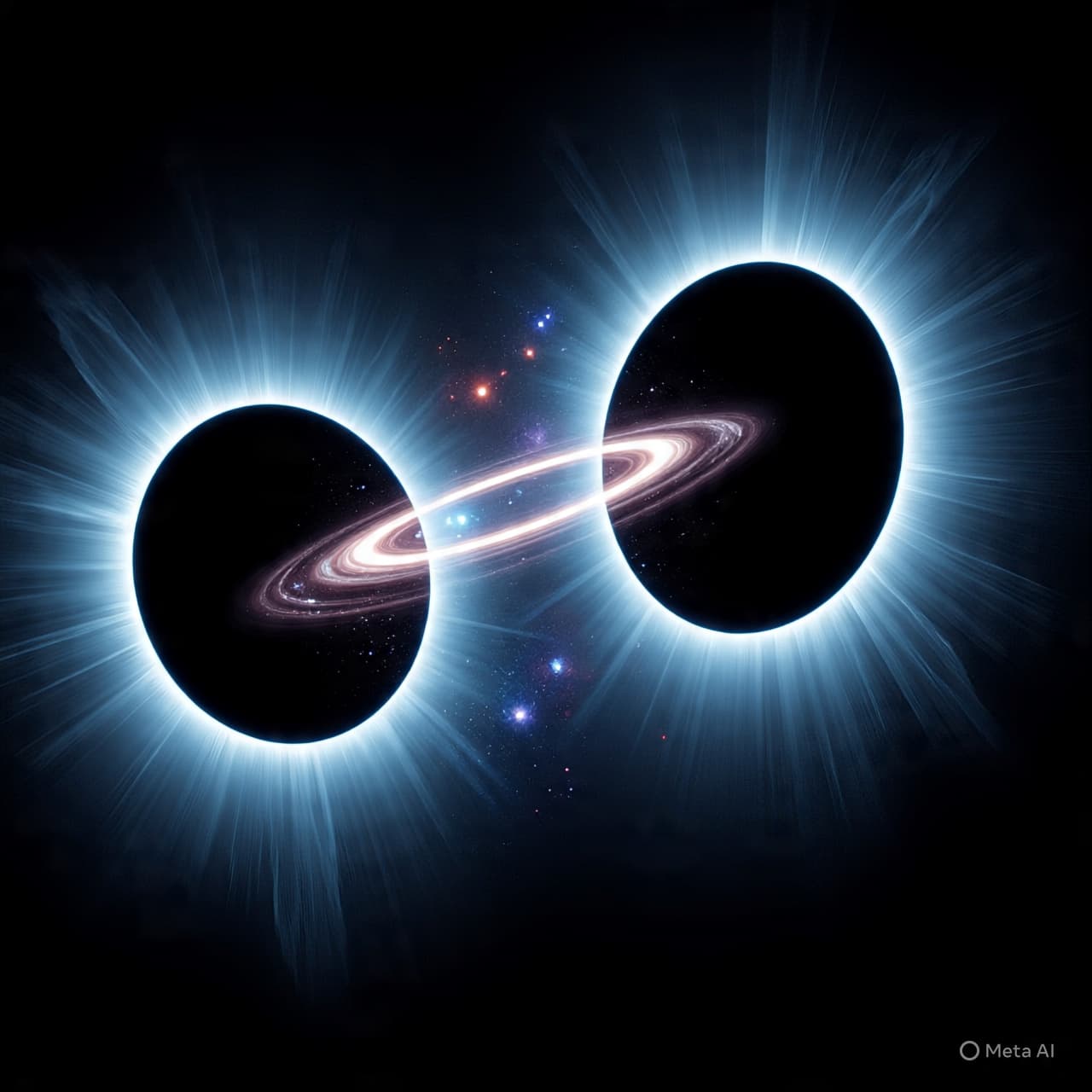
There are moments in science that feel like listening for a note just below the threshold of hearing — when the universe murmurs something intriguing but not yet audible in full. In the vast theaters of galaxies, where stars swirl in opulent spirals and nebulae bloom with color, some of the most powerful actors are unseen: supermassive black holes, twins bound in a slow, spiraling embrace. Like a cosmic dance hidden behind a velvet curtain, these pairs have evaded our gaze, whispering their presence only in subtle rhythms that careful instruments strain to catch. Yet now, with fresh insight and deft reasoning, physicists have sketched a new chord in that cosmic composition — a way to recognize these elusive duos by the light they briefly magnify as they pirouette through space.
At the heart of many large galaxies lie black holes of staggering mass, millions or even billions of times that of our Sun. When galaxies merge — a slow but inevitable encounter in the eons of cosmic time — their central black holes can become gravitationally bound, forming what scientists call a supermassive black hole binary. These pairs, orbiting one another closely, are expected to be sources of gravitational waves and magnificent astrophysical events. But finding them before they merge has proved difficult; the pairs are compact, distant, and obscured in the luminous bustle of galactic cores.
In a paper published this month in Physical Review Letters, researchers from the University of Oxford and the Max Planck Institute for Gravitational Physics propose a clever twist on the problem: black holes might betray their hidden dance through patterns in the starlight from their host galaxy. Black holes are extreme objects whose immense gravity bends and magnifies light passing near them — an effect known as gravitational lensing. Usually this phenomenon produces rare flashes when light from a background star aligns precisely with a single black hole lens. But in the case of a tightly orbiting pair, the geometry becomes richer and more playful.
Because two massive bodies warp space in concert, the regions where light can be significantly magnified — known as caustic curves — sweep across larger swaths of the sky as the pair rotates. If a star happens to lie along one of these shifting paths, its light can brighten dramatically, not once but repeatedly, each time the binary’s configuration passes over it. This pattern of repeating brightening — gentle pulses in the starlight — may serve as a distinctive signature of a supermassive black hole binary, visible even when the black holes themselves are cloaked in darkness.
Such quasi‑periodic magnification events, fleeting as they are, suggest a new method of discovery that does not rely on gas accretion or the bright activity often associated with galactic nuclei. In essence, the black holes act as natural telescopes, and the cosmic dance they perform can reveal its presence in periodic flickers of starlight. This approach, researchers note, could open a window onto many binaries that have so far been inaccessible to traditional methods of detection.
Scientists imagine that current and upcoming wide‑field sky surveys — like those to be conducted by telescopes such as the Vera C. Rubin Observatory or the Nancy Grace Roman Space Telescope — might be able to identify these repeating lensing signatures amidst the millions of observed galaxies. If so, the technique would provide astronomers with early indicators of supermassive black hole pairs that are spiraling ever closer toward the copse of gravitational waves, long before future space‑based detectors like LISA come online.
In this subtle interplay of light and gravity, there is both beauty and promise: the promise of more complete censuses of cosmic giants, and the beauty of a universe that still finds ways to surprise us. For now, the suggestion of repeating starlight pulses hangs like a question in the sky — inviting observers and thinkers alike to look upward with patience, curiosity, and open minds.
And in the landscape of astrophysical news, this proposal brings word of a novel technique that could help pinpoint supermassive black hole binaries by their distinctive lensing patterns, broadening the tools scientists use to map the hidden workings of galaxies.
AI Image Disclaimer Images in this article are AI‑generated illustrations, meant for concept only.
Sources (credible mainstream/niche):
Max Planck Society / Phys.org science coverage The Brighter Side of News (science news platform) EurekAlert (science press releases) Yale News (on related black hole binary detection research) Physical Review Letters (peer‑review journal reported widely by press)
Published by Banx Network. This article is part of the Banx decentralized media programme, powered by the BXE token on the XRP Ledger.