Key Highlights
- Jamie Dimon warns about the sustainability of the U.S. dollar's reserve status.
- The dollar remains central to global trade and finance, but risks are emerging.
- Factors like U.S. government debt and alternative financial technologies could impact dollar demand.
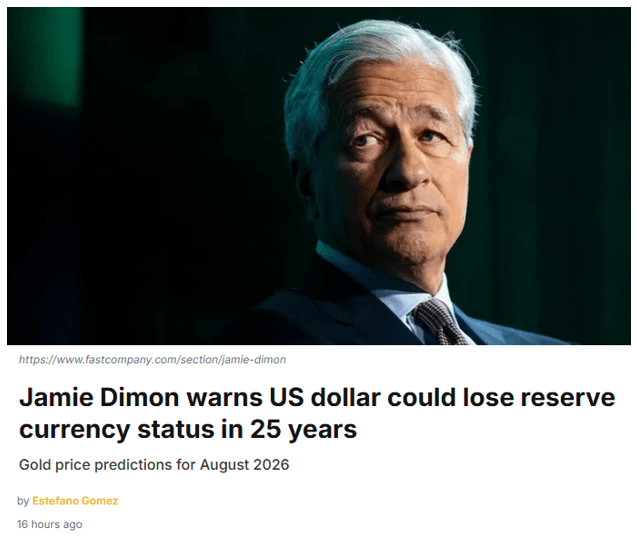
JPMorgan CEO Jamie Dimon has renewed a long-standing warning regarding the future of the U.S. dollar, emphasizing that America’s position as the world's reserve currency should not be taken for granted. This caution is particularly significant given the dollar's pivotal role in global trade, international finance, and central bank reserves, which provides the United States with advantages that few other economies enjoy.
The dollar's status as a reserve currency means it is widely held by governments, financial institutions, and corporations globally. It is heavily utilized in international transactions and remains the dominant currency in global financial markets. This persistent demand for dollar-denominated assets, especially U.S. Treasury securities, underscores the dollar's current strength.
However, Dimon’s warning highlights several factors that could gradually undermine this position. A primary concern is the escalating size and trajectory of U.S. government debt. As the U.S. continues to borrow, investors are increasingly scrutinizing whether the country can maintain fiscal discipline and sustain confidence in its Treasury markets. While a reserve currency does not vanish simply due to high government debt, the perception of fiscal sustainability is crucial.
The United States still benefits from its large economy, deep capital markets, and robust political institutions, alongside the dollar's extensive international network. Yet, reserve status is heavily reliant on confidence. If international investors begin to doubt the sustainability of U.S. fiscal policy, they may start diversifying their reserves and portfolios. Such a shift would not likely lead to an immediate collapse of the dollar's status; rather, transitions in reserve currencies typically unfold over decades.
Emerging financial technologies also add complexity to this landscape. Central bank digital currencies, stablecoins, and tokenized deposits could expedite international payments and potentially lessen reliance on traditional banking networks. However, many of these digital innovations are still denominated in dollars, indicating that technological advancements do not inherently weaken the currency.
The dollar's most significant advantage lies in its network effect. Businesses use dollars because others do, banks hold dollars due to client demand, and central banks maintain dollar reserves because of the currency's liquidity in international markets. Replacing such an entrenched system would necessitate an alternative that offers comparable scale, liquidity, and trust.
Dimon’s warning should be interpreted as a long-term risk assessment rather than a prediction of an imminent end to the dollar's dominance. The more pressing concern is whether the U.S. fiscal position could lead to a gradual shift towards greater diversification in reserves. If countries begin to reduce their dollar exposure, the demand for U.S. government debt could be affected, potentially leading to higher borrowing costs, especially if Treasury issuance remains high. Increased yields could subsequently impact businesses, consumers, and financial markets across the American economy.
This issue is also intertwined with the evolving structure of global finance. Countries are increasingly investigating local-currency settlements, alternative payment networks, and digital financial infrastructures. While these developments do not necessarily indicate a coordinated effort to replace the dollar, they do provide additional options for international transactions.
For investors, the key takeaway is that reserve-currency status is an economic advantage, not an unconditional guarantee. Maintaining this status requires ongoing confidence in U.S. institutions, markets, and fiscal management. Dimon’s 25-year warning thus raises a critical strategic question: can the United States uphold the economic and institutional conditions that have made the dollar indispensable to the global financial system?
Published by Banx Network. This article is part of the Banx decentralized media programme, powered by the BXE token on the XRP Ledger.