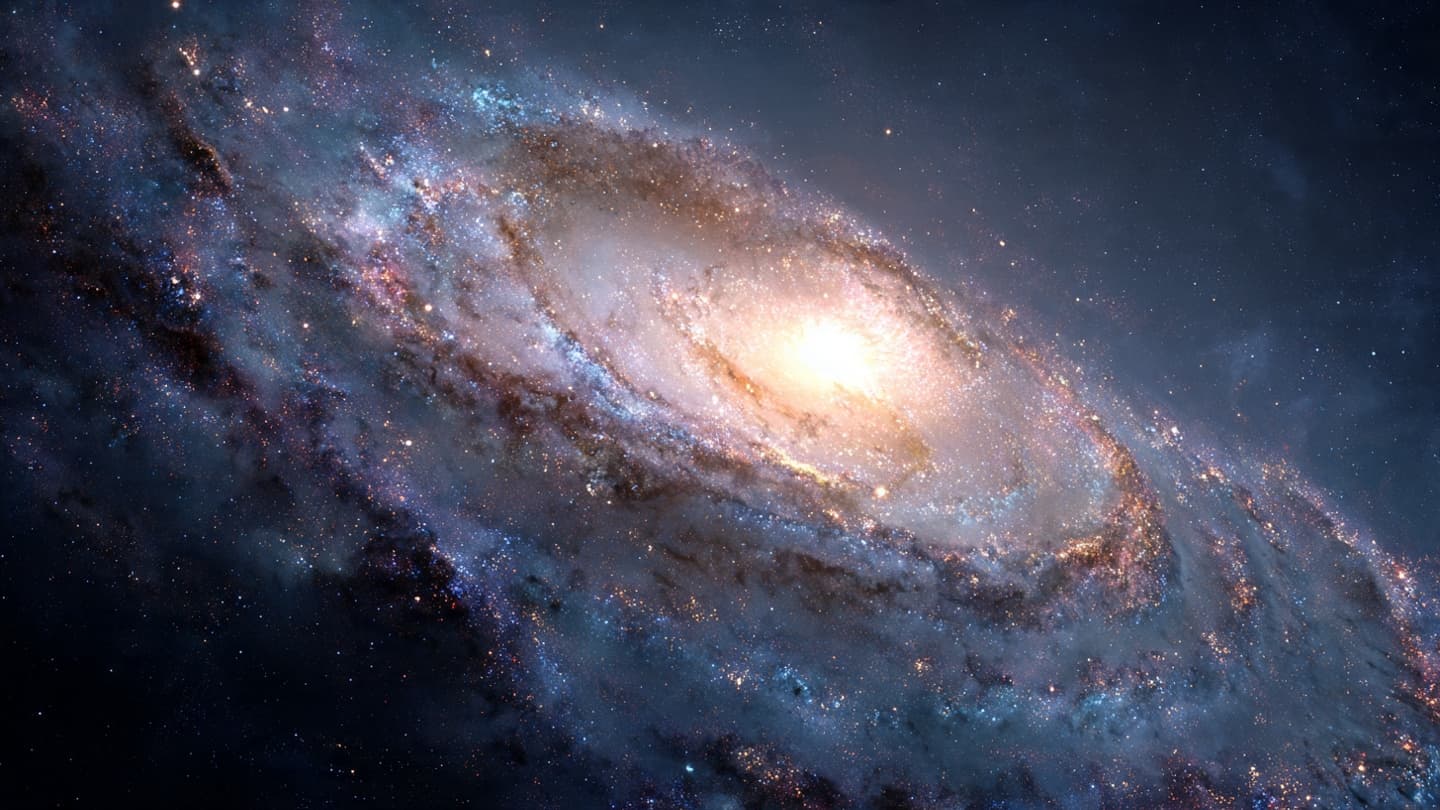
At the heart of our galaxy lies a region both luminous and mysterious. Hidden behind clouds of dust and crowded with stars, the galactic center has long resembled a distant city whose lights reveal only part of its story. Now, scientists are revisiting one of astronomy's enduring puzzles.
Researchers investigating unexplained radiation emanating from the center of the Milky Way suggest that dark matter could potentially contribute to the phenomenon. The proposal adds another chapter to decades of efforts aimed at understanding the invisible substance believed to make up much of the universe's mass.
Astronomers have detected unusual high-energy radiation signals from the galactic center for years. While several conventional explanations exist, none has fully resolved all observed characteristics.
Dark matter itself cannot be observed directly because it neither emits nor reflects light. Scientists infer its presence through gravitational effects on galaxies and cosmic structures.
Some theoretical models propose that when dark matter particles interact or annihilate one another, they could release detectable radiation. Researchers believe such interactions might help explain portions of the mysterious emissions observed near the Milky Way's core.
However, scientists caution that the evidence remains preliminary. Alternative explanations include rapidly rotating neutron stars known as pulsars or other energetic astrophysical processes occurring in the densely populated galactic center.
Current and future observatories are expected to provide more detailed measurements. Improved observational data may help researchers distinguish between competing hypotheses.
Understanding the source of this radiation could significantly advance knowledge about both galactic dynamics and the fundamental composition of the universe.
For now, the mystery endures, inviting scientists to continue exploring one of astronomy's most intriguing frontiers.
AI Image Disclaimer: The images used to accompany this story are AI-generated interpretations intended solely for illustrative purposes.
Source Verification Check: NASA, Physical Review Letters, Live Science, New Scientist
Published by Banx Network. This article is part of the Banx decentralized media programme, powered by the BXE token on the XRP Ledger.