The universe has always invited humanity to ask questions that stretch beyond ordinary experience. Every generation has looked toward the night sky and wondered whether reality extends further than current knowledge can reach. A recent theoretical study has revived one of the most fascinating possibilities in modern cosmology: that collapsing stars could potentially give rise to entirely new universes.
The research explores ideas connected to black holes and the extreme environments created when massive stars collapse under their own gravity. These events represent some of the most powerful processes known in nature, producing conditions that challenge current understanding of physics.
According to the theoretical framework, certain collapsing stellar remnants may not end as simple gravitational dead ends. Instead, under specific conditions, they could potentially generate new regions of space-time that evolve independently from the parent universe.
Scientists emphasize that the proposal remains highly theoretical. At present, there is no direct observational evidence confirming the existence of newly formed universes emerging from black holes or collapsing stars. The concept is primarily explored through mathematical models and advanced theoretical physics.
The idea is nevertheless significant because it addresses fundamental questions about the origin and structure of reality. Researchers continue searching for ways to reconcile general relativity, which describes gravity, with quantum mechanics, which governs the microscopic world.
Some cosmologists have suggested that our own universe might have originated through processes connected to similar cosmic events. While such ideas remain speculative, they encourage scientists to examine alternative explanations for the birth and evolution of the cosmos.
The study also illustrates the important role of theoretical research. Not all scientific advances begin with direct observation. In many cases, mathematical exploration provides frameworks that later guide experiments and observations.
Astronomers continue gathering data from black holes, neutron stars, and other extreme cosmic environments. Future observations may help determine whether any measurable evidence supports or challenges these theoretical possibilities.
For now, the concept remains an intriguing reminder that the universe still contains profound mysteries. Whether or not collapsing stars create new universes, the search for answers continues to expand humanity's understanding of existence itself.
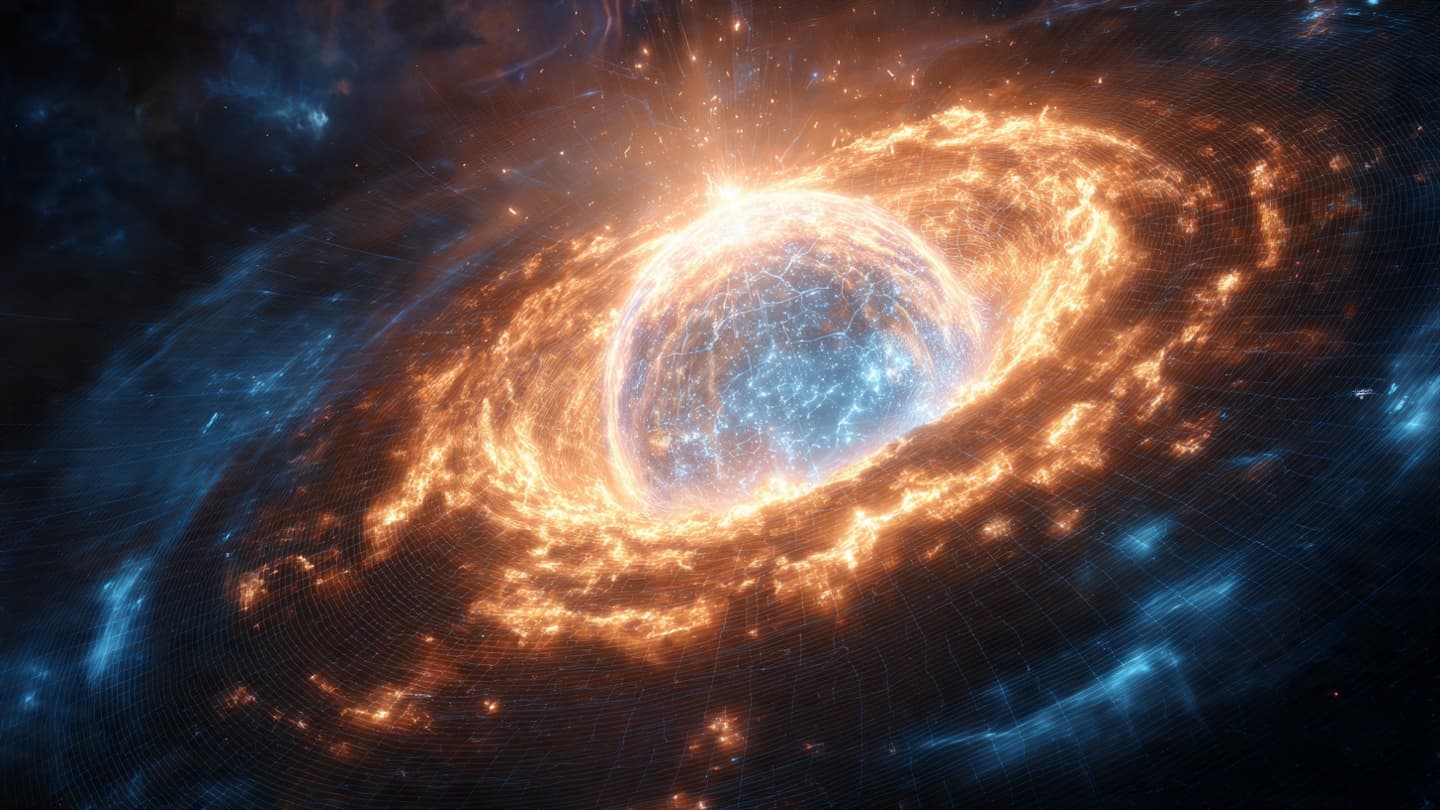
AI Image Disclaimer: This article includes an AI-generated illustration created to visualize theoretical scientific concepts and does not depict an observed astronomical event.
Source Verification Check: ScienceDaily, Nature Astronomy, Scientific American, New Scientist, Space.com
Published by Banx Network. This article is part of the Banx decentralized media programme, powered by the BXE token on the XRP Ledger.