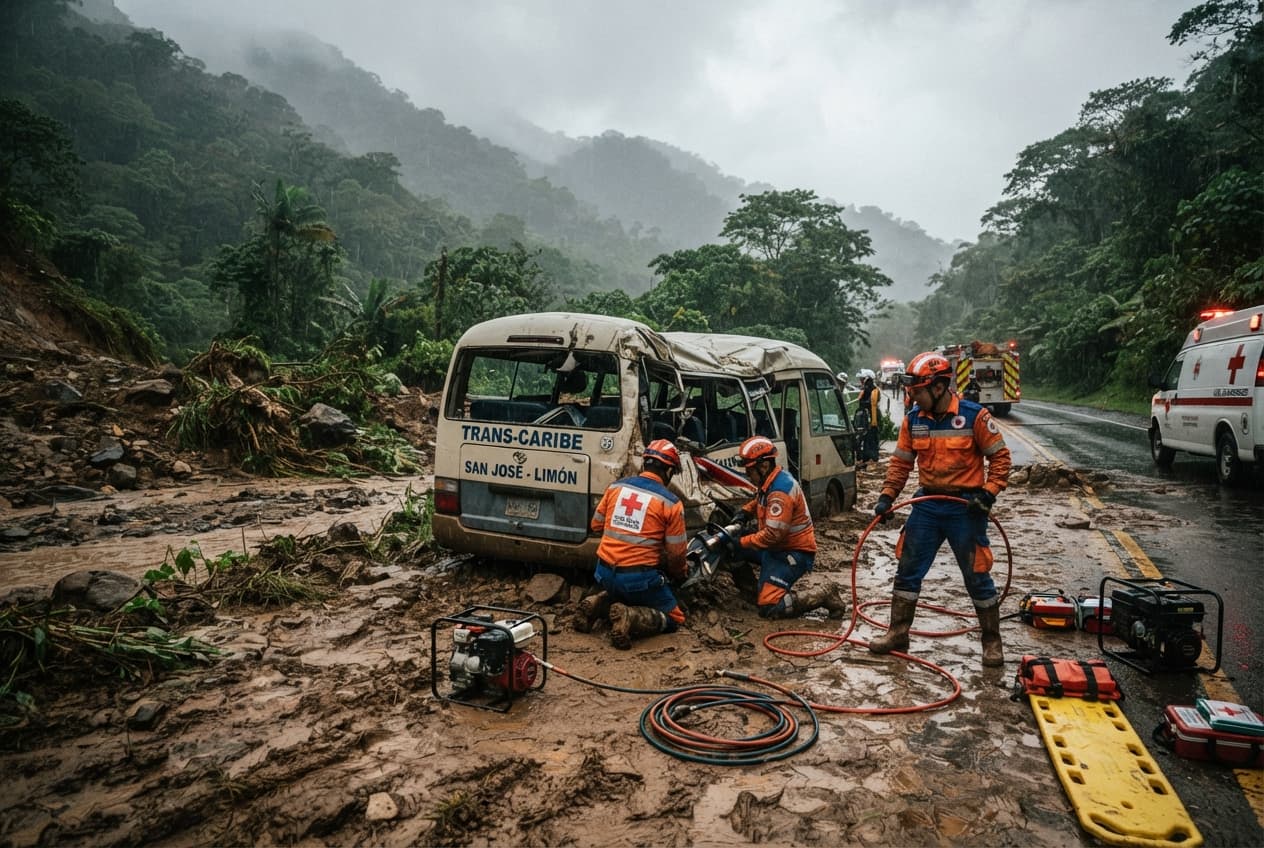
San José, Costa Rica—A massive wall of mud and rock detached from a steep mountain slope along Highway 32, crushing a passenger minibus transiting the Braulio Carrillo national park sector. Traffic police confirmed that two occupants died instantly when tons of debris buried the vehicle against the concrete retaining wall. Continuous heavy rainfall over the Caribbean slope saturated mountain soils beyond structural thresholds, triggering the sudden slide without warning. Emergency rescue units rushed to the mountain pass as incoming traffic ground to a halt.
The violent earth movement swept across multiple lanes, pushing the commercial minibus into the shoulder barrier and deforming the cabin entirely. First responders arrived with hydraulic extraction tools, fighting against continuous rolling debris from the unstable slope above. Police officers closed all transit lanes across the mountain corridor, stranding hundreds of freight trucks and passenger cars. Rescue teams utilized manual shovels to carve temporary access paths through the dense muck.
The minister of public works and transport addressed media representatives near the emergency checkpoint outside the park boundary. The geological profile of the Braulio Carrillo pass makes it uniquely susceptible to rapid slope failure during intense downpours, officials stated. Our engineering units are waiting for movement on the upper slope to cease before initiating heavy clearing operations. The entire highway corridor remains closed indefinitely.
Transport associations and transit unions pointed to chronic maintenance delays and insufficient rockfall protection infrastructure along the critical trade route. Repeated engineering audits recommended installing high-tensile anchor netting and automated slope sensors, but funding was repeatedly deferred. Those administrative oversights left daily commuters and commercial drivers exposed to recurring landslide hazards. The resulting tragedy highlighted systemic vulnerabilities in national infrastructure management.
Paramedics set up a mobile triage station on the asphalt highway shoulder, treating three surviving passengers for severe shock and fractures. Local hospitals activated emergency response protocols to receive trauma casualties transferred from the mountain pass. Heavy excavation equipment staged near the blockage site, waiting for geotechnical clearance to begin lifting the crushed minibus. Communication lines across the sector remained unstable due to falling branches and downed power infrastructure.
Engineers deployed aerial drone units to scan the upper ridge line for active fissures and hanging debris masses. Preliminary thermal scans indicated ongoing soil displacement directly above the primary slide zone, threatening rescue personnel. Civil protection authorities issued mandatory precautionary evacuation warnings for nearby maintenance outposts. Recovery operations continue under portable floodlight arrays as rain showers persist across the cordillera.
Published by Banx Network. This article is part of the Banx decentralized media programme, powered by the BXE token on the XRP Ledger.