From the depths of interstellar space, visitors occasionally pass through our solar system, carrying secrets from distant stars. Comet 3I/ATLAS, the third known interstellar object to visit us, has been under intense scrutiny since its discovery in July 2025. Now, new observations from the James Webb Space Telescope and other facilities have shed light on its origins, revealing that it formed in extremely cold conditions billions of years ago.
Analysis of the comet’s composition shows high levels of carbon monoxide and other volatile ices, suggesting it originated in the frigid outer regions of its home star system. Unlike comets formed in warmer zones, 3I/ATLAS has remained largely unchanged since its birth, preserving a pristine record of early planetary formation. This makes it a valuable time capsule, offering insights into the chemical environments of other stellar nurseries.
The trajectory of 3I/ATLAS indicates it was ejected from its system during a period of gravitational instability, likely caused by the migration of giant planets. This process is common in young solar systems, where shifting orbits can fling smaller bodies into interstellar space. By studying 3I/ATLAS, astronomers can better understand the dynamic history of planetary systems across the galaxy.
Spectroscopic data also reveals a lack of certain complex organic molecules found in local comets, hinting at different chemical pathways in its place of origin. This diversity challenges the assumption that all comets share a similar makeup, emphasizing the unique conditions present in different parts of the Milky Way. It is a reminder of the vast variety inherent in cosmic creation.
For scientists, the arrival of 3I/ATLAS is a rare opportunity to test theories about interstellar travel and survival. How do such objects withstand the harsh radiation of space over millions of years? What protects their icy cores from sublimation? The answers lie in the detailed observations being collected now, as the comet moves away from the Sun and fades from view.
The public fascination with interstellar objects continues to grow, fueled by the mystery of their origins. 3I/ATLAS joins 1I/ʻOumuamua and 2I/Borisov as a member of this exclusive club, each adding a piece to the puzzle of our galactic neighborhood. These visitors remind us that we are part of a larger cosmic community, connected by the exchange of material and energy.
As the data is processed, researchers hope to pinpoint the specific star system from which 3I/ATLAS came. While this remains challenging due to the vast distances involved, improved modeling techniques are making it increasingly possible. Identifying its home would provide a direct link to another world, expanding our sense of connection to the universe.
In the end, 3I/ATLAS is more than just a rock and ice; it is a messenger from afar. Its story enriches our understanding of planetary formation and the dynamic nature of the cosmos. By listening to its silent journey, we learn more about ourselves and our place in the stars.
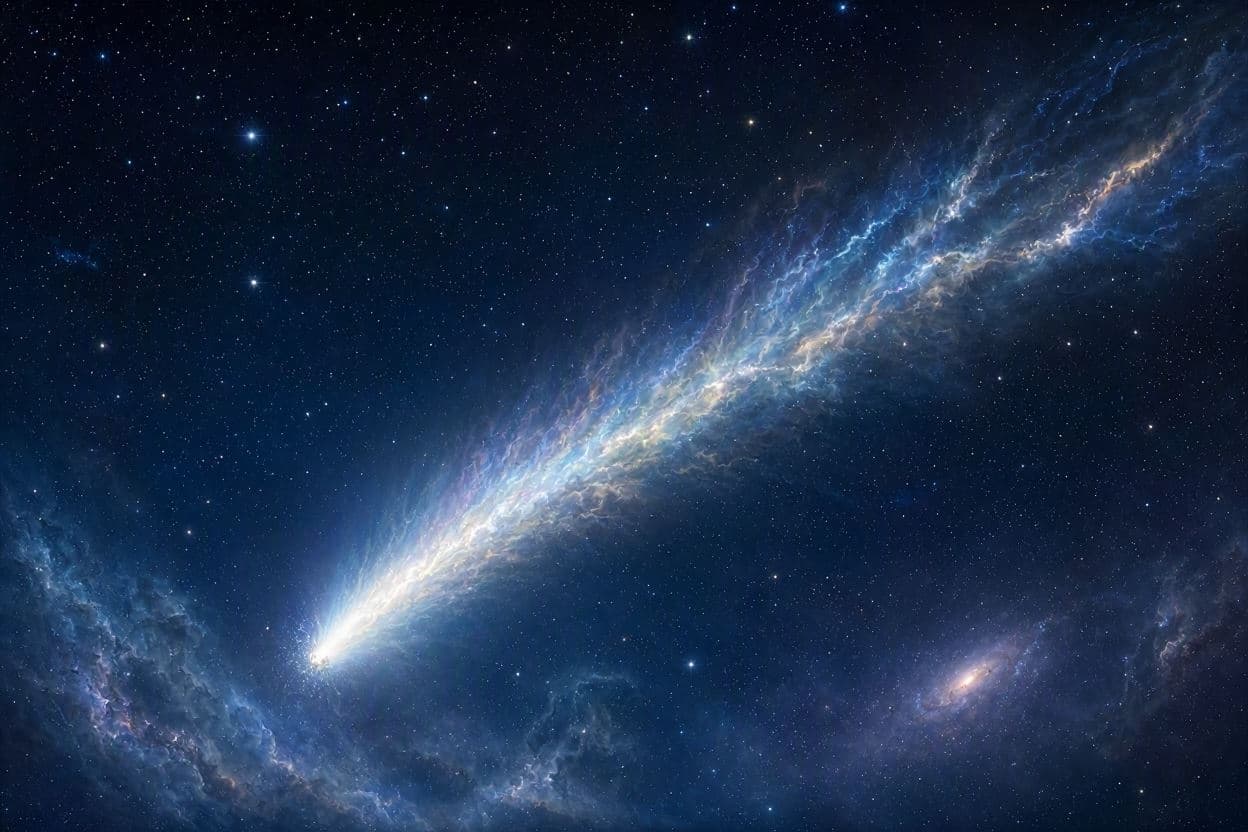
AI Image Disclaimer: Images used in this article are AI-generated to visualize the concept of an interstellar comet and its journey, avoiding any depiction of actual telescope images or specific scientific data plots.
Sources: ESA Web, Universe Today, NASA Science, Sky & Telescope
Published by Banx Network. This article is part of the Banx decentralized media programme, powered by the BXE token on the XRP Ledger.