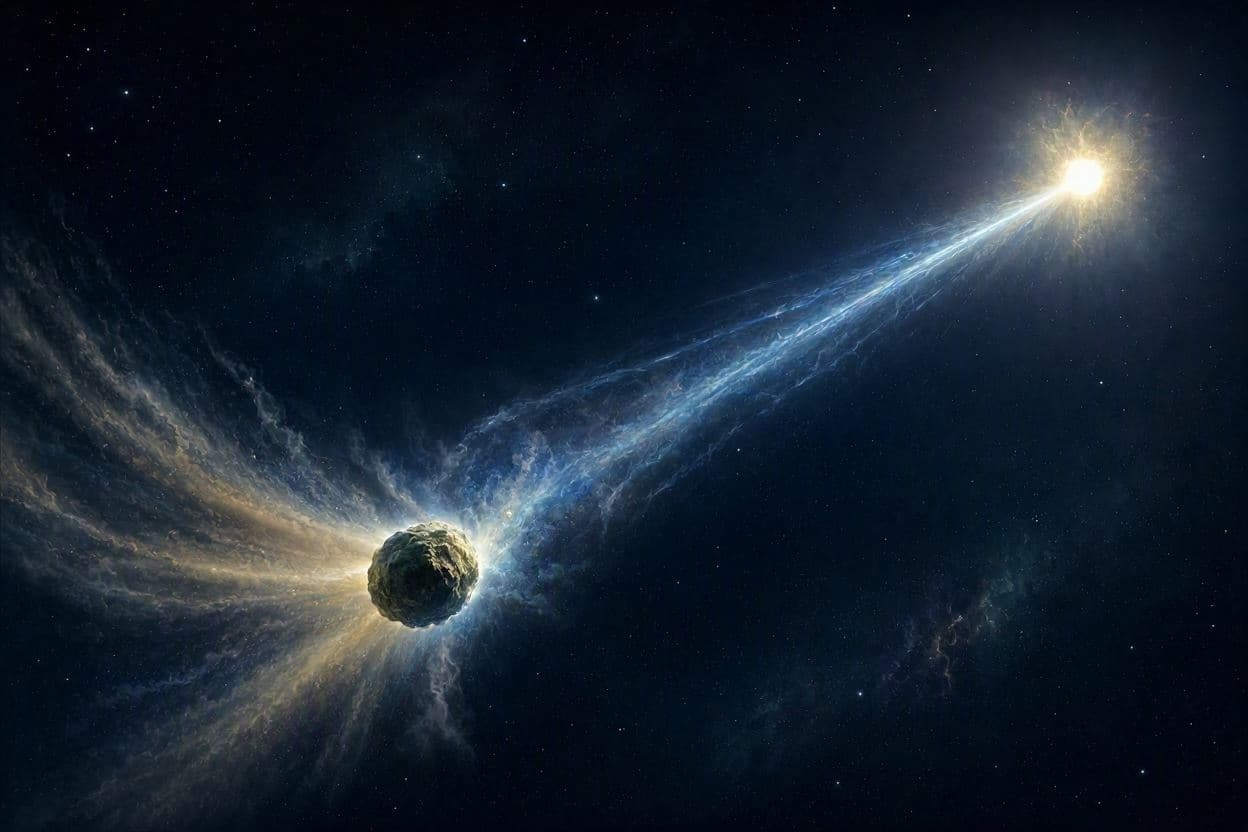
In the distant systems of other stars, icy wanderers known as exocomets are playing a role similar to that of comets in our own solar system. Recent observations suggest that these celestial bodies are transporting water and other volatiles from the cold outer regions of their systems toward the warmer inner zones. This process may be a key mechanism for delivering the ingredients necessary for life to rocky planets orbiting close to their host stars.
Exocomets are detected when they pass in front of their star, causing slight dips in brightness or absorbing specific wavelengths of starlight. These signatures reveal the presence of gas and dust released as the comet heats up. By analyzing these spectral lines, astronomers can determine the composition of the cometary material, often finding evidence of water vapor, carbon monoxide, and other organic compounds.
The delivery of water is critical for the potential habitability of exoplanets. While rocky planets may form dry due to the high temperatures near their star, exocomets can act as cosmic couriers, bringing ice from the frozen outskirts. This mechanism mirrors the theory that comets delivered water to early Earth, suggesting that such processes may be common throughout the galaxy.
Studying exocomets also provides insights into the architecture of young planetary systems. Their presence indicates that there are still large reservoirs of icy bodies in the outer disks, similar to our Kuiper Belt or Oort Cloud. The frequency and behavior of these comets can tell us about the gravitational influences of unseen planets and the stability of the system over time.
Recent data from space telescopes have identified exocomet activity in several nearby stellar systems, including Beta Pictoris. These systems are relatively young, offering a glimpse into the early stages of planetary formation. Observing them helps scientists understand how our own solar system might have looked billions of years ago, during its own chaotic youth.
The discovery of water-rich exocomets reinforces the idea that the basic building blocks of life are widespread in the universe. It suggests that the conditions for life may not be as rare as once thought, provided that planets can receive and retain these vital deliveries. Each exocomet observed is a piece of evidence supporting the universality of planetary processes.
As our technology improves, we will be able to detect smaller and more distant exocomets, building a more complete picture of their role in planetary evolution. For now, these icy messengers serve as a reminder of the interconnectedness of cosmic systems. In their fleeting passage, they carry the promise of water and the potential for life to worlds far beyond our own.
AI Image Disclaimer: The visual content in this article is AI-generated to depict the concept of exocomets and their interaction with distant stars.
Sources: ESA, Nature Astronomy, Space.com
Published by Banx Network. This article is part of the Banx decentralized media programme, powered by the BXE token on the XRP Ledger.