
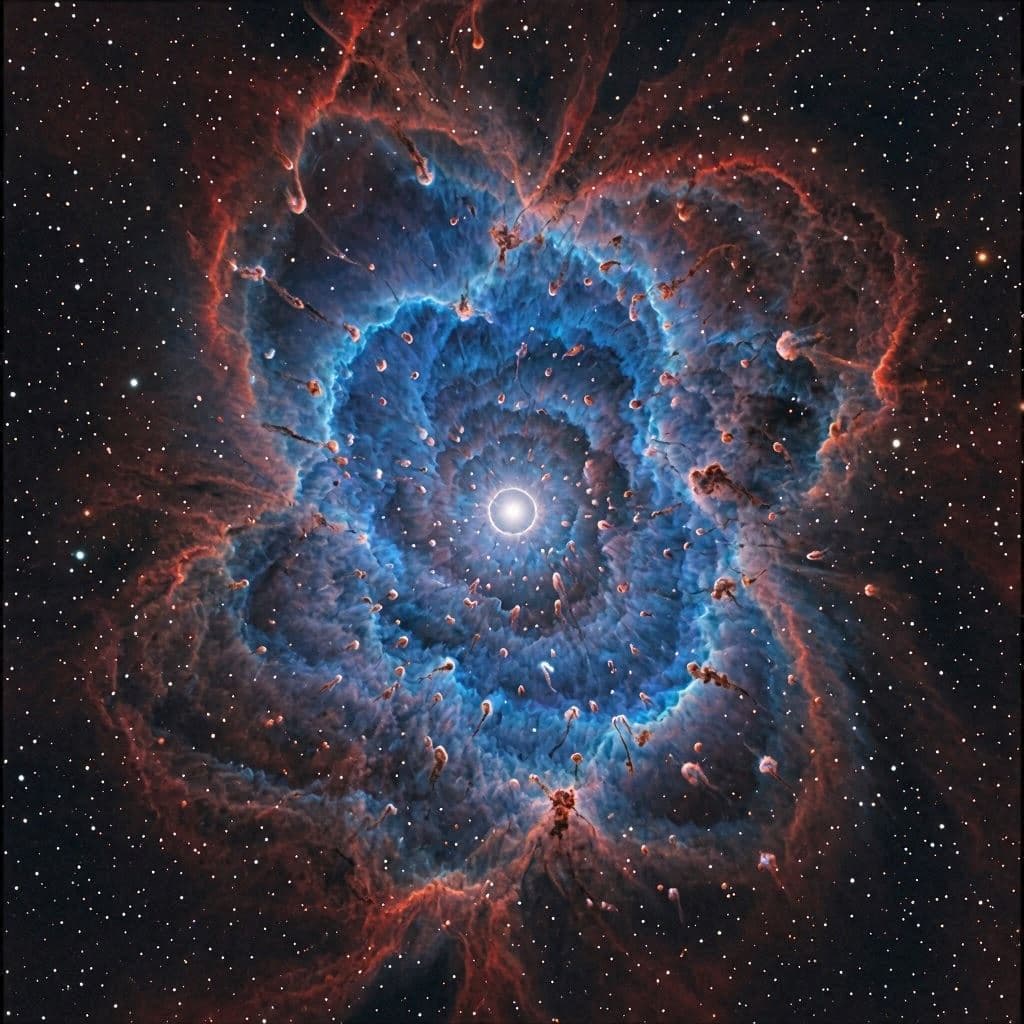
Key Highlights
- Location:The Helix Nebula is situated in the constellation Aquarius.
- Discovery:Cometary knots were first observed in detail by the Hubble Space Telescope.
- Significance:These knots contribute to our understanding of stellar evolution and chemical enrichment.
The Helix Nebula, often referred to as the 'Eye of God' due to its striking appearance, is a planetary nebula located approximately 650 light-years from Earth. This nebula is a remnant of a sun-like star that has shed its outer layers, leaving behind a hot white dwarf at its center. Among its many features, astronomers have identified peculiar structures known as 'cometary knots.' These knots are dense clumps of molecular gas that exhibit tails streaming away from the central star, resembling comets but differing significantly in their formation and scale.
The discovery of cometary knots adds a layer of complexity to our understanding of stellar evolution. Initially observed in detail by the Hubble Space Telescope, these knots are believed to be remnants from the star's earlier red giant phase. As the star evolved, it expelled material into space, which later formed these distinct structures. The knots are composed of cooler, denser gas that has managed to withstand the intense radiation and stellar winds emanating from the white dwarf.
As the energy from the central star interacts with these gas clumps, it creates long, ionized tails that point away from the source, similar to how a comet's tail is oriented away from the Sun. This interaction results in a striking visual contrast within the nebula, with bright heads and faint, elongated tails that stretch across the cosmic landscape. The study of these cometary knots provides astronomers with valuable insights into the processes of mass loss in aging stars.
The formation of these knots suggests that the ejection of material from the star was not a uniform process. Instead, it likely occurred in bursts or with varying densities, challenging simpler models of stellar death. This asymmetry indicates that factors such as magnetic fields or the presence of binary companions may influence the shaping of the nebula. Each cometary knot acts as a fossil record, revealing the dynamic history of the star and its evolution.
Moreover, the presence of these knots has significant implications for the chemical enrichment of the interstellar medium. As the knots eventually dissipate, they release heavier elements that were forged in the star's core into space. These elements serve as the building blocks for new stars and planets, illustrating the interconnectedness of stellar life cycles. The death of one star paves the way for the birth of others, highlighting a cosmic cycle of renewal driven by gravity and radiation.
Recent advancements in spectroscopy have enabled scientists to measure the temperature and density of the gas within these knots. This data enhances our understanding of the physical conditions present in planetary nebulae and aids in refining theoretical models of stellar evolution. The Helix Nebula continues to be a vital laboratory for studying these phenomena, providing a clear view of processes that are often obscured in more distant celestial objects.
In summary, the cometary knots within the Helix Nebula exemplify the intricate beauty of stellar evolution. They serve as a reminder that even in death, stars create structures of profound complexity and significance. As astronomers continue to observe these celestial wonders, they deepen our appreciation for the forces that shape our universe.
Published by Banx Network. This article is part of the Banx decentralized media programme, powered by the BXE token on the XRP Ledger.



