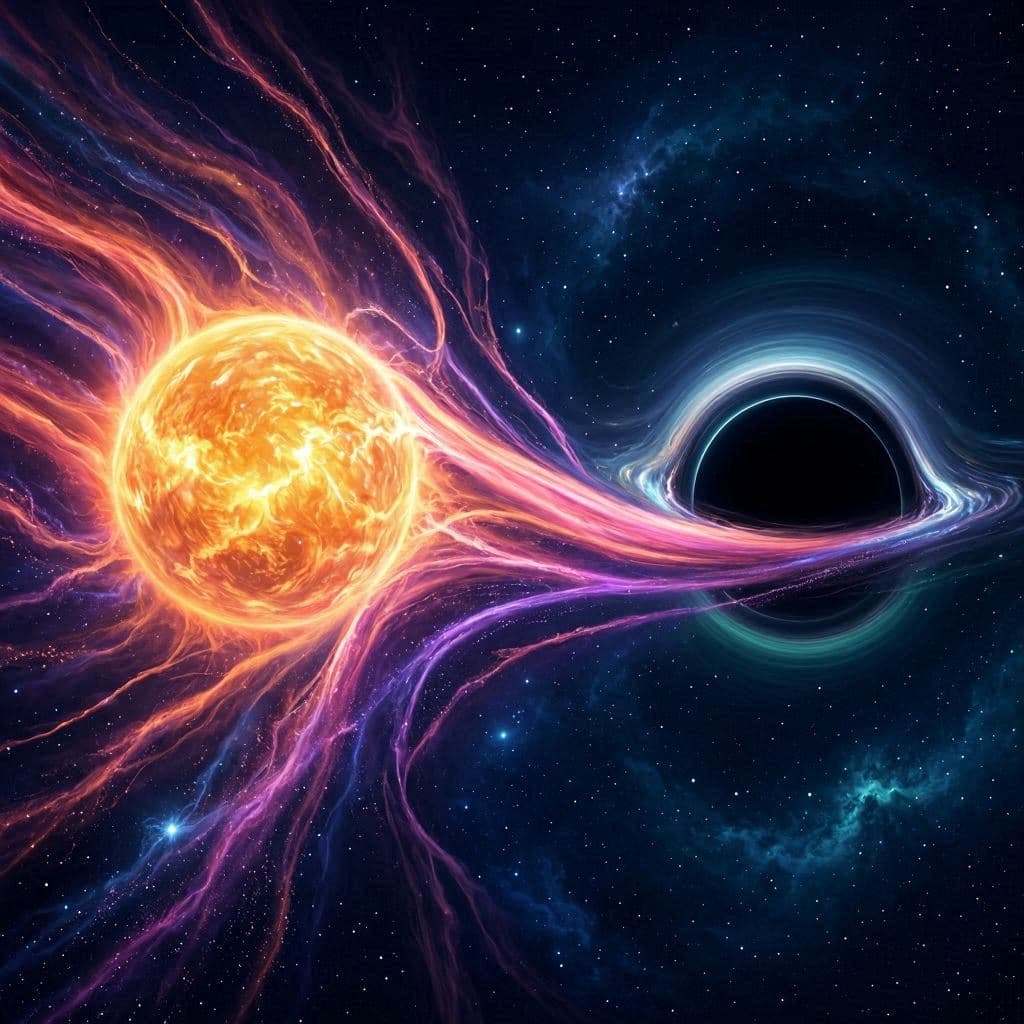
In the vast, silent theater of the cosmos, where gravity reigns supreme and light bends to its will, a dramatic event has unfolded. NASA’s telescopes have captured images of a rare tidal disruption event, where a black hole violently tears apart a passing star. This cosmic cannibalism, though occurring millions of light-years away, offers scientists a unique opportunity to study the extreme physics of black holes and the fate of stellar matter. It is a reminder of the dynamic and often violent nature of the universe, hidden within the darkness of space.
The observation serves as a powerful testament to human ingenuity, allowing us to witness events that defy everyday experience. It invites reflection on the forces that shape galaxies and the mysteries that still lie beyond our reach.
Body: The event, detected by NASA’s Neil Gehrels Swift Observatory and other instruments, occurred when a star wandered too close to a supermassive black hole. The immense gravitational forces stretched the star into a stream of gas, a process known as spaghettification. As the material spiraled into the black hole, it heated up, emitting bright flares of X-rays and ultraviolet light that traveled across the universe to reach our detectors.
Tidal disruption events are rare, estimated to occur once every 10,000 to 100,000 years in a typical galaxy. Capturing one in real-time allows astronomers to test theories about black hole accretion and energy release. The data provides insights into the mass and spin of the black hole, parameters that are difficult to measure through other means.
The brightness of the flare peaked and then began to fade, following a predictable pattern that matches theoretical models. This consistency helps validate our understanding of general relativity and hydrodynamics in extreme environments. It confirms that even in the most chaotic cosmic events, there is an underlying order governed by physical laws.
For the public, the image of a black hole "devouring" a star is both terrifying and mesmerizing. It captures the imagination, illustrating the power of invisible forces. NASA’s release of the data and visualizations helps bridge the gap between complex astrophysics and public engagement, making science accessible and exciting.
The star involved was likely similar in size to our sun, a humble victim of cosmic bad luck. Its destruction contributes to the growth of the black hole, adding to its mass and influencing the evolution of its host galaxy. Every such event is a building block in the grand structure of the universe.
Scientists continue to monitor the aftermath, looking for echoes or secondary effects that might reveal more about the environment surrounding the black hole. Future missions, with even more sensitive instruments, will likely detect many more of these events, turning rare occurrences into routine observations.
This discovery also highlights the importance of international collaboration in astronomy. Data from multiple telescopes around the world and in space were combined to create a comprehensive picture of the event. Such cooperation is essential for advancing our knowledge of the cosmos.
As we look up at the night sky, it is comforting to know that such violent events are distant and rare in our own galactic neighborhood. Yet, they remind us that the universe is alive with change and transformation, constantly reshaping itself.
Closing: NASA’s capture of a black hole devouring a star provides valuable data on tidal disruption events. It enhances our understanding of black hole physics and the dynamic nature of the universe.
AI Image Disclaimer: Images used in this report are AI-generated depictions intended to illustrate the themes of astrophysics and cosmic phenomena.
Sources: NASA Space.com Scientific American The Astrophysical Journal
Published by Banx Network. This article is part of the Banx decentralized media programme, powered by the BXE token on the XRP Ledger.