
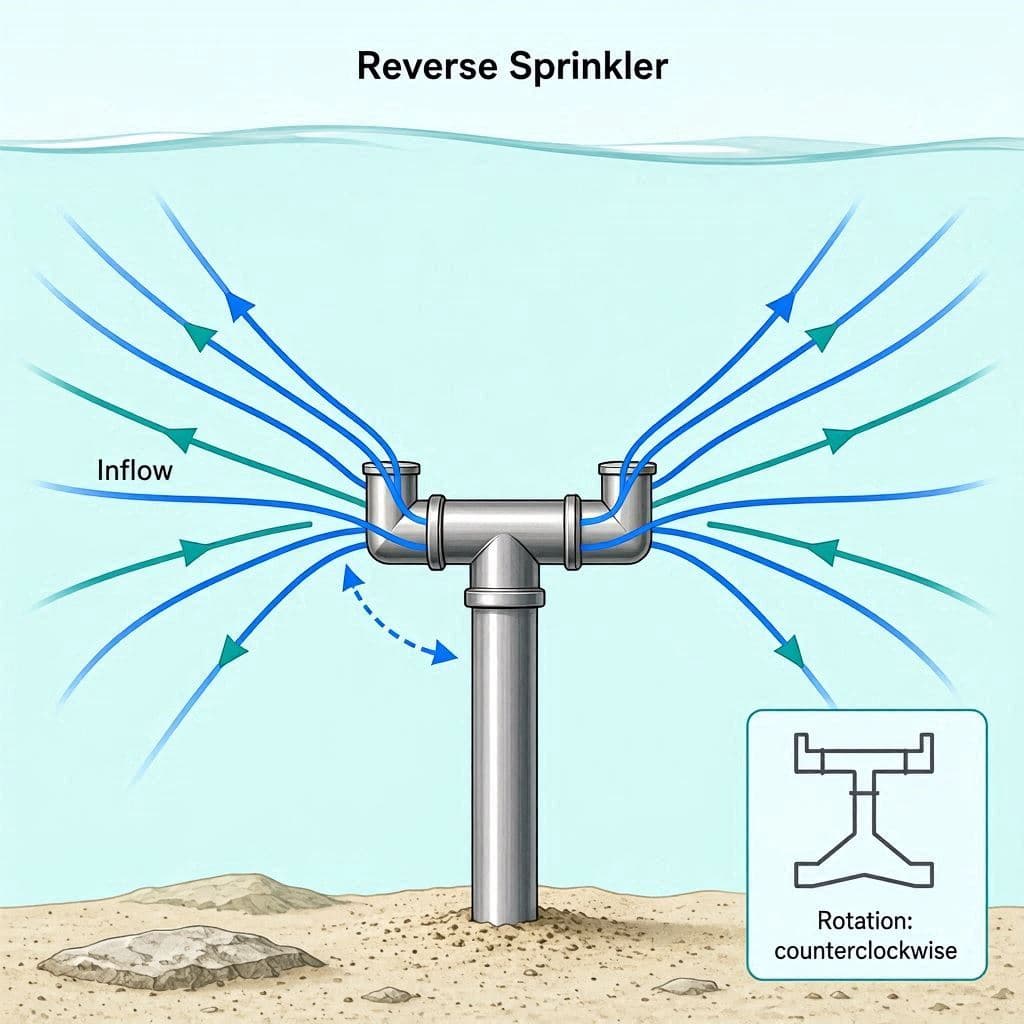
In the world of physics, even the greatest minds can be challenged by the simplest of puzzles. Richard Feynman, the Nobel laureate known for his curiosity and wit, once pondered a seemingly trivial question: how does a lawn sprinkler behave when it sucks water in instead of spraying it out? Decades later, physicists have finally solved this "reverse sprinkler" problem, revealing that Feynman’s initial intuition was not entirely correct.
The experiment, often referred to as "Feynman’s Sprinkler," has become a classic thought experiment in fluid dynamics. Its resolution offers insights into the complex interactions between flowing fluids and rotating structures, demonstrating that even well-established ideas can be refined by new evidence.
Body: Feynman had suggested that a reverse sprinkler would not rotate, or would rotate very weakly, due to the symmetry of the forces involved. However, recent experiments conducted by researchers at New York University have shown that the device does indeed rotate, but in the opposite direction to a normal sprinkler and with a different mechanism.
Using high-speed cameras, lasers, and colored dyes, the team visualized the flow of water into the sprinkler’s nozzles. They discovered that the rotation is driven by angular momentum created as water is drawn in and collides with the inner walls of the device. This interaction generates a torque that causes the sprinkler to spin.
The findings, published in 2024 and further elaborated in 2026, clarify the physics behind the phenomenon. The researchers explained that the inflow of water creates vortices that transfer momentum to the sprinkler, a process that is distinct from the outward jetting of water in a standard sprinkler.
This discovery has implications beyond lawn care. Understanding how fluids exert forces on structures is crucial for designing efficient turbines, pumps, and other mechanical systems. The principles uncovered in the sprinkler experiment can be applied to improve the performance of these technologies.
The resolution of the puzzle also highlights the importance of experimental verification in science. Even theoretical predictions by renowned physicists must be tested against reality. The collaborative effort of the NYU team demonstrates the value of rigorous inquiry and advanced instrumentation.
For students and educators, the reverse sprinkler serves as an engaging example of fluid dynamics. It illustrates how counterintuitive phenomena can be understood through careful observation and analysis. The story of its solution adds a human element to the practice of science.
As the scientific community reflects on this achievement, it reinforces the idea that knowledge is always evolving. What was once a mystery is now a clarified concept, ready to be built upon by future generations of researchers.
Closing: The correction of Feynman’s theory on reverse sprinklers is a testament to the self-correcting nature of science. It reminds us that curiosity and experimentation are the keys to unlocking the secrets of the natural world.
AI Image Disclaimer: The visuals in this article are AI-generated illustrations designed to reflect the experimental setup and fluid dynamics concepts.
Sources: NYU News APS Physics Science Daily Ars Technica
Published by Banx Network. This article is part of the Banx decentralized media programme, powered by the BXE token on the XRP Ledger.



