There is a certain logic to the way young creatures learn the shape of their world. They stay close, at first, to the places that feel safe—the shallow water, the familiar reef, the shadow of something larger than themselves. Only later, when size and confidence permit, do they venture into the open. A new study of giant manta rays off the coast of Costa Rica has found that this logic holds even for one of the ocean's most imposing fish.
Researchers tracked endangered oceanic manta rays between 2018 and 2025, fitting 59 of them with acoustic transmitters, tagging 12 with satellite devices, and using photo identification to build a detailed picture of their movements . What emerged was a clear pattern: juveniles remained within Costa Rica's coastal waters, while mature adults undertook long-distance journeys, some reaching as far as the waters off Guatemala .
The size difference between the two groups is significant. The smaller, immature mantas in the study measured roughly 3 to 3.5 meters across. Those making the longer journeys measured 4 to 4.5 meters . Even a three-meter manta would appear enormous to a swimmer, but that size may not be enough protection against the ocean's larger predators. "This makes us believe that smaller mantas do not risk these long migrations, likely due to the threat of large predators like orcas and tiger sharks," said Jeffry Madrigal-Mesén, lead author of the study published in Frontiers in Fish Science .
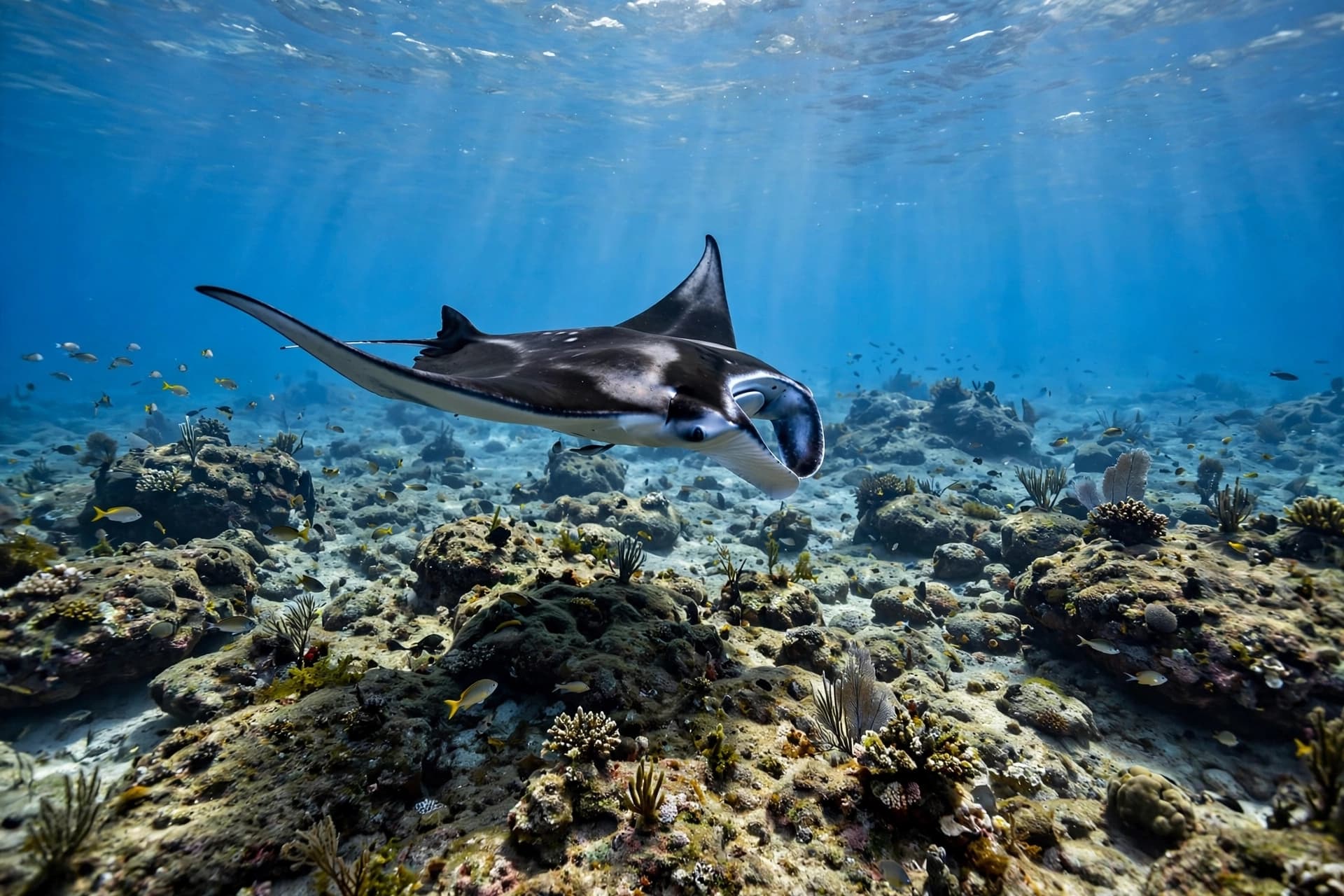
The coastal waters serve another purpose beyond refuge. The mantas repeatedly return to the same rocky reef sites, where small fish remove parasites from their skin—a symbiotic arrangement known as a cleaning station . Observations of feeding, courtship, and recent mating suggest these sites may also function as social hubs. The researchers do not yet know how the mantas navigate back to particular locations, but Madrigal-Mesén offered a simple analogy: "We humans have favourite places we like to go to. Why couldn't mantas have a preference for one cleaning station over another?" .
What remains unclear is what prompts a manta to eventually join the migratory population. The researchers suspect that reaching feeding and breeding grounds in the productive waters of Central America may play a role . The tracking data also raises the possibility that Central America has its own distinct population, rather than being a waypoint for mantas from Ecuador or Mexico—a question the team is now investigating through genetic work .
The findings carry conservation implications. Once the mantas leave Cocos Island and the monitored coastal sites, they enter waters with no protection, where fishing and vessel traffic pose threats . "Studies like this help us recognise that these coastal havens only protect them for a specific time of the year," Madrigal-Mesén said. "This is why it is so critical to protect the marine corridors these migratory species travel through" .
For now, the young mantas remain in their coastal refuges, gliding over reefs and returning to familiar cleaning stations, while the adults trace their long routes across the open sea. The ocean holds both patterns, the staying and the going, and the study offers a map of how a creature grows into the fullness of its range.
This article includes AI-generated images for illustrative purposes.
Sources: Reuters, Yahoo News Malaysia, Popular Science, Bulgarian News Agency
Published by Banx Network. This article is part of the Banx decentralized media programme, powered by the BXE token on the XRP Ledger.