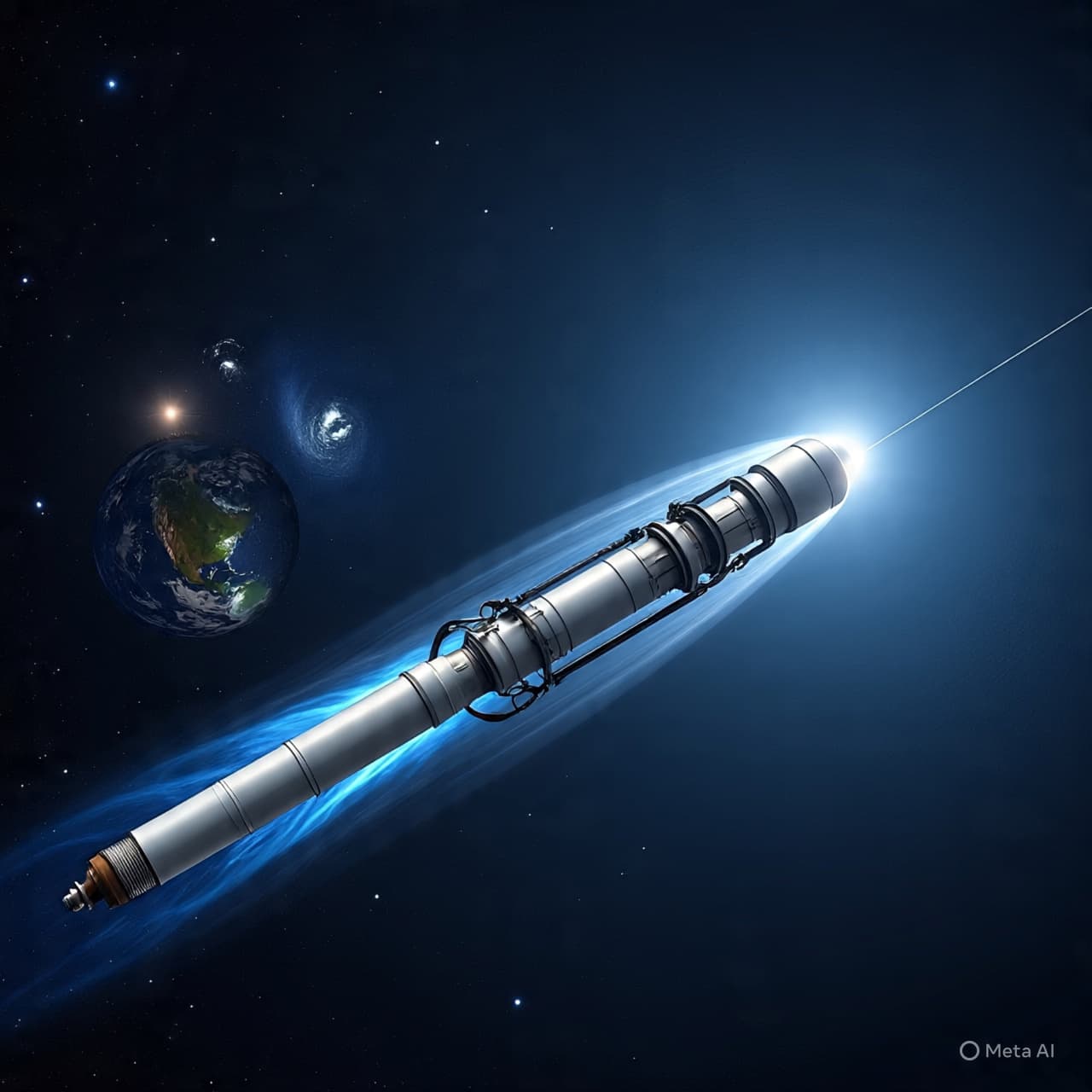
There is a boundary above us that is not marked by lines, but by thinning air and fading resistance—a region where Earth’s atmosphere still lingers, yet gradually gives way to the quiet expanse of space. It is in this narrow and delicate layer that Very Low Earth Orbit, or VLEO, finds its place, a region where satellites move closer to Earth than many of the machines that have long circled overhead.
Recent developments from Fudan University suggest a meaningful step forward in this area. Researchers have been working on technologies that allow satellites to operate in VLEO more effectively, where atmospheric drag is stronger and the challenges of maintaining stable orbit are more pronounced. In these lower altitudes, satellites can achieve sharper imaging, reduced signal latency, and improved observation detail, but only if they can withstand the constant pull of residual atmospheric particles.
Operating in VLEO requires a careful balance. Unlike higher orbits, where satellites can glide with minimal resistance, this region introduces a quiet but persistent friction. Without careful design, a satellite would gradually lose altitude and return to Earth. To counter this, engineers explore advanced propulsion systems, aerodynamic shaping, and materials that can endure prolonged exposure to this environment. The work emerging from Fudan contributes to this evolving toolkit, offering new approaches to sustaining satellite function in these demanding conditions.
The broader interest in VLEO is not only about proximity, but about perspective. From lower altitudes, the resolution of Earth observation improves, revealing patterns in weather, terrain, and environmental change with greater clarity. This has implications across fields within Remote sensing, where precision and timeliness can shape how data is interpreted and used.
Yet the challenges are equally significant. Atmospheric drag is not constant; it fluctuates with solar activity, time of day, and geographic location. Satellites in VLEO must respond to these variations, maintaining stability in an environment that is less predictable than higher orbital paths. It is within this interplay of forces—technology and atmosphere, motion and resistance—that innovation continues to take shape.
Fudan’s advancement sits within a global effort to explore and utilize this lower orbital band, where the line between Earth and space feels less distant, more immediate. It reflects a growing interest in pushing the boundaries of satellite engineering, not by moving farther away, but by moving closer—into regions that were once considered too unstable or demanding for sustained operation.
As research continues, VLEO may become an increasingly important layer in the architecture of space systems, bridging the gap between ground-based observation and traditional satellite orbits. For now, it remains a space of experimentation and gradual discovery, where each technological step contributes to a clearer understanding of how close to Earth’s surface sustained orbital motion can exist.
AI Image Disclaimer: Illustrations were created using AI tools and are not real photographs.
Source Check: Nature, Science, Reuters, BBC News, South China Morning Post
Published by Banx Network. This article is part of the Banx decentralized media programme, powered by the BXE token on the XRP Ledger.