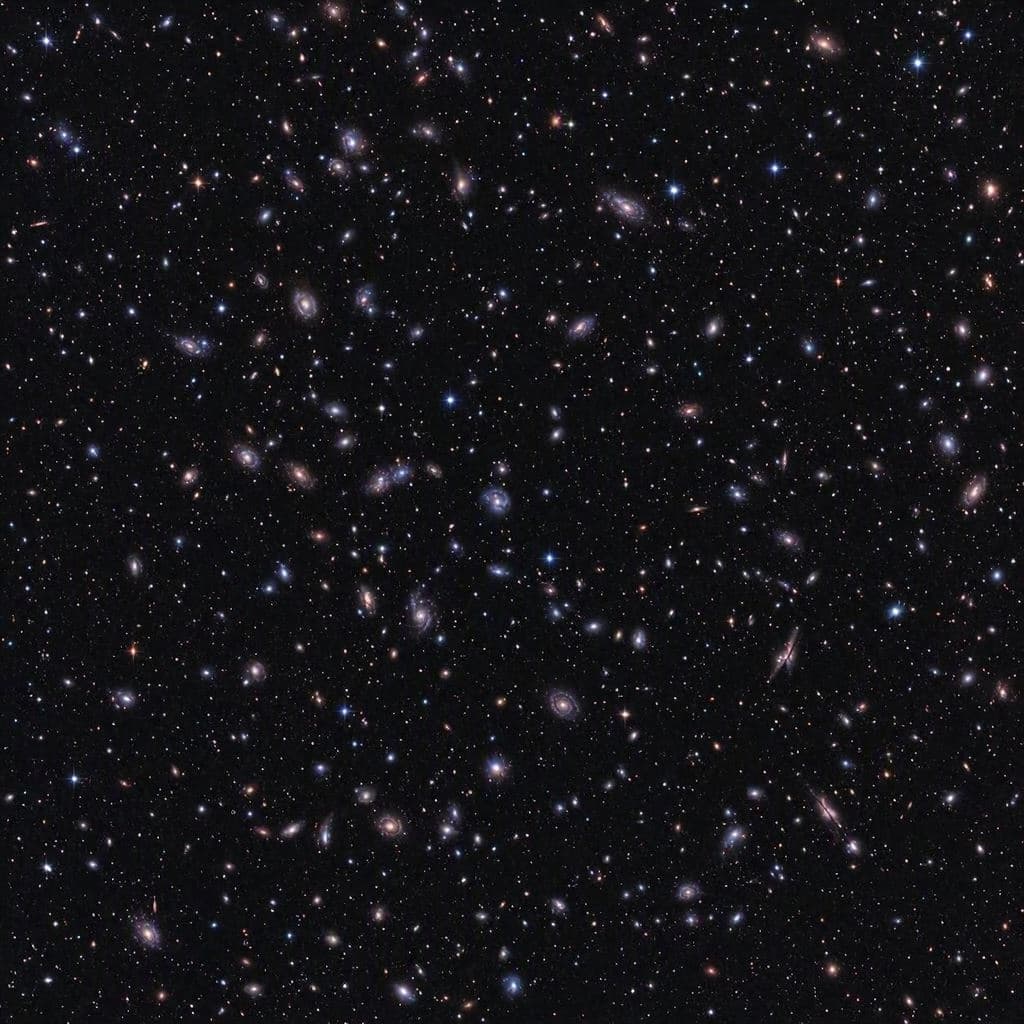
In the vast, silent expanse of the cosmos, where time stretches back to the very first moments of creation, scientists have achieved a milestone of remarkable clarity. By focusing on some of the most pristine and remote galaxies ever discovered, researchers have pinpointed a key measurement of the early universe with unprecedented precision. This achievement not only refines our understanding of cosmic history but also sharpens the tools we use to explore the fundamental laws that govern existence.
The research team, utilizing data from advanced telescopes including the James Webb Space Telescope, targeted fifteen small, distant galaxies that have remained largely untouched by the chaotic mergers and star formation processes that characterize later cosmic eras. These "fossil" galaxies serve as clean laboratories, offering a clearer view of the conditions that prevailed shortly after the Big Bang. By analyzing their light, which has traveled for billions of years to reach us, scientists can reconstruct the universe’s expansion rate during its infancy.
The measurement in question relates to the Hubble constant, a value that describes how fast the universe is expanding. For decades, there has been a tension between measurements taken from the early universe and those taken from the local universe, a discrepancy known as the "Hubble Tension." This new study provides a more robust anchor for the early-universe side of the equation, reducing uncertainty and allowing for more rigorous tests of cosmological models.
The precision of this new data is a testament to the technological leaps made in modern astronomy. Instruments capable of detecting faint infrared signals from the edge of observable space have transformed theoretical speculation into empirical fact. Each photon captured from these distant sources carries information about the density, composition, and dynamics of the young cosmos, enabling scientists to piece together a more accurate timeline of cosmic evolution.
For cosmologists, this refinement is crucial. It helps distinguish between standard models of physics and more exotic theories that might explain the universe’s accelerated expansion. If the tension between early and late measurements persists despite improved precision, it could signal the need for new physics, such as unknown forms of energy or modifications to gravity. Thus, this measurement is not just a number; it is a probe into the deepest mysteries of reality.
The implications extend beyond academic interest. Understanding the universe’s expansion history informs our predictions for its future fate. Will it continue to expand forever, cooling into darkness? Or will it eventually collapse back upon itself? While these questions remain open, each precise measurement brings us closer to an answer, grounding our speculations in hard data.
As the scientific community digests these findings, the focus shifts to integrating them with other observational datasets. The journey to understand the cosmos is collaborative and cumulative, with each discovery building upon the last. In this quest for knowledge, the record-breaking precision achieved by this team marks a significant step forward, illuminating the path through the dark ages of the early universe.
AI Image Disclaimer: The visual representations in this article are AI-generated illustrations designed to convey the concepts of deep space observation and cosmic measurement.
Sources: Phys.org, University of Minnesota
Published by Banx Network. This article is part of the Banx decentralized media programme, powered by the BXE token on the XRP Ledger.