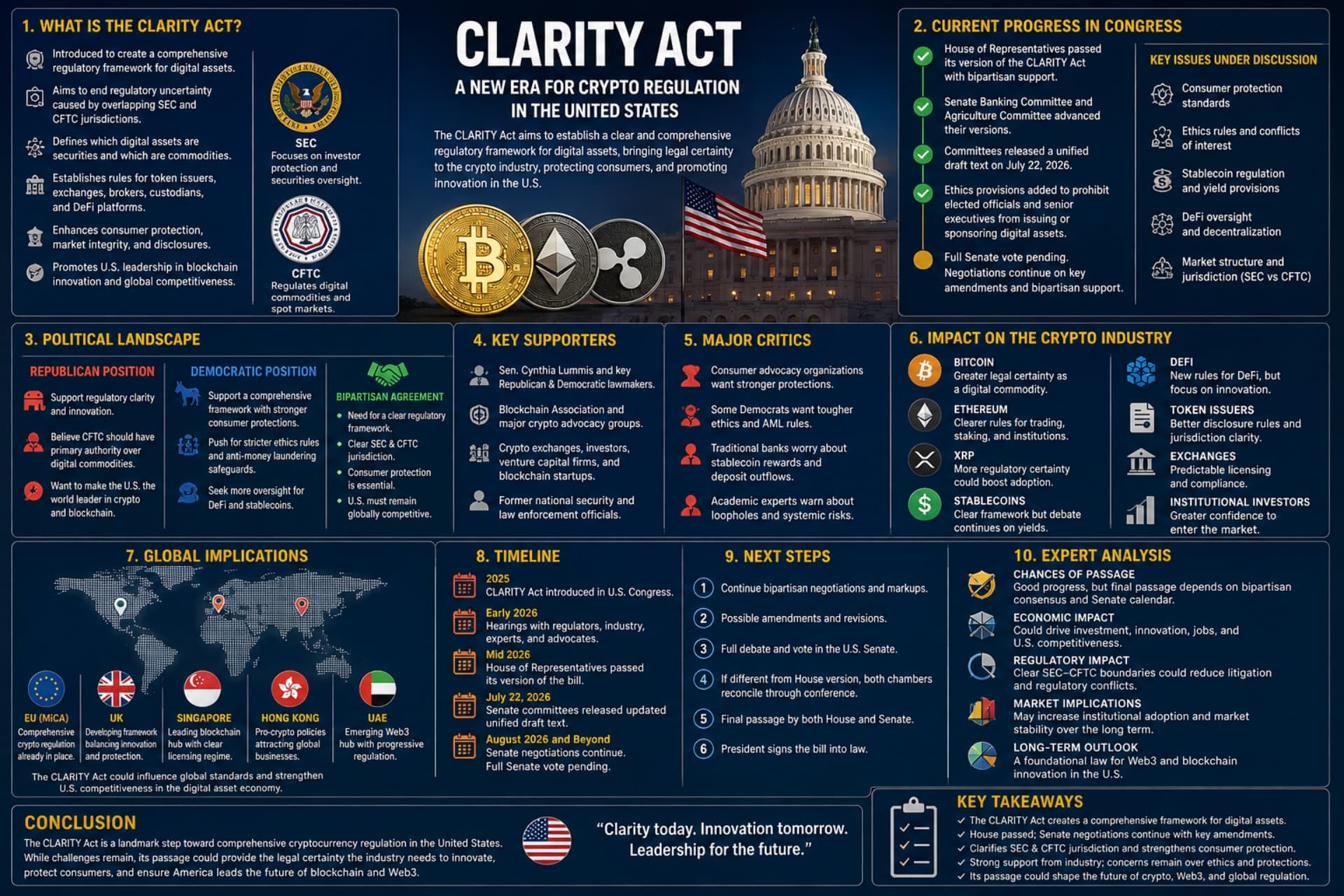
CLARITY Act Progress 2026: Senate Negotiations Intensify as Landmark U.S. Crypto Bill Faces Critical Test
Executive Summary
The Digital Asset Market CLARITY Act, commonly known as the CLARITY Act, has reached one of the most important stages of its legislative journey in the United States Congress. After securing strong bipartisan support in the House of Representatives, attention has shifted to the U.S. Senate, where lawmakers are attempting to reconcile competing priorities while crafting a comprehensive regulatory framework for digital assets.
Although Senate committees have made substantial progress by advancing the legislation and releasing a unified draft text, the bill has not yet received a final vote before the full Senate. Negotiations continue over consumer protection measures, ethics provisions concerning public officials' involvement in digital assets, and the respective responsibilities of the Securities and Exchange Commission (SEC) and the Commodity Futures Trading Commission (CFTC).
As the congressional calendar grows increasingly crowded, supporters argue that passing the CLARITY Act would provide long-awaited legal certainty for the cryptocurrency industry, while critics insist that stronger investor protections and conflict-of-interest safeguards are still needed before the legislation can move forward.
What is the CLARITY Act?
The CLARITY Act is one of the most ambitious pieces of cryptocurrency legislation ever considered by the United States Congress. Its primary objective is to establish a clear legal framework governing digital assets while resolving years of regulatory uncertainty that has affected blockchain companies, investors, developers, and financial institutions.
For more than a decade, the U.S. crypto industry has operated under overlapping regulatory authorities. The Securities and Exchange Commission (SEC) has often argued that many digital assets qualify as securities, while the Commodity Futures Trading Commission (CFTC) has maintained authority over digital commodities such as Bitcoin. This overlap has created confusion, inconsistent enforcement, and costly legal disputes.
The CLARITY Act seeks to eliminate much of this uncertainty by defining which digital assets fall under SEC jurisdiction and which should instead be regulated by the CFTC. It also establishes disclosure requirements for token issuers, creates standards for secondary market trading, strengthens oversight of crypto intermediaries, and introduces new consumer protection measures designed specifically for blockchain-based financial products.
Supporters believe that these reforms would encourage innovation, attract investment, reduce regulatory litigation, and strengthen America's competitiveness in the global digital asset economy.
Current Progress in Congress
The CLARITY Act has already achieved several significant legislative milestones.
The House of Representatives previously approved its version of the legislation with bipartisan support, marking one of the most important victories for the digital asset industry in recent years. That vote demonstrated growing recognition among lawmakers that the United States needs a modern regulatory framework for cryptocurrencies and blockchain technology.
In the Senate, both the Banking Committee and the Agriculture Committee advanced separate versions of the legislation during 2026. Senate negotiators later combined these proposals into a single updated draft designed to reconcile differences between the committees and accelerate consideration before the full Senate.
One of the most notable revisions added an ethics provision that would prohibit elected officials and certain senior government officials from issuing or sponsoring digital assets while serving in office. The provision was introduced after lawmakers from both parties raised concerns about potential conflicts of interest involving government officials with significant cryptocurrency holdings or business interests.
Despite this progress, the legislation still faces major political hurdles.
Several Senate Democrats continue to argue that the revised ethics language remains insufficient. Others believe stronger consumer protections, additional oversight mechanisms, and stricter safeguards against market manipulation should be incorporated before the bill receives their support. Meanwhile, Senate Republicans maintain that delaying regulatory clarity could encourage blockchain innovation and investment to move overseas.
Time has also become a critical factor. With only a limited number of legislative days remaining before Congress begins its August recess, Senate leaders must balance the CLARITY Act against judicial confirmations, appropriations bills, sanctions legislation, and other high-priority measures. As a result, many analysts believe the timetable for Senate passage has become increasingly challenging, even though negotiations remain active.
Published by Banx Network. This article is part of the Banx decentralized media programme, powered by the BXE token on the XRP Ledger.