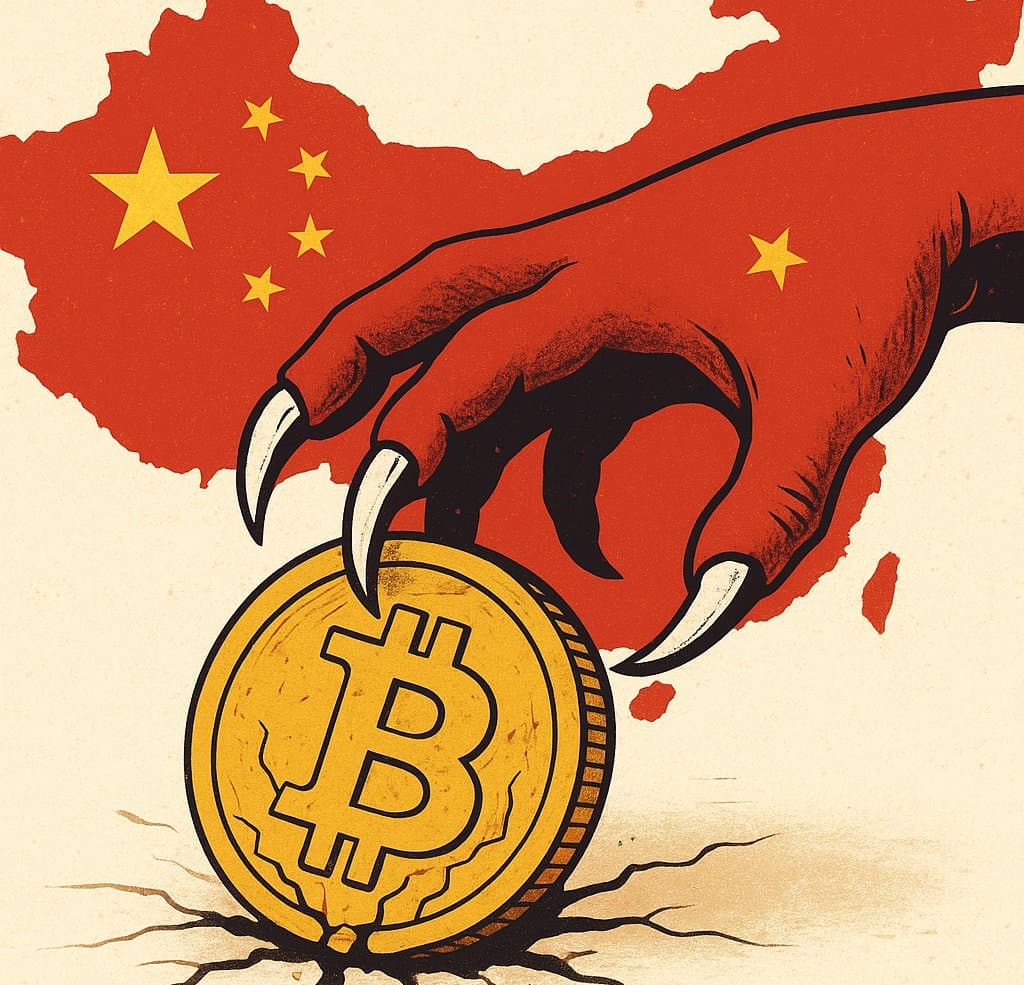
China has shaken the crypto world once again. In a fresh announcement, the People’s Bank of China has reaffirmed its nationwide cryptocurrency ban—this time with a sharper warning aimed at stablecoins and offshore platforms. The message is unmistakably clear: Beijing wants complete control over its digital economy, and it’s willing to squeeze harder to get it.
Although China has maintained strict crypto restrictions since 2021, the new statement signals a more aggressive approach. Stablecoins—considered essential tools in global trading and cross-border settlement—are now under heightened scrutiny. The move aligns with China’s long-term strategy: push out decentralized assets while accelerating the dominance of its state-backed digital yuan.
This renewed crackdown comes at a moment when global crypto adoption is surging. Bitcoin’s price is climbing, institutional buying is accelerating, and tokenization is gaining momentum across banking sectors. China’s stance, therefore, stands in stark contrast to countries like Singapore, the UAE, the US, and parts of Europe, all of which are moving toward clearer regulatory frameworks rather than outright bans.
Yet history has shown that China’s restrictions tend to spark more innovation elsewhere. When the nation banned crypto mining, the industry quickly migrated to the United States, Kazakhstan, and Canada. When exchanges were forced to leave, new hubs like Hong Kong, Seoul, Dubai, and Singapore became homes for major blockchain companies. Every clampdown seems to shift power rather than eliminate the technology.
Some analysts believe China’s latest warning may trigger short-term volatility, especially among traders exposed to offshore stablecoins. But long term, the global crypto ecosystem has proven remarkably adaptable. Decentralized networks do not vanish because borders tighten; they simply reroute.
This reaffirmation is also an indirect acknowledgment of crypto’s growing influence. If digital assets were irrelevant, there would be no need for repeated bans. Instead, China’s continued attempts to suppress the crypto market show just how powerful and unstoppable the sector has become.
As the rest of the world edges closer to embracing blockchain, digital payments, and tokenized finance, China’s approach remains a high-stakes bet: isolate the population from decentralized innovation while pushing forward a centralized alternative. Whether this strategy ultimately strengthens or isolates the nation is a story still unfolding.
But one thing is certain—crypto survives every crackdown, every ban, and every warning.
Published by Banx Network. This article is part of the Banx decentralized media programme, powered by the BXE token on the XRP Ledger.