
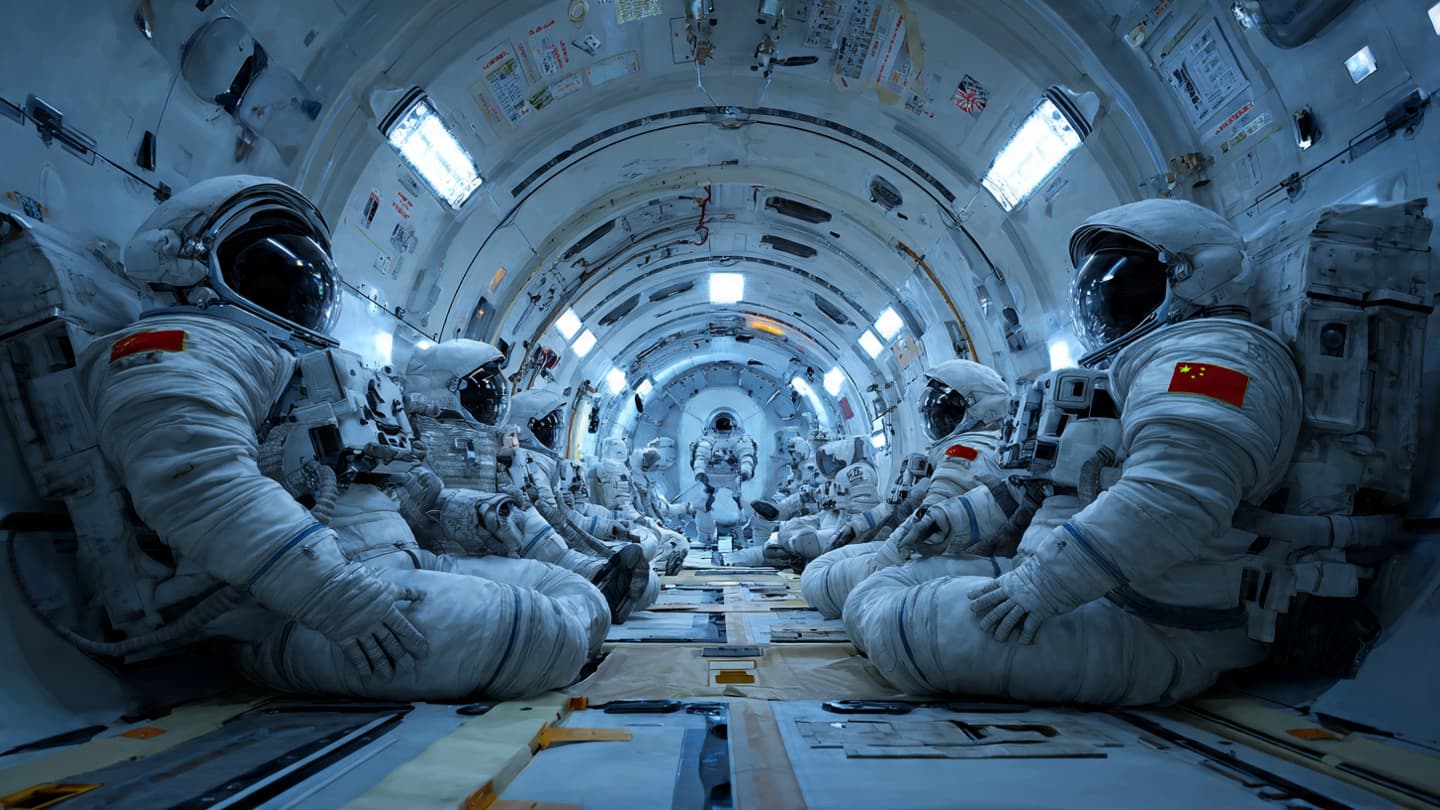
Space missions often compress human experience into isolated environments where time moves differently from life on Earth. Days become measured by orbital cycles, scientific tasks, and communication windows rather than familiar routines. This week, China announced a new long-duration space mission that will send astronauts into orbit for approximately one year as part of its expanding exploration program.
The mission is expected to support scientific research, medical studies, and operational testing aboard China’s growing space station infrastructure. Long-duration missions provide valuable information about how extended exposure to microgravity affects human health, psychology, and physical performance.
Chinese officials described the mission as an important step toward future deep-space ambitions, including potential lunar exploration projects planned for the coming decade. China’s space program has expanded rapidly in recent years through investments in launch systems, satellite networks, and orbital technology.
Astronauts participating in year-long missions face unique challenges involving muscle loss, bone density reduction, sleep regulation, and social isolation. Scientists closely monitor these conditions because understanding long-term human adaptation remains essential for future missions to the Moon and Mars.
The development reflects increasing global competition and cooperation in human spaceflight. Alongside China, agencies such as NASA, Roscosmos, and the European Space Agency continue studying how humans can safely operate for longer periods beyond Earth.
China’s space station program has also become a symbol of national technological advancement. The country views space exploration not only as scientific achievement, but also as part of broader strategic development involving innovation, engineering, and international influence.
Researchers aboard orbital stations frequently conduct experiments involving biology, materials science, medicine, and Earth observation. Microgravity environments allow scientists to study physical processes that behave differently than they do under normal gravitational conditions.
Public interest in human spaceflight has increased significantly worldwide during the past decade, driven by both government missions and commercial aerospace development. Images of astronauts living and working in orbit continue capturing global imagination across generations.
As preparations continue for the upcoming mission, the project highlights humanity’s growing ability to remain in space for increasingly long periods. What once represented brief experimental journeys has gradually evolved into sustained orbital presence, bringing future exploration of deeper space closer to practical reality.
AI Image Disclaimer: Certain visuals associated with this article are AI-generated representations inspired by modern space missions.
Sources Reuters China National Space Administration ScienceDaily Associated Press
Published by Banx Network. This article is part of the Banx decentralized media programme, powered by the BXE token on the XRP Ledger.



