
Key Highlights
- Date of Visit:Miloš Vystrčil's trip to Taiwan occurred on May 31, 2026.
- Chinese Response:China condemned the visit, urging adherence to the one-China principle.
- Political Context:The trip reflects a growing economic relationship between the Czech Republic and Taiwan.
China has voiced strong disapproval regarding the recent trip made by Miloš Vystrčil, the President of the Czech Senate, to Taiwan on May 31, 2026. The Chinese embassy in Prague issued a statement urging the Czech Republic to adhere strictly to the one-China principle, which asserts that Taiwan is an integral part of China. This diplomatic rebuke highlights the sensitivity surrounding Taiwan's international engagements and the potential repercussions for countries that engage with it.
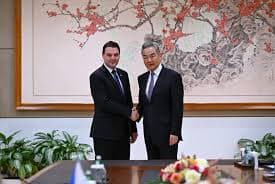
Vystrčil, a member of the opposition Civic Democratic Party (ODS), is leading a delegation aimed at strengthening economic and political ties with Taiwan. His itinerary includes meetings with Taiwanese President Lai Ching-te and various business officials, emphasizing the importance of Taiwan's semiconductor industry to the Czech economy. This visit marks a significant moment in the evolving relationship between the Czech Republic and Taiwan, as both nations seek to enhance their cooperation in technology and trade.
Despite the Czech government's official recognition of Beijing, there has been a noticeable shift in recent years towards fostering closer ties with Taiwan. This shift is particularly evident in light of increasing investments and business exchanges. Earlier in May, Taiwanese Foreign Minister Lin Chia-lung visited Prague, signaling a warming of relations and a potential pivot in Czech foreign policy.
Czech Prime Minister Andrej Babis, whose party currently leads the government, publicly criticized Vystrčil's trip. He emphasized the necessity for a foreign policy that prioritizes pragmatism over values-based diplomacy, reflecting a divide within the Czech political landscape regarding relations with China and Taiwan. Babis’ administration notably declined to provide a government plane for Vystrčil's travels, further illustrating the tensions between the two political factions.
The ongoing diplomatic tensions underscore the complex landscape in which the Czech Republic operates. While it seeks to maintain a constructive relationship with China, it is simultaneously cultivating closer ties with Taiwan. This balancing act is indicative of broader geopolitical trends, where nations are increasingly reassessing their foreign policies in response to changing global dynamics.
As the situation develops, it remains to be seen how the Czech Republic will navigate its relationships with both China and Taiwan, particularly in light of the growing economic interactions and the potential for increased political friction.
Published by Banx Network. This article is part of the Banx decentralized media programme, powered by the BXE token on the XRP Ledger.



