Comets are the wanderers of the solar system, icy messengers that visit us from the distant reaches of space. Among them, Halley’s Comet holds a special place in human history, appearing in our skies roughly every 76 years like a celestial clockwork. Its next return is scheduled for 2061, and for the first time, humanity may be ready to meet it not just with eyes, but with spacecraft. A proposed mission aims to rendezvous with the comet, offering an unprecedented opportunity to study its composition and behavior up close. This ambitious plan invites us to reflect on our enduring fascination with these cosmic visitors and our growing ability to explore them.
Halley’s Comet has been observed since ancient times, recorded in chronicles from China to Europe. Each appearance has offered new insights, but always from a distance. The 1986 flyby by several spacecraft provided valuable data, yet a rendezvous mission would allow for a much deeper investigation. By traveling alongside the comet, scientists could monitor its changes as it approaches the Sun, studying the release of gas and dust in real time.
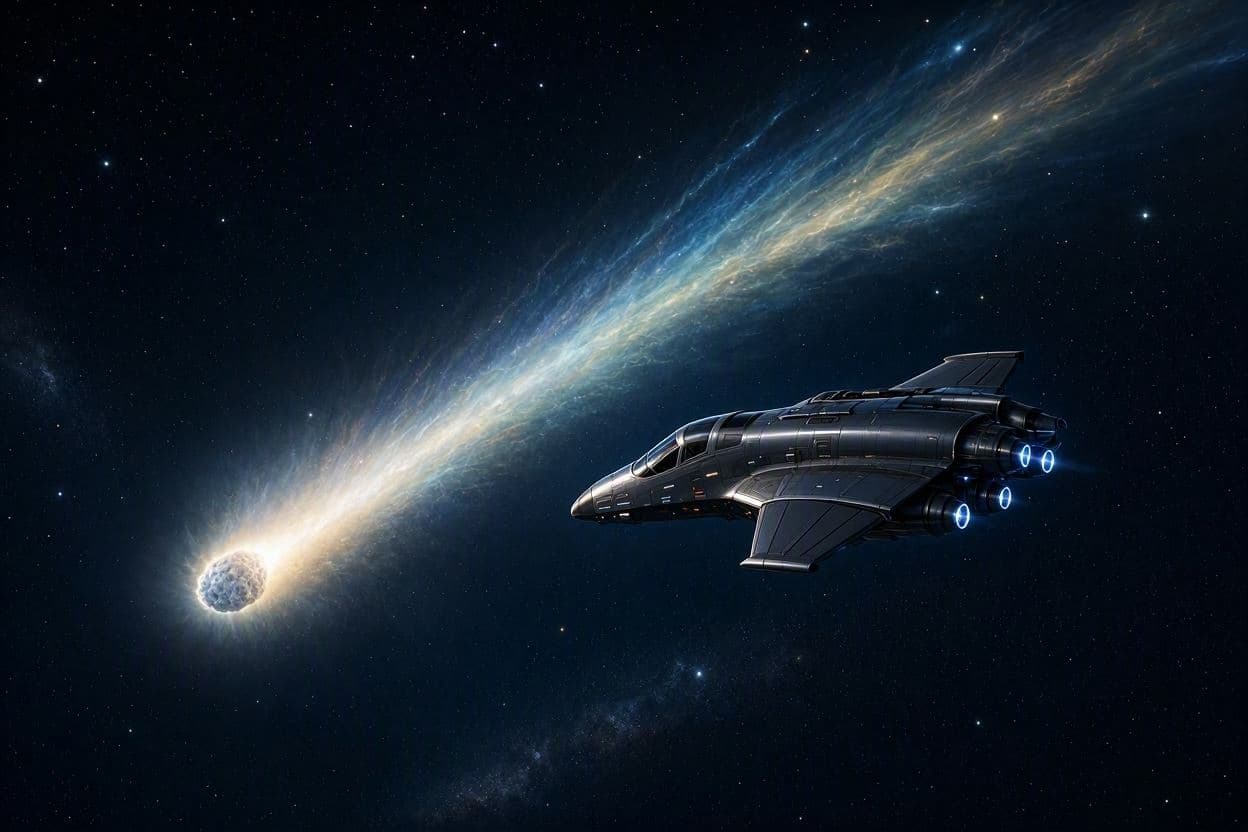
The proposed mission, part of a broader international effort, involves launching a spacecraft that will wait in space for the comet’s arrival. This requires precise orbital mechanics and long-term planning, as the journey spans decades. The spacecraft would need to withstand the harsh environment near the Sun, where the comet becomes most active. Engineering such a vessel is a significant challenge, but one that modern technology is increasingly capable of meeting.
Studying Halley’s Comet is crucial for understanding the origins of the solar system. Comets are considered primordial leftovers, preserving the chemical ingredients from which the planets formed. By analyzing their ice and dust, scientists can learn about the water and organic molecules that may have seeded life on Earth. Halley, being a short-period comet, offers a unique window into these ancient processes.
The 2061 timeline also allows for technological advancements that are currently in development. Ion propulsion, advanced autonomous navigation, and improved scientific instruments will make the mission more feasible and productive. Waiting for the right moment ensures that when we do go, we go with the best tools available. It is a lesson in patience and preparation.
Public interest in Halley’s Comet remains high, driven by its historical significance and regular visibility. A successful rendezvous mission would capture the imagination of a new generation, inspiring interest in space exploration. It connects the past, present, and future, linking ancient observers with modern scientists. This continuity is a powerful narrative for space agencies.
International collaboration is key to the mission’s success. Space exploration is increasingly a global endeavor, with countries pooling resources and expertise. Such cooperation not only reduces costs but also fosters diplomatic ties through shared scientific goals. The comet belongs to no one nation, but to all humanity.
As we look toward 2061, the anticipation builds. The mission represents a commitment to curiosity and discovery. It reminds us that while we cannot control the orbits of comets, we can choose to meet them with open arms and open minds. The journey will be long, but the destination is worth it.
A proposed mission to rendezvous with Halley’s Comet in 2061 offers a unique chance to study this iconic visitor. It highlights the value of long-term planning in space exploration. Let us look forward to this future encounter.
AI Image Disclaimer: The visuals accompanying this piece are AI-generated interpretations intended for illustrative purposes only.
Sources: European Space Agency Planetary Society New Scientist
Published by Banx Network. This article is part of the Banx decentralized media programme, powered by the BXE token on the XRP Ledger.