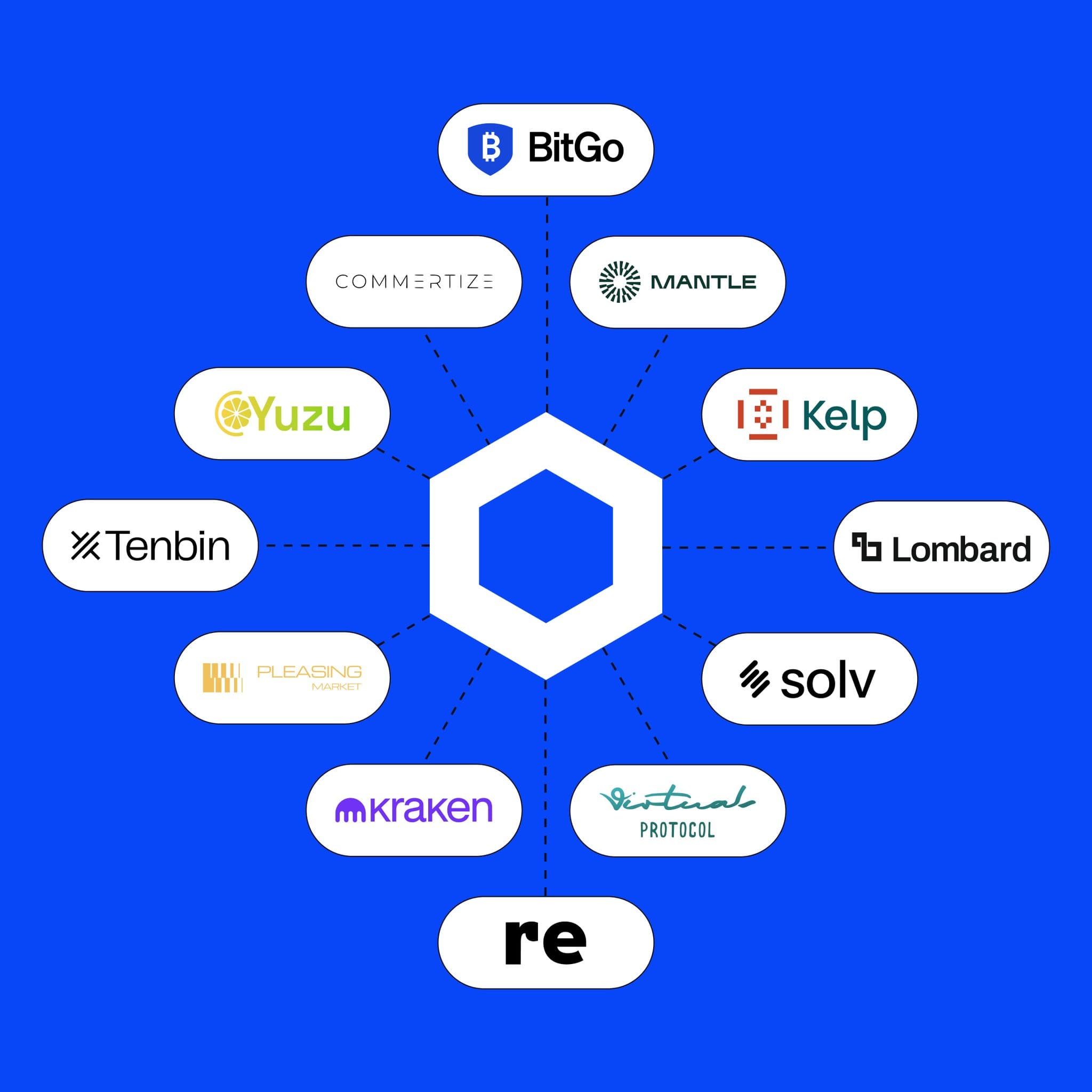
Chainlink is continuing to expand its role as infrastructure connecting blockchain networks with financial applications, with a growing group of companies and protocols shown in the supplied graphic. The ecosystem displayed includes BitGo, Mantle, Kelp, Lombard Finance, Solv Protocol, Virtuals, Kraken, Pleasing Market, Tenbin Labs, Yuzu Money and Commerztize, alongside other projects. The message accompanying the graphic is simple: “Just use Chainlink.” Behind that statement is a much larger development taking place across digital finance — the increasing need for reliable data, interoperability and infrastructure capable of connecting traditional assets with blockchain-based applications. Chainlink's importance comes from the problem it attempts to solve. Blockchains are designed to verify information within their own networks, but many applications need information that originates elsewhere. Prices, interest rates, proof of reserves, financial-market data and events occurring outside a blockchain cannot simply be assumed to be accurate by a smart contract. Infrastructure known as an oracle network can provide that external information. As decentralized finance has developed, reliable data has become increasingly important. Lending protocols need accurate asset prices to determine collateral values. Tokenized assets require information that confirms what an underlying asset represents. Stablecoin systems can require market information to maintain appropriate mechanisms. Cross-chain applications also need systems capable of securely communicating information between different blockchain environments. The projects shown in the graphic demonstrate how broad the potential application has become. BitGo is associated with institutional digital-asset custody, while Lombard and Solv are involved in blockchain-based financial products. Mantle operates within the broader Ethereum ecosystem, and Kelp is associated with restaking infrastructure. Kraken represents a major digital-asset exchange, while other names shown are developing applications involving lending, tokenization, payments, trading and decentralized services. The significance is not necessarily that every project uses Chainlink in exactly the same way. Rather, the collection illustrates the growing demand for common infrastructure across an increasingly fragmented blockchain industry. As more networks and applications emerge, developers need reliable systems that can move information between them without forcing every project to build its own infrastructure from scratch. This becomes even more important as traditional financial assets move onto blockchains. Tokenization involves representing assets such as funds, securities, commodities or other financial instruments digitally. Once those assets become programmable, smart contracts can potentially interact with them automatically. But automation only works if the underlying information can be trusted. Consider a tokenized financial product that depends on an external price. A smart contract may need to determine whether collateral remains sufficient or whether a transaction should occur. If the price information is inaccurate, delayed or manipulated, the entire application can be exposed to significant risk. Reliable data infrastructure therefore becomes a fundamental component rather than an optional feature. Cross-chain activity creates another challenge. The digital-asset market is no longer concentrated on a single blockchain. Ethereum, Solana, Avalanche, various layer-2 networks and specialized chains all host different applications and assets. Users increasingly expect these systems to communicate with one another. Infrastructure that helps applications operate across multiple environments can therefore become increasingly valuable. The institutional side is equally important. Large financial companies typically require stronger controls, dependable infrastructure and transparent verification before deploying capital on public blockchains. Services involving custody, proof of reserves and secure data transmission can help address some of those requirements. However, Chainlink's growing ecosystem does not eliminate the risks associated with blockchain infrastructure. Oracle failures, smart-contract vulnerabilities, network congestion and incorrect external information can still create problems. Adoption also does not automatically translate into token-value appreciation because infrastructure usage, company revenues and token economics are separate questions. The larger trend is nevertheless clear. Blockchain applications are moving beyond simple cryptocurrency transfers toward increasingly complex financial systems. As that happens, the need for dependable data and communication infrastructure grows. The graphic's list of companies and protocols therefore represents more than a collection of partnerships. It illustrates an emerging digital-finance stack in which custody, lending, tokenization, exchanges, restaking and decentralized applications increasingly require shared infrastructure. If blockchain adoption continues expanding into institutional finance, the companies providing this underlying infrastructure could become strategically important. The long-term competition may not simply be between individual blockchains, but between entire ecosystems capable of providing secure data, interoperability and financial functionality.
Published by Banx Network. This article is part of the Banx decentralized media programme, powered by the BXE token on the XRP Ledger.