

Key Highlights
- Date of Incident:July 28, 2026, marked by a devastating airstrike.
- Casualties:At least one confirmed death and over a dozen injuries reported.
- Impact:Hundreds of displaced individuals left homeless after the attack.
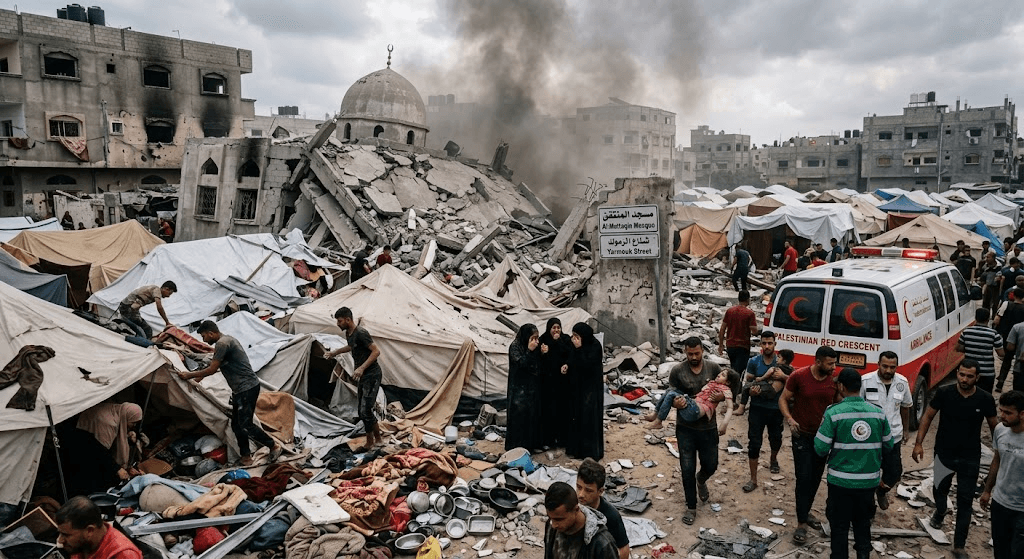
GAZA CITY — A devastating Israeli airstrike ripped through central Gaza City on Tuesday, July 28, 2026, completely destroying a local mosque and a makeshift tent camp that was providing shelter to hundreds of displaced Palestinians. The attack has left at least one person dead, over a dozen wounded, and hundreds more entirely homeless amidst an ongoing humanitarian crisis.
Israeli warplanes targeted the Al-Muttaqin Mosque, located in central Gaza City near the Young Men’s Christian Association (YMCA) building and Yarmouk Stadium. The area surrounding the mosque had become a sanctuary of last resort, packed with tightly clustered tents housing families who had already fled violence in other parts of the enclave. This airstrike is part of a broader pattern of military actions that have intensified in recent weeks, exacerbating the already dire humanitarian situation in Gaza.
Video footage from the scene captured the moment the missile struck, triggering a massive fireball and sending a towering plume of thick smoke and debris into the sky. The blast completely leveled the religious structure and instantly incinerated the surrounding tents, leaving a scene of utter devastation. Eyewitness accounts describe the chaos that ensued as families scrambled to escape the destruction, highlighting the urgency and fear that permeated the area.
According to local reports, the Israeli military issued a warning shortly before the bombardment; however, residents were given an incredibly narrow window of time to evacuate, leaving them struggling to flee the immediate blast zone. This raises questions about the effectiveness and morality of such warnings in a densely populated area where escape routes are limited.
Medical sources confirmed that at least one Palestinian was killed in the immediate aftermath of the strike, and more than 12 others sustained varying degrees of injuries. Emergency responders and local civilians frantically dug through the burning wreckage and rubble of the collapsed mosque to pull survivors to safety. The physical destruction has compounded an already desperate situation. With their makeshift shelters reduced to ash, hundreds of displaced Gazans have once again been cast into the streets with nowhere left to turn.
The strike was part of a broader wave of aerial bombardments focusing on central and northern Gaza. In a separate, near-simultaneous attack on Tuesday, Israeli forces struck a crowded market in the Nuseirat refugee camp farther south, killing another individual and wounding at least 20 others as civilians went about their daily activities. These incidents underscore the ongoing volatility and danger faced by civilians in the region.
Despite ongoing diplomatic discussions and previous international frameworks aimed at establishing lasting regional stability, near-daily military strikes continue to disrupt the lives of the roughly two million residents confined to Gaza's heavily damaged coastal areas. For the hundreds of families displaced by Tuesday's bombing, the loss of both their place of worship and their temporary shelters underscores a stark reality: in Gaza, true safe havens remain tragically out of reach.
Published by Banx Network. This article is part of the Banx decentralized media programme, powered by the BXE token on the XRP Ledger.




