
Key Highlights
- Location:A major highway in Cartago, Costa Rica, was blocked by a landslide.
- Casualties:Two motorists were confirmed dead after their vehicles were buried.
- Response:Emergency services faced challenges due to ongoing earth movement.
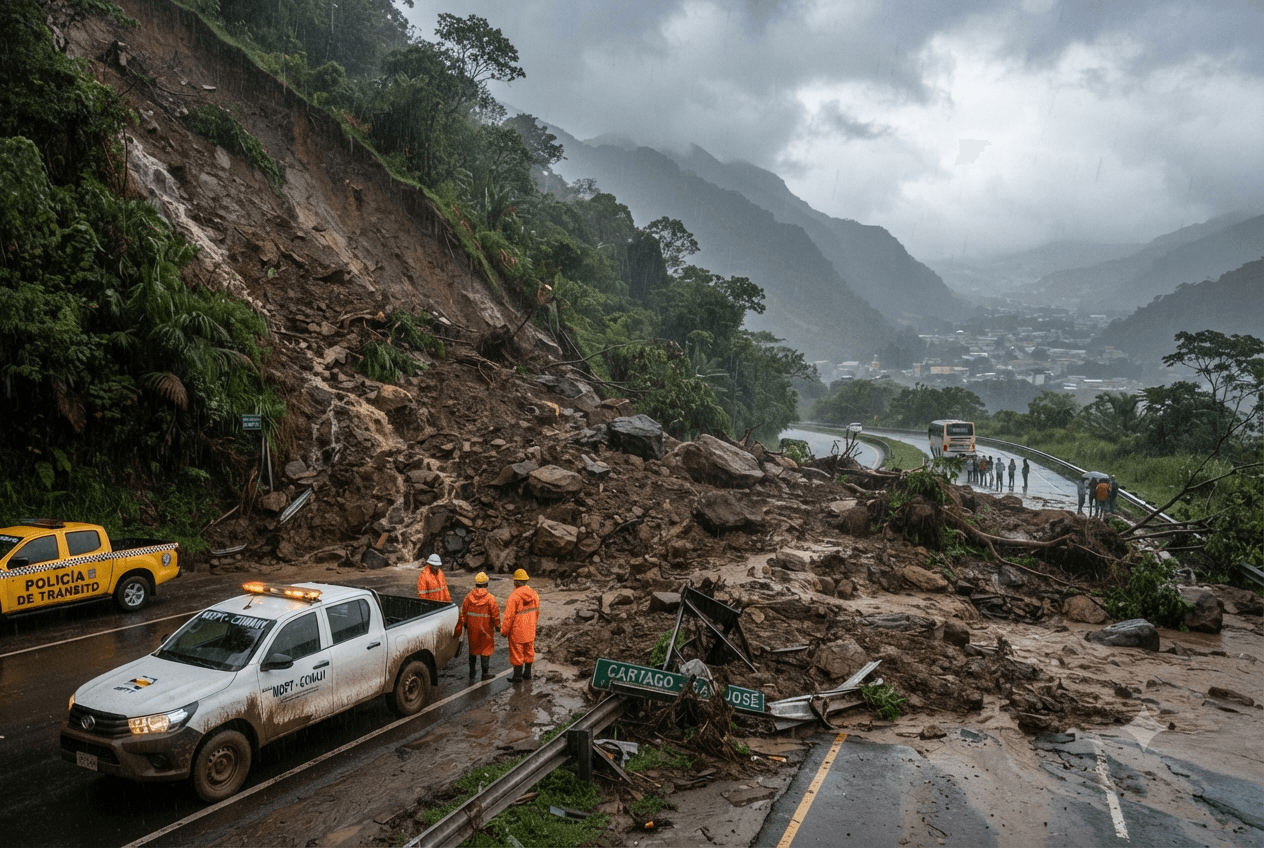
On Friday afternoon, a catastrophic landslide occurred in Cartago, Costa Rica, burying a vital inter-provincial highway under thousands of tons of mud and rock. The National Commission for Risk Prevention and Emergency Response reported that the landslide struck suddenly, crushing two moving passenger vehicles beneath a dense layer of debris. This tragic event was triggered by heavy seasonal rainfall that had saturated the volcanic soils, leading to the slope's failure.
Emergency medical units were dispatched to the scene but encountered significant difficulties in accessing the buried vehicles due to the ongoing risk of further earth movement. Rescue workers, equipped with heavy hydraulic jacks and manual shovels, worked tirelessly to clear the thick layer of reddish clay. Unfortunately, officials later confirmed the deaths of the two motorists trapped inside the wreckage before extraction teams could reach them.
In response to the disaster, highway patrol officers closed off several miles of the arterial transit route in both directions to prevent secondary accidents. Heavy excavation machinery was brought in from nearby municipal depots to clear the massive amounts of earth that had spilled onto the highway. The operation was complicated by the unstable conditions of the upper ridge, which geological engineers warned could lead to additional collapses.
Transport ministry officials took immediate action by diverting commercial cargo and commuter traffic onto alternate winding mountain passes, significantly increasing transit times for travelers. Local residents living near the base of the ravine were placed on high alert, with mandatory evacuation orders being prepared should the rain intensity increase further. Maintenance crews were also deployed to inspect nearby bridge foundations and culverts for any structural damage caused by the torrential runoff.
As the emergency operation continued into the evening, floodlights illuminated the chaotic scene where recovery specialists worked to retrieve the flattened vehicles. The victims were subsequently transferred to the forensic pathology center in the capital for identification and further investigation. Transport authorities announced that the critical transit corridor would remain closed for at least forty-eight hours while geotechnical assessments were conducted to ensure safety before reopening.
Long lines of commercial freight trucks formed along the highway shoulders, as drivers awaited updates on when the route would be cleared for travel. The tragic landslide not only claimed lives but also disrupted the flow of goods and services in the region, highlighting the ongoing challenges posed by extreme weather conditions in Costa Rica.
Published by Banx Network. This article is part of the Banx decentralized media programme, powered by the BXE token on the XRP Ledger.



