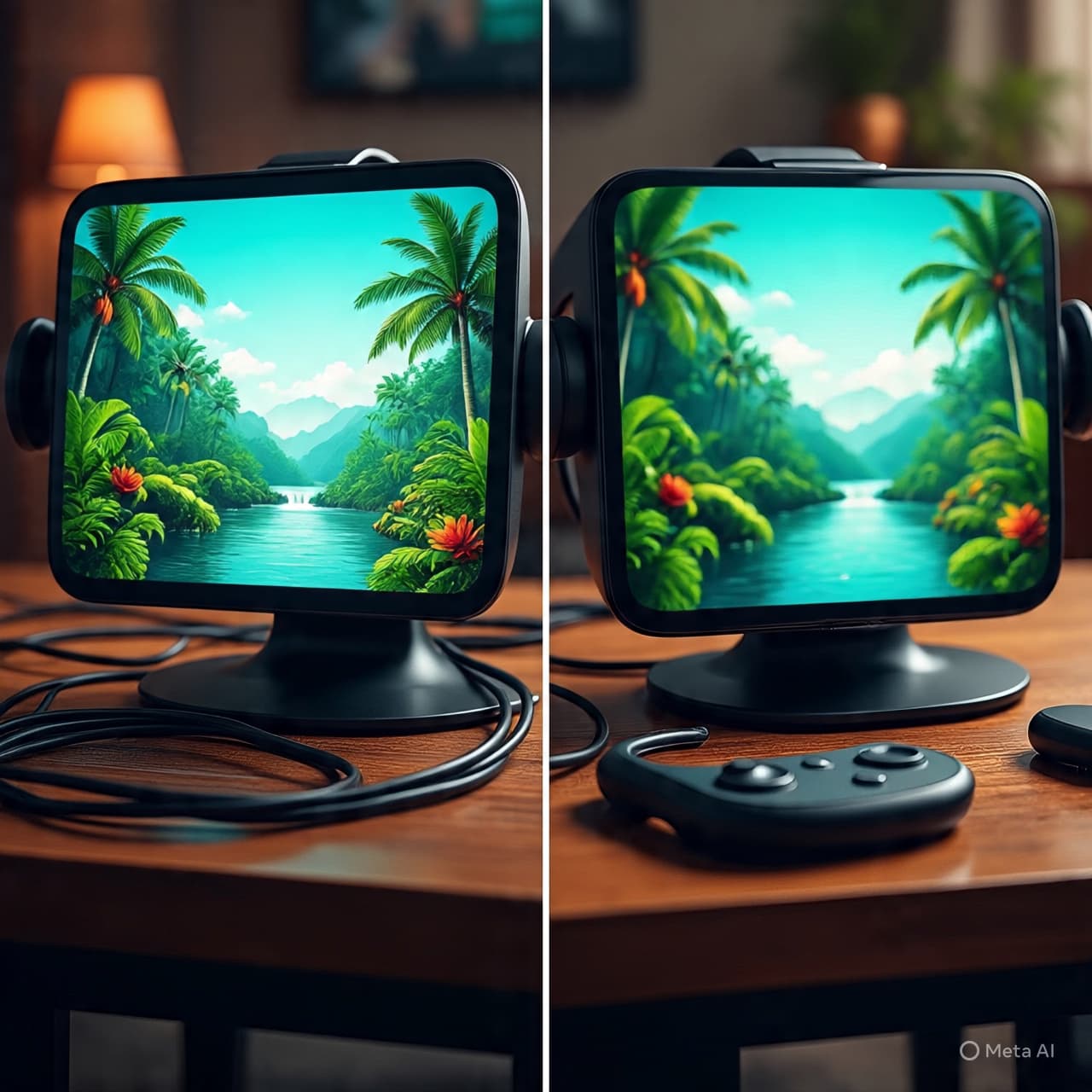
In the world of virtual reality, how a game feels can be as important as how it looks. Like comparing a grand oil painting viewed up close with the same piece glimpsed from across a crowded room, virtual worlds reveal different images depending on the “canvas” they’re painted on. This contrast has become especially clear with Pirates VR: Jolly Roger, a swashbuckling VR adventure that’s now available both on PC VR and as a standalone Quest (Meta Quest 3/3S) port — and brought into sharp focus the trade‑offs inherent in bringing ambitious VR titles across platforms.
Pirates VR: Jolly Roger casts players as a would‑be buccaneer on a cursed Caribbean island, exploring lush jungles, dark caverns, and ocean horizons in search of Davy Jones’ treasure. Released initially on PC via Steam in early 2025 and later rebuilt for Quest hardware in early 2026, the game’s core adventure — puzzles, climbing, combat, and exploration — remains intact across both versions.
Graphics and Detail: On a capable PC VR setup, the world of Jolly Roger shows off richer textures, more dynamic lighting, and greater visual fidelity overall. Shadows from lanterns cast more realistically across surfaces, fine details in rock and foliage hold up at distance, and environmental effects such as dust and particles add depth to exploration scenes. Characters and enemy skeletons also display more nuance in clothing and model detail. This fuller visual picture is partly due to the higher rendering budgets allowed by desktop GPUs compared to standalone hardware.
On Quest 3/3S, however, the game adapts cleverly to hardware limits. While the overall environment and core visuals remain recognizable and immersive, textures and geometric detail are noticeably reduced compared with the PC VR equivalent. Certain lighting effects are more selective, and some dynamic shadowing is scaled back. Standalone optimization techniques — like Application Spacewarp and fixed foveated rendering — help maintain framerate, but can introduce minor micro‑stutters or softer edges when objects move across the visual field.
Performance and Experience: PC VR running Jolly Roger tends to offer smoother transitions between high‑detail zones and better stability at higher graphics settings on strong GPU rigs. Quest’s version holds its own impressively, but will occasionally dip in framerate or show texture pop‑in in distant environments — especially when looking out toward ocean horizons or densely built scenes.
Immersion vs Accessibility: What’s particularly striking is how much of the atmosphere survives the graphical scaling. The Quest port doesn’t feel like a drastically inferior game; instead, it plays like a slightly pared‑down version of its PC sibling. Environments remain engaging and navigable, lighting retains dramatic impact even if shadows aren’t as deep, and environmental storytelling — like the glow of torches in caverns — still enhances immersion.
In many ways, this comparison mirrors the broader evolution of VR: developers striving to bring visually ambitious titles to more accessible hardware without losing the soul of the experience. Whether you’re sailing from a powerful PCVR rig or stepping into the pirate’s boots on a Quest headset, Pirates VR: Jolly Roger shows that adventure in virtual reality can be both broad in vision and flexible in scope.
AI Image Disclaimer “Visuals are created with AI tools and are intended as conceptual illustrations, not real screenshots.”
📚 Sources UploadVR’s graphics comparison of Pirates VR: Jolly Roger on PCVR and Meta Quest along with platform and release information.
Published by Banx Network. This article is part of the Banx decentralized media programme, powered by the BXE token on the XRP Ledger.