There are moments in science that feel less like announcements and more like thresholds. A door stands closed for decades, built with care, patience, and collective ambition. Then, almost quietly, it opens. The light that spills through is not a single beam, but a flood.
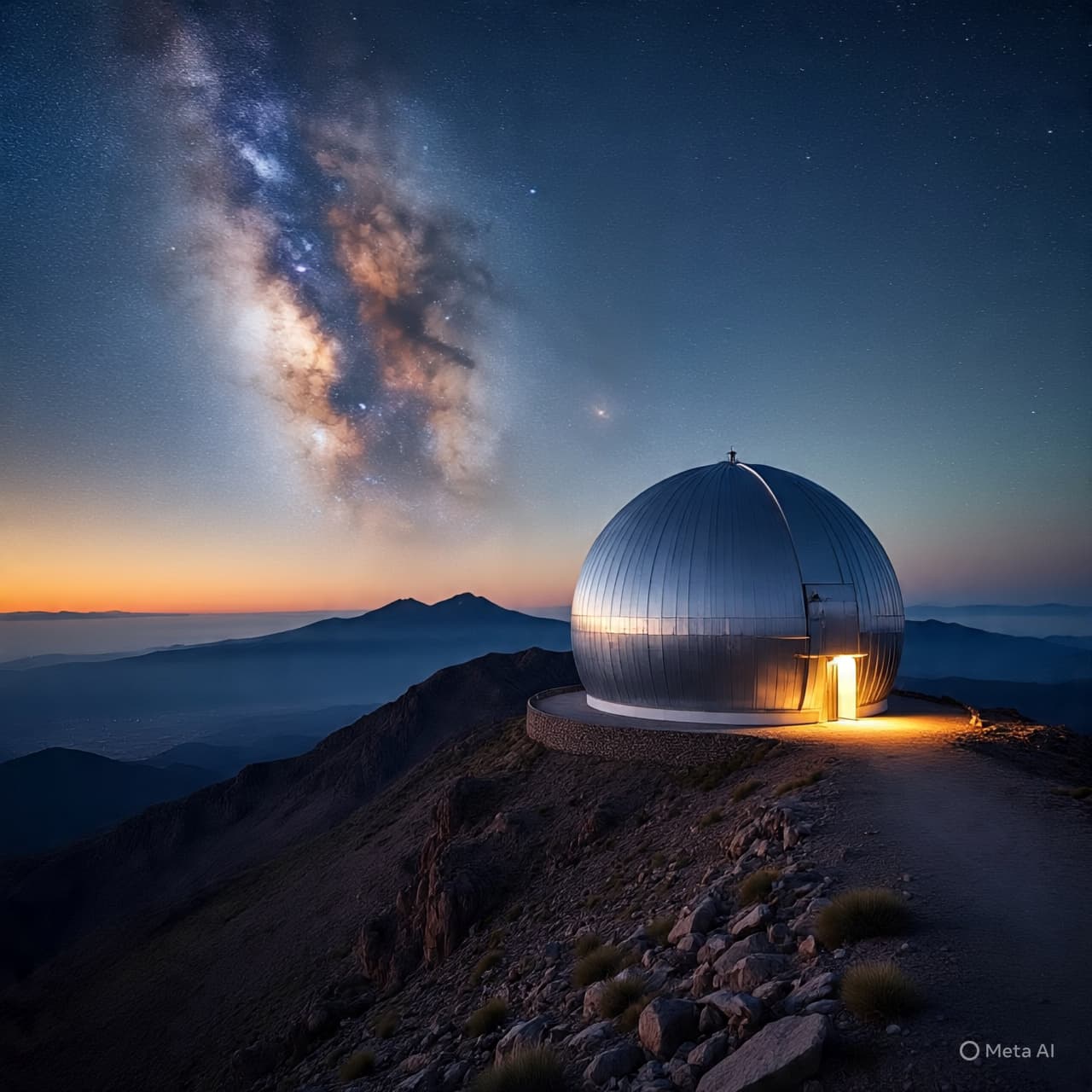
High in the Chilean Andes, the Vera C. Rubin Observatory is preparing for such a moment. Perched atop Cerro Pachón, the observatory is nearing the start of full science operations, bringing with it the promise of a data stream unlike anything astronomy has seen before. If previous sky surveys were measured in snapshots, Rubin’s Legacy Survey of Space and Time (LSST) will be more like a cinematic record of the universe in motion.
At the heart of this effort is the largest digital camera ever built for astronomy, designed to repeatedly scan the entire visible southern sky. Every few nights, the telescope will sweep overhead, capturing faint galaxies, wandering asteroids, flickering stars, and transient flashes that last only hours. Over ten years, it is expected to collect tens of terabytes of data each night, building a time-lapse archive of the cosmos.
The ambition is not spectacle for its own sake. Rubin Observatory was conceived to answer some of the most persistent questions in modern astrophysics. By mapping billions of galaxies and tracking their distribution across space and time, scientists hope to refine measurements of dark matter and dark energy—the unseen components believed to shape the universe’s structure and expansion. The observatory’s deep, wide-field imaging will also help trace the subtle gravitational distortions that reveal dark matter’s presence.
Closer to home, Rubin will monitor millions of objects within our own solar system. Near-Earth asteroids, distant Kuiper Belt objects, and faint comets will pass through its field of view. With its rapid cadence, the telescope can detect small shifts in position night after night, improving planetary defense catalogs and expanding our knowledge of the solar system’s outer reaches.
And then there are the unexpected discoveries—the events no one has yet imagined. Supernovae appearing in remote galaxies. Stars dimming in unusual patterns. Brief, brilliant outbursts from compact objects. Because Rubin will revisit the same regions of sky again and again, it will capture change as a fundamental feature of the universe, not as a rare anomaly.
The observatory is named for Vera Rubin, whose work in the 20th century provided some of the clearest evidence for dark matter. Her measurements of galactic rotation suggested that invisible mass surrounds galaxies, altering their motion. It is fitting that a facility designed to probe the dark universe bears her name. The survey’s scale reflects her insight: that what we cannot see may matter most.
Yet the true deluge may not be limited to discoveries alone. It will also be a deluge of data. Astronomers, data scientists, and software engineers are preparing new tools powered by machine learning and advanced analytics to sift through the nightly torrent. Alerts about transient events will be distributed within minutes of observation, inviting global collaboration. In this sense, Rubin is not just a telescope; it is an ecosystem.
There is something poetic about the timing. In an era when information often feels overwhelming, the scientific community is preparing for a different kind of abundance—one measured in light-years and magnitudes. The sky has always changed. We simply have not always been able to watch it closely enough.
As the Rubin Observatory begins its full survey, expectations are high but measured. The instrument has been tested, calibrated, and refined. The first images have already hinted at its clarity and depth. Soon, the routine scanning will begin, and with it, a decade-long conversation between Earth and sky.
The flood is coming—not of water, but of photons captured, cataloged, and shared. And somewhere within that steady cascade of light, new patterns will emerge, reshaping how we understand the cosmos. For now, the doors are opening. The night sky waits, as it always has, patient and immense.
AI Image Disclaimer Graphics are AI-generated and intended for representation, not reality.
Sources NASA National Science Foundation (NSF) NOIRLab Science Nature
Published by Banx Network. This article is part of the Banx decentralized media programme, powered by the BXE token on the XRP Ledger.