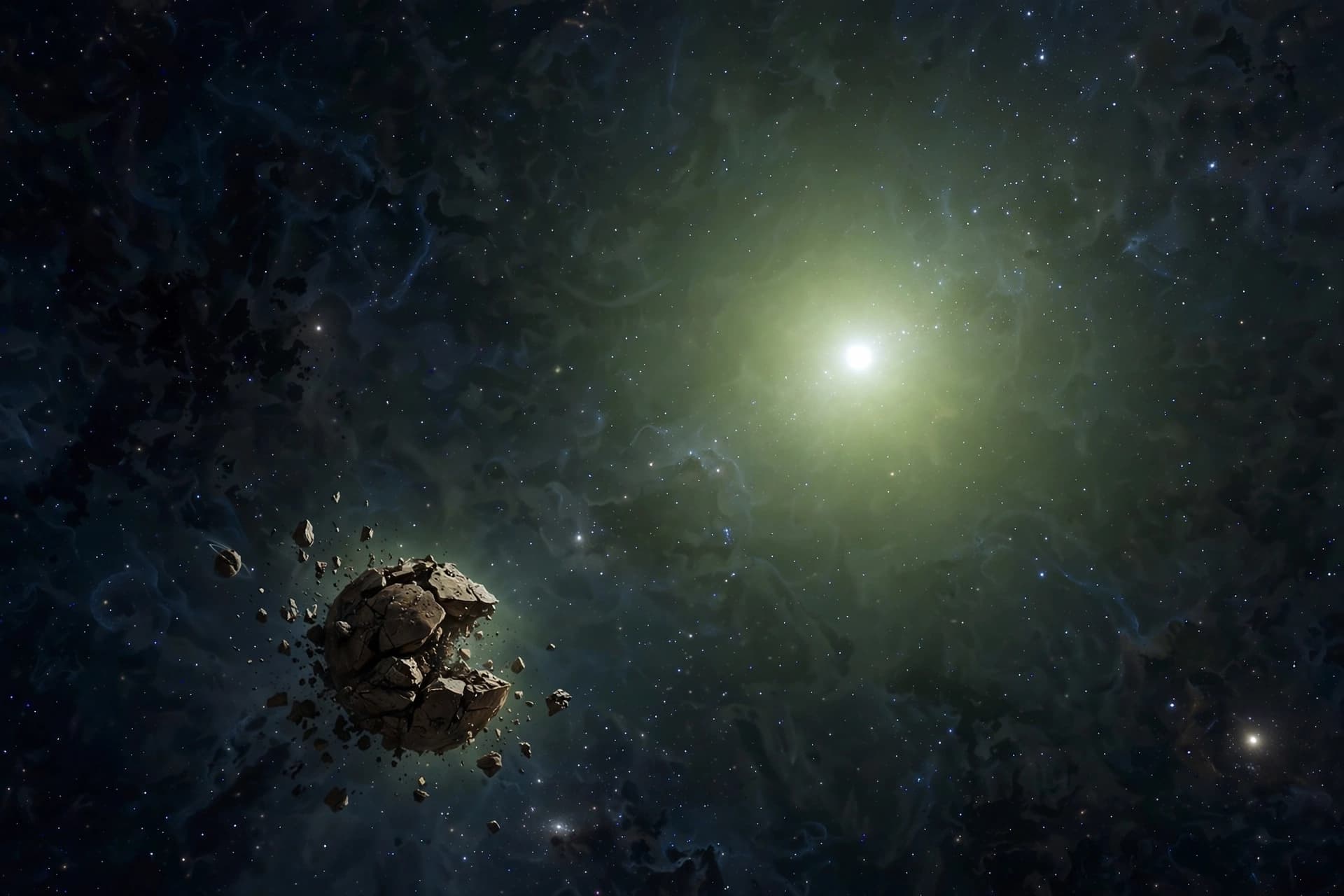
At the heart of our galaxy, where starlight tangles with shadow and gravity gathers its quiet strength, there lies a region both turbulent and strangely fertile. The Milky Way’s center does not shimmer like the spiral arms we imagine in postcards. It swirls, compresses, and glows in wavelengths invisible to the human eye. In that dense and restless expanse — known as the Central Molecular Zone — chemistry unfolds on a cosmic scale.
Astrochemistry, the study of molecules in space, finds one of its richest laboratories in this inner galactic region. The Central Molecular Zone, often abbreviated as CMZ, spans hundreds of light-years around the Milky Way’s core. It contains vast clouds of gas and dust, packed far more densely than those found in the galaxy’s quieter outskirts. Within these clouds, atoms meet, bond, and rearrange, giving rise to a surprising variety of complex molecules.
The environment here is anything but gentle. Radiation levels are higher, shockwaves from supernovae ripple through space, and magnetic fields thread the region with invisible tension. Temperatures and pressures fluctuate in ways that challenge conventional models of star formation. Yet, rather than stifling chemistry, these extreme conditions appear to encourage it.
Radio telescopes and infrared observatories have detected a diverse inventory of molecules within the CMZ — from simple compounds like carbon monoxide to more intricate organic molecules containing carbon chains and alcohol groups. Some of these molecules are considered precursors to the building blocks of life. While no one suggests that life thrives in these harsh galactic depths, the chemistry itself hints at the universality of molecular complexity.
What distinguishes the Central Molecular Zone is not merely the number of molecules detected, but the abundance and distribution patterns. Compared to calmer regions of the Milky Way, the CMZ shows elevated levels of certain complex organic molecules. Researchers believe that shockwaves, turbulence, and intense cosmic radiation may liberate molecules from dust grains, injecting them into the gas phase where they can be observed and further transformed.
Observations from facilities such as radio interferometers have allowed astronomers to map these molecules with increasing precision. By analyzing spectral lines — the specific frequencies of light emitted or absorbed by molecules — scientists can determine chemical composition, temperature, density, and motion within the clouds. In effect, they are reading a chemical fingerprint etched across light-years.
The chemistry of the CMZ also intersects with broader galactic questions. How do stars form in such an extreme environment? Why does star formation there appear less efficient than the sheer mass of gas might suggest? Some researchers propose that turbulence and strong magnetic forces prevent clouds from collapsing easily, delaying the birth of stars even as chemical complexity grows.
There is a quiet irony in this region. Near the supermassive black hole at the Milky Way’s center — a place associated with immense gravitational pull — delicate molecular structures persist. The same forces that compress and heat the gas may also catalyze new reactions, forging molecules that drift through interstellar space.
Astrochemistry in the Central Molecular Zone is still an evolving field. As next-generation observatories refine their sensitivity and resolution, scientists expect to uncover even more complex species and better understand the pathways that create them. Laboratory experiments on Earth attempt to replicate these interstellar conditions, offering complementary insights into how molecules form on icy dust grains or in shock-heated gas.
In straightforward terms, current research shows that the Central Molecular Zone of the Milky Way contains a rich and dynamic chemical environment. Ongoing observations continue to map its molecular composition and examine how extreme galactic conditions influence both chemistry and star formation.
AI Image Disclaimer:
Images in this article are AI-generated illustrations, meant for concept only.
Sources:
NASA European Space Agency (ESA) Nature Astronomy Science Space.com
Published by Banx Network. This article is part of the Banx decentralized media programme, powered by the BXE token on the XRP Ledger.