
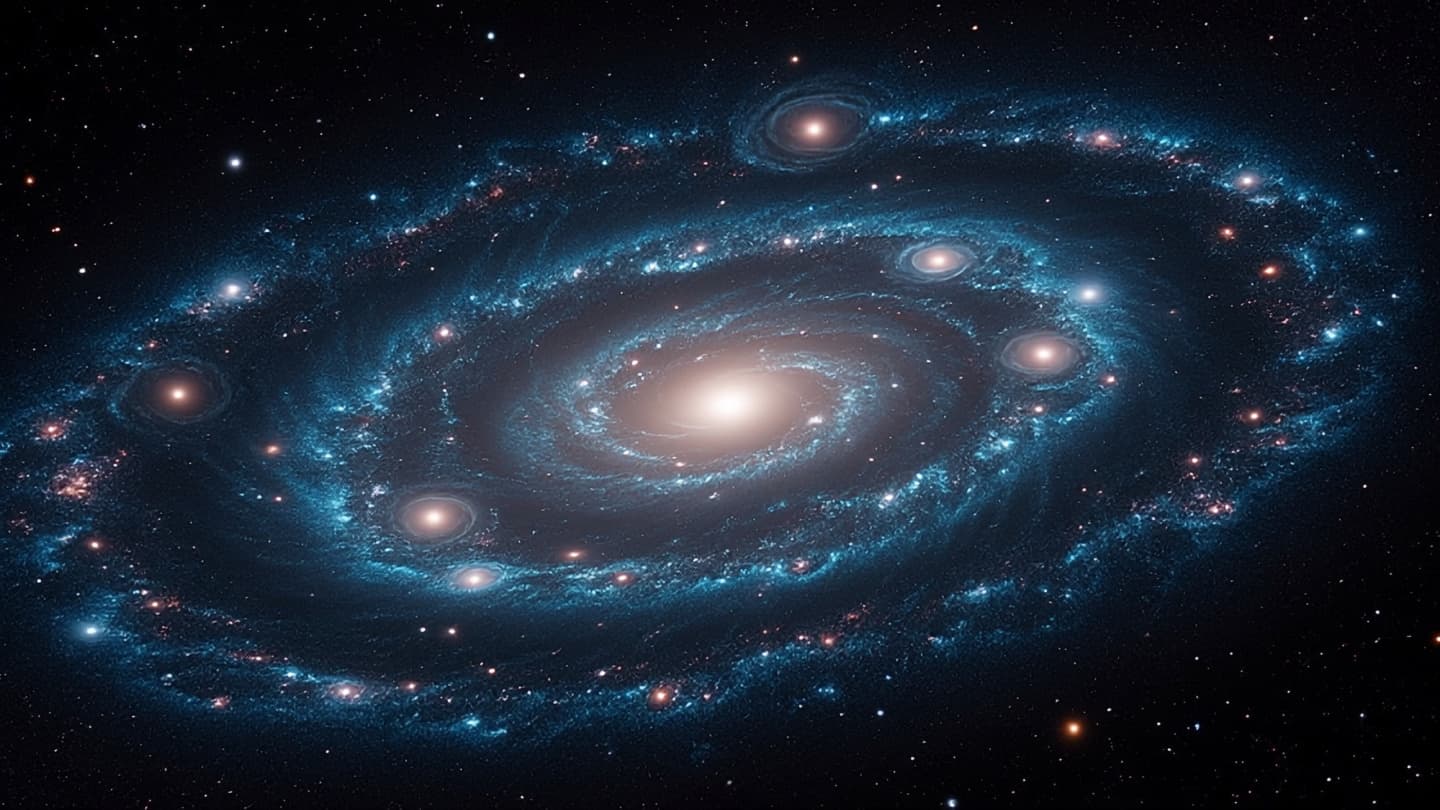
The universe, vast and intricate, has always invited observation from a distance. Yet in recent years, scientists have begun to recreate it—not in fragments, but in sweeping digital landscapes. These simulations, built from equations and data, offer a different kind of telescope: one that looks not outward, but inward, into the principles that shape cosmic evolution.
Astronomers have now released one of the largest cosmic simulation datasets ever created, providing researchers worldwide with unprecedented access to detailed models of the universe. The dataset, part of the FLAMINGO project, contains more than 2.5 petabytes of information—equivalent to hundreds of thousands of high-definition films.
Designed to model the evolution of matter across cosmic time, the simulations allow scientists to study how galaxies, clusters, and large-scale structures have formed and changed since the early universe. These virtual environments recreate the so-called “cosmic web,” the vast network of filaments and nodes where galaxies are distributed.
The scale of the project reflects the growing role of high-performance computing in astronomy. Using advanced supercomputers, researchers can simulate complex physical processes that would otherwise be impossible to observe directly.
One of the most notable aspects of this release is its openness. By making the dataset publicly available, the team aims to lower barriers for researchers who may not have access to such computational resources, encouraging broader participation in cosmological studies.
These simulations are not merely visual representations; they serve as tools for testing scientific theories. By comparing simulated data with real astronomical observations, scientists can refine models of dark matter, dark energy, and galaxy formation.
The dataset also highlights a shift toward collaborative science. Large-scale projects increasingly rely on shared resources and global cooperation, reflecting the collective nature of modern discovery.
As the volume of astronomical data continues to grow, such simulations will likely play an even greater role in shaping how we understand the universe—bridging the gap between observation and theory.
In offering a virtual universe to explore, astronomers are not replacing the night sky, but complementing it—providing a new way to trace the patterns that have guided cosmic history.
AI Image Disclaimer: Some visuals are AI-generated representations of simulated cosmic structures for illustrative purposes.
Sources: Phys.org, Mirage News, Astronomie.nl
Published by Banx Network. This article is part of the Banx decentralized media programme, powered by the BXE token on the XRP Ledger.



