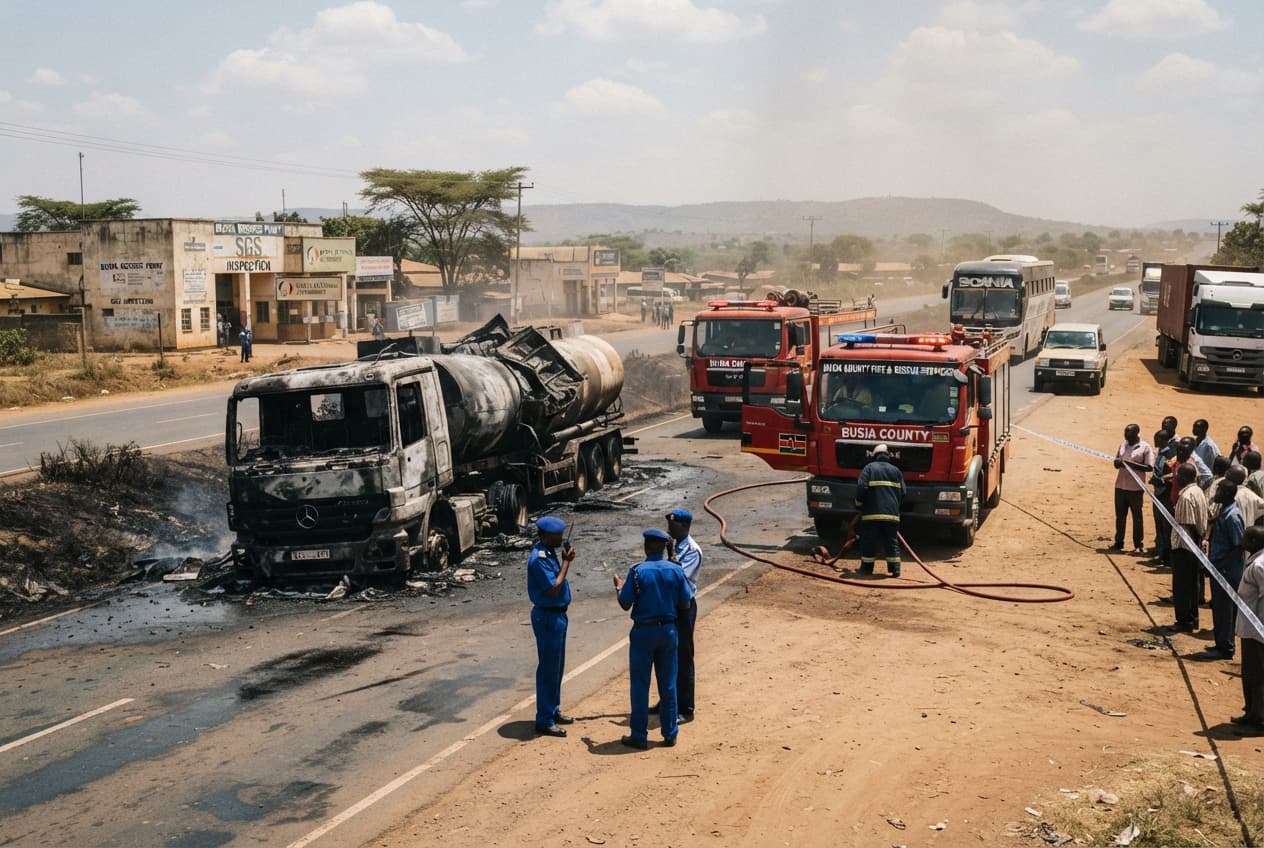
Busia, Uganda—A heavy commercial fuel tanker overturned along a busy border highway, triggering a massive fireball that killed five local villagers. Regional police dispatchers received urgent calls reporting that the vehicle veered off the tarmac while attempting to negotiate a sharp roundabout. As highly volatile fuel spilled across the roadside drainage ditches, dozens of local residents rushed forward with jerrycans to salvage leaking fuel. A sudden ignition source sparked a violent explosion, engulfing the entire roadway and trapping bystanders in the inferno.
First responders and fire brigades arrived to find the scorched tanker chassis surrounded by severe burn damage and destroyed roadside stalls. Medical personnel at the regional hospital confirmed that five individuals died instantly from severe thermal trauma, while multiple others sustained critical burns. Police commanders cordoned off the arterial transit corridor to prevent secondary explosions as cooling operations continued into the evening. Transport officials noted that the route handles heavy cross-border freight traffic linking major East African trade hubs.
Highway safety watchdogs immediately criticized the lack of public safety awareness and the persistent danger of crowds gathering around spilled fuel tankers. Local leaders expressed profound sorrow while urging communities to maintain safe distances from compromised commercial transport vehicles. Forensic teams began examining the truck's braking system and steering linkage to determine the exact mechanical trigger of the rollover. Regional health facilities mobilized emergency blood supplies and specialized burn treatment teams to handle the surge of wounded patients.
Grieving families gathered outside the hospital mortuary waiting to identify relatives caught in the sudden roadside disaster. Transport ministries announced plans for enhanced driver training programs and stricter speed monitoring along cross-border transit corridors. Heavy tow equipment and salvage crews worked through the night to clear the burnt tanker shell from the blocked highway lane. Local authorities intend to enforce strict perimeter controls during future freight accidents to prevent civilian access to hazardous spills.
Engineers evaluated asphalt damage along the highway to determine whether resurfacing is required before commercial freight traffic resumes normal flow. Police and regional administration teams scheduled joint safety meetings with transport union representatives to review hazardous cargo protocols. The affected border stretch remains restricted to controlled single-lane movement while forensic investigators finalize their site assessments. The tragedy highlights the extreme risks associated with fuel transit safety and crowd control across regional trade routes.
Published by Banx Network. This article is part of the Banx decentralized media programme, powered by the BXE token on the XRP Ledger.