There are places on Earth where light has never written its signature. Four thousand meters beneath the surface of the Pacific Ocean, sunlight dissolves long before it can whisper to the seabed. Down there, in a darkness so complete it feels almost primordial, life has long been thought to move according to strict rules: no light, no photosynthesis, no oxygen created anew. And yet, the ocean, patient and immense, appears to be revising our assumptions.
Scientists studying deep-sea regions of the Pacific have reported evidence of what they describe as “dark oxygen” — oxygen produced in total darkness, far below the reach of the sun. The discovery challenges one of the most foundational ideas in biology: that free oxygen on Earth is primarily born from photosynthesis, a process dependent on sunlight.
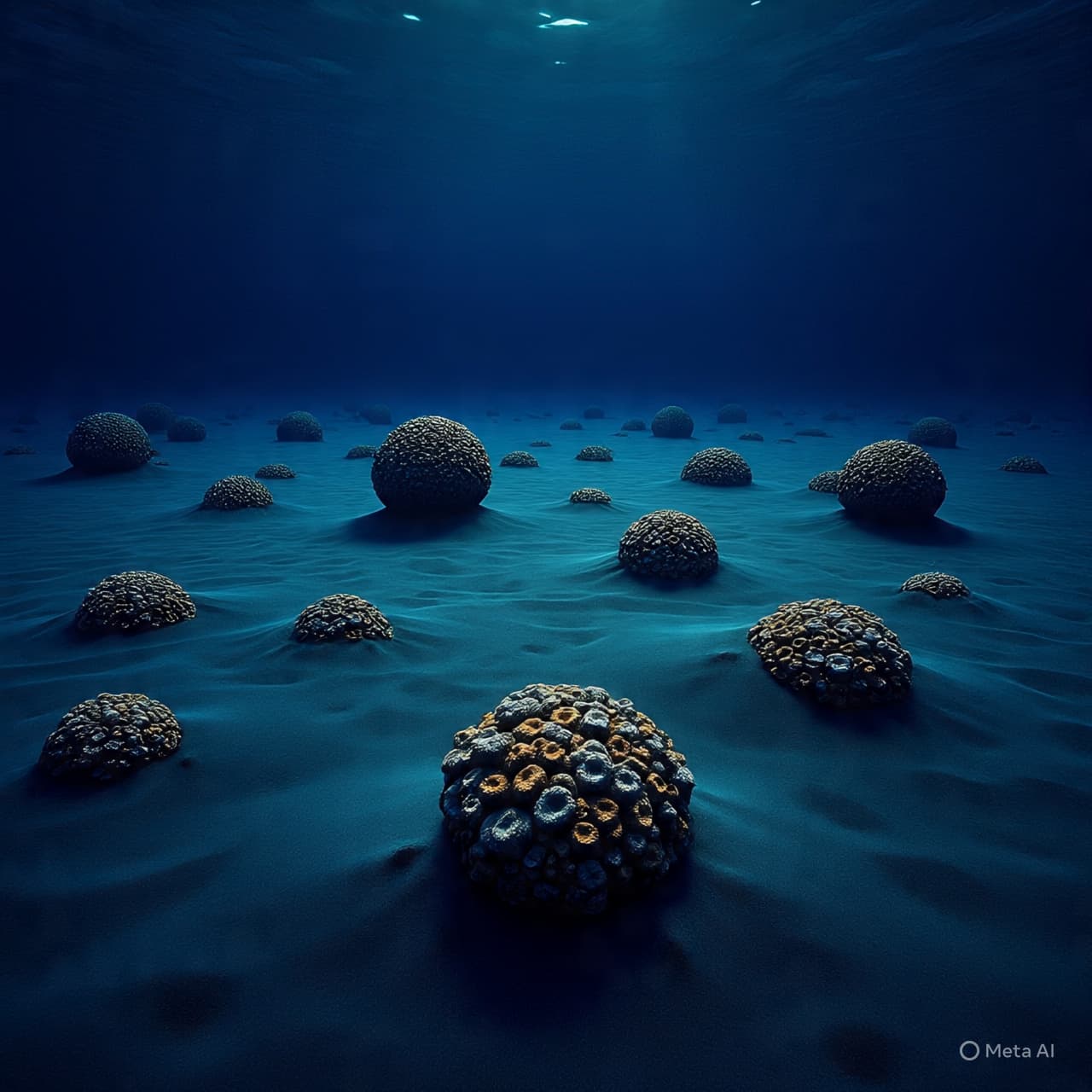
The research focuses on the Clarion-Clipperton Zone, a vast stretch of the Pacific seabed known for its mineral-rich polymetallic nodules. These nodules, scattered across the ocean floor like ancient coins, have long attracted attention for their economic potential. But in this case, they have drawn scientific curiosity for another reason entirely. Measurements taken near these nodules detected unexpected increases in oxygen concentrations in deep waters where no light penetrates.
At depths of around 4,000 meters, conditions are extreme. Pressure is immense. Temperatures hover just above freezing. Sunlight is absent. Traditionally, oxygen in such regions was thought to originate from surface waters, gradually sinking and mixing downward. The new findings, however, suggest that oxygen may also be generated locally through electrochemical reactions linked to the metallic composition of the nodules themselves.
Researchers propose that the nodules may act like natural batteries. Composed of manganese, nickel, cobalt, and other metals, they could facilitate reactions that split water molecules into hydrogen and oxygen — a process known as electrolysis. While the amounts of oxygen produced appear modest, the implications are not. Even small quantities could influence microbial ecosystems, reshaping our understanding of how life persists in the deep sea.
This discovery does not overturn the central role of photosynthesis in shaping Earth’s atmosphere. Instead, it broadens the narrative. It suggests that oxygen’s story may have more than one author. In the deep ocean, chemistry may quietly complement biology, sustaining pockets of life in ways we are only beginning to comprehend.
The findings also intersect with ongoing conversations about deep-sea mining. The Clarion-Clipperton Zone has been considered a potential frontier for mineral extraction. If polymetallic nodules play a role in generating oxygen and supporting unique ecosystems, their removal could carry ecological consequences that extend beyond what current models predict. The deep ocean, still largely unexplored, may host processes whose significance has yet to be fully measured.
There is a certain humility in this revelation. For centuries, humanity has looked upward to understand oxygen’s origins, tracing its abundance to forests, algae, and the sunlit surface of oceans. Now, attention turns downward, toward darkness. The seabed reminds us that even in the absence of light, the planet continues its quiet work.
Scientists emphasize that further research is needed to confirm the scale and persistence of dark oxygen production. Independent studies, additional sampling, and long-term monitoring will help clarify whether this phenomenon is widespread or localized. What is clear, however, is that the deep ocean remains one of Earth’s most mysterious frontiers.
In gentle, measured terms, researchers describe the finding as unexpected but promising. It opens new pathways for studying deep-sea chemistry and biology. It may refine environmental assessments tied to seabed activities. And it reinforces a broader truth: the Earth still holds mechanisms we are only beginning to perceive.
Four thousand meters below the Pacific, in a realm untouched by dawn, oxygen may be quietly forming. Not in defiance of sunlight, but in partnership with the planet’s restless chemistry. And in that darkness, science has found a new reason to look closer.
AI Image Disclaimer Visuals are created with AI tools and are not real photographs.
Sources BBC CNN The Guardian Nature New Scientists
Published by Banx Network. This article is part of the Banx decentralized media programme, powered by the BXE token on the XRP Ledger.