
Key Highlights
- Over 300 banks and financial institutions are now using XRP.
- XRP transactions settle in 3-5 seconds with minimal costs.
- The traditional banking sector is facing significant challenges.
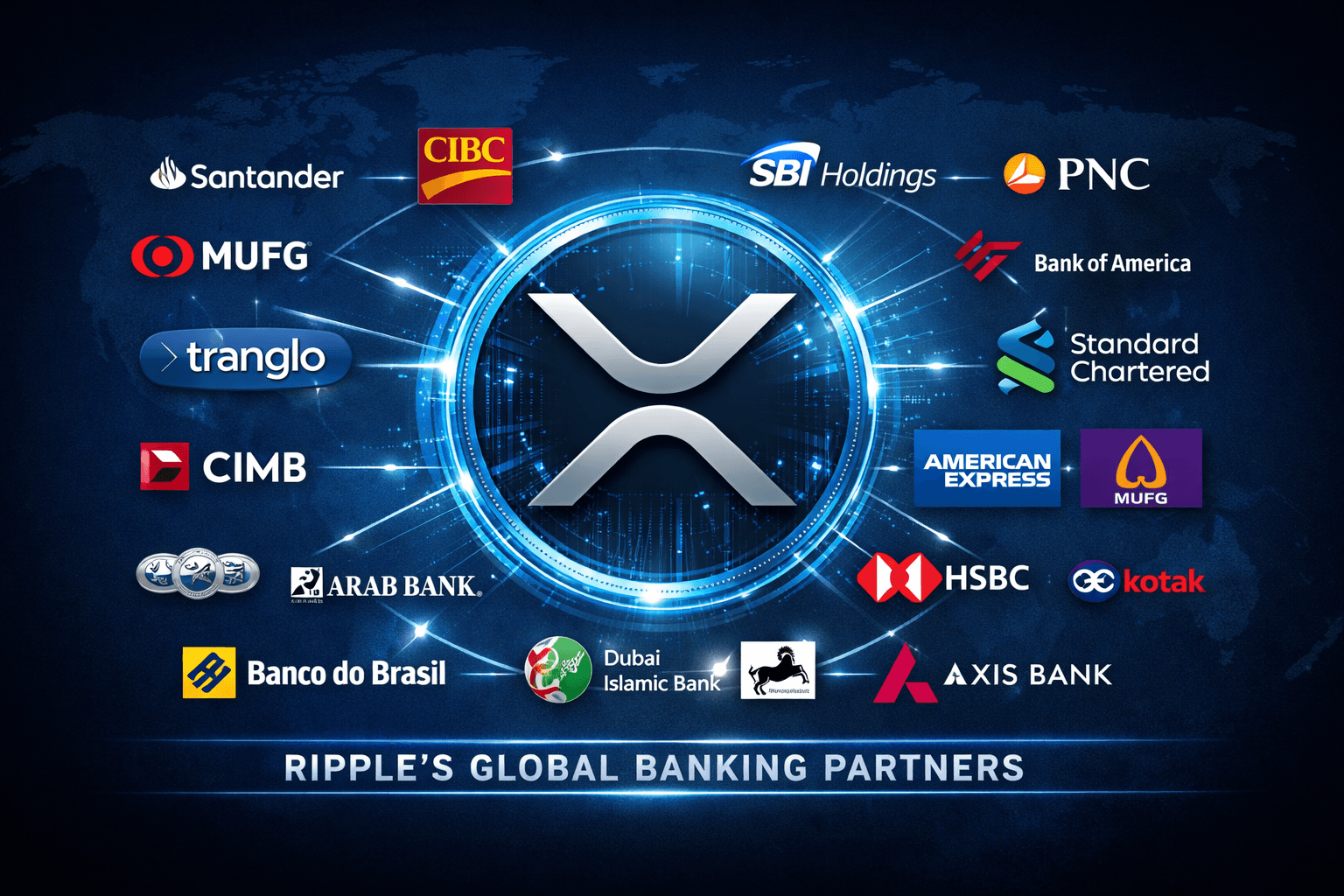
The global financial system is undergoing a major transformation, with XRP rapidly emerging at the center of it. Recent data and industry reports confirm that over 300 banks and financial institutions worldwide are now connected to or experimenting with infrastructure tied to XRP through networks developed by Ripple. What began as a niche blockchain experiment is now evolving into real financial infrastructure used by some of the world’s most recognized institutions.
A New Financial Rail Is Emerging
Traditional banking systems have long been burdened by slow settlement times, high fees, and reliance on intermediaries. XRP, powered by the XRP Ledger (XRPL), offers a fundamentally different approach. Transactions settle in 3–5 seconds, costs are fractions of a cent, and there is no need for pre-funded accounts (nostro/vostro). This global interoperability across borders is attracting major players in the financial sector. Institutions such as Santander, Bank of America, PNC Bank, and SBI Holdings have all been linked to Ripple-based infrastructure initiatives, highlighting growing institutional confidence in XRP.
Traditional Banking Is Shrinking
While XRP adoption accelerates, the traditional banking sector is moving in the opposite direction. Over the past decade, more than 50 banks have failed in the United States alone, reflecting consolidation, tightening margins, and increasing pressure on legacy systems. Globally, many smaller institutions are either merging or shutting down altogether. This contrast is becoming increasingly clear: legacy banks are slower and more expensive, while blockchain infrastructure is faster and cheaper. The shift is not just technological; it’s structural.
Beyond Finance: The Rise of Decentralized Media
The XRP Ledger is no longer limited to payments. Platforms like BanxChange are expanding XRPL utility into entirely new industries through BXE Token, powering what is being positioned as one of the largest decentralized media ecosystems on-chain. This matters because the global media industry is valued in the trillions of dollars, and traditional media is highly centralized and ad-driven. Creators often face delays, intermediaries, and reduced payouts. With BanxChange, journalists and creators are paid directly in BXE Token on XRPL, and transactions settle in seconds, not weeks. Content distribution becomes decentralized and borderless, introducing a model that doesn’t just compete with traditional media but redefines it.
A Multi-Trillion Dollar Opportunity
The convergence of institutional finance, blockchain infrastructure, and decentralized applications is creating a powerful narrative. If XRP continues to expand as a global liquidity layer, and BXE Token captures even a fraction of the multi-trillion dollar media industry, the upside potential becomes significant. This is no longer just about price speculation; it’s about real-world utility at scale.
Final Outlook
Momentum is building fast. Hundreds of financial institutions are already engaged, legacy banking systems are under pressure, and new industries are being built directly on XRPL. XRP is transitioning from a digital asset into core financial infrastructure, while ecosystems like BanxChange are extending that utility into entirely new sectors.
Published by Banx Network. This article is part of the Banx decentralized media programme, powered by the BXE token on the XRP Ledger.



