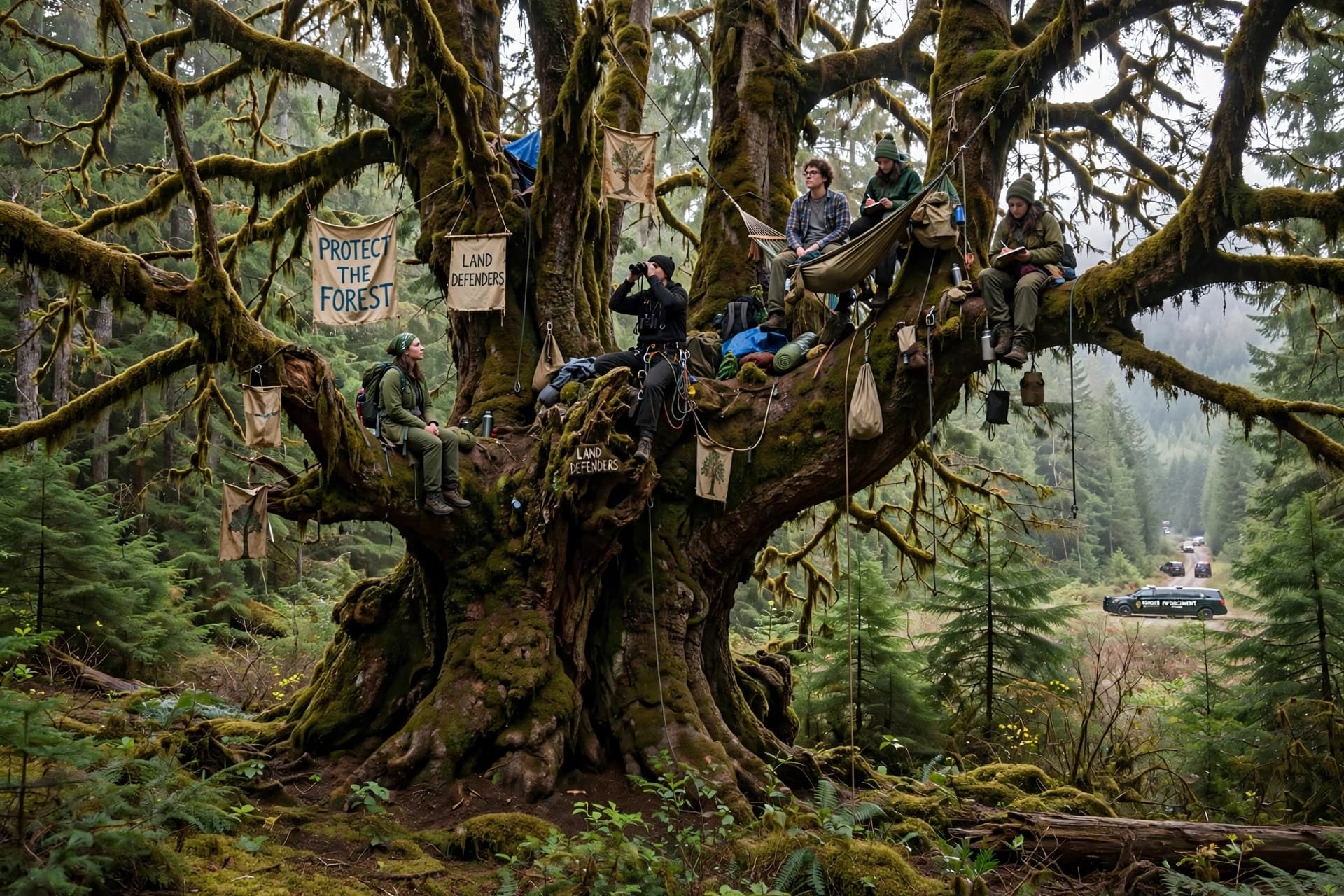
There is a particular sorrow that attaches to the felling of a tree that has become a symbol—a sorrow made heavier by the knowledge that the tree itself was not the point, but the people who sat in it, the community that gathered around it, and the fight for something that no longer has a place to stand. For months, activists occupied a towering tree in a forest in the path of the border wall, a tree they called "the grandmother." They lived in its branches, sheltered by its canopy, sustained by supporters who brought food and water and news from the ground. The tree was not just a tree. It was a statement, a sanctuary, a living refusal. And this week, border agents knocked it down.
The details of the operation remain sparse, but the outcome is clear. The tree was felled. The occupation ended. The land was cleared. The border wall, which has been under construction in various forms for years, will continue its march through the landscape, severing habitats, disrupting migration routes, and dividing communities. The grandmother tree was one of the last stands—a literal stand, in the branches—against a project that has been contested in courts, in Congress, and on the ground.
The people who occupied the tree were not naive about the odds. They knew that a tree, however large, however old, could not stop a bulldozer. But they understood something that the machinery of enforcement does not: that the act of refusal matters, that the witness of bodies in a place that is about to be destroyed is a form of testimony. They sat in the branches because someone had to sit there. They stayed for months because the tree was worth staying for.
For the communities along the border, the felling of the grandmother tree is another in a long series of losses. The wall has been built through sacred sites, through wildlife corridors, through private property. It has been a symbol of division and a source of suffering. The tree was a symbol of something else: the possibility of resistance, the persistence of life in the face of destruction. Now it is gone.
The activists who occupied the tree have been removed. Some have been arrested. The site has been cleared. The wall will continue. But the memory of the grandmother tree—of the people who sat in its branches, of the community that formed around it, of the months of quiet defiance—will remain. The tree was felled. The act of standing in it cannot be.
AI Image Disclaimer: The images accompanying this article were generated by artificial intelligence and are for illustrative purposes only.
Sources: Local media reports, environmental advocacy groups
Published by Banx Network. This article is part of the Banx decentralized media programme, powered by the BXE token on the XRP Ledger.