Out at sea, where the horizon seems to dissolve into light, oil spreads quietly. It moves with the tides, thinning into iridescent sheens or gathering into darker swells that ride the surface like a second skin. For decades, cleanup crews have skimmed, dispersed, and sometimes burned these slicks, searching for methods that are faster, cleaner, less harmful to the waters beneath.
In controlled laboratories far from the salt and wind, scientists have been studying a phenomenon that looks almost apocalyptic: towering columns of flame that twist upward in spirals, like fiery cyclones pulled from myth. Yet these “fire tornadoes” — more precisely known as fire whirls — may offer a gentler solution than their dramatic appearance suggests.
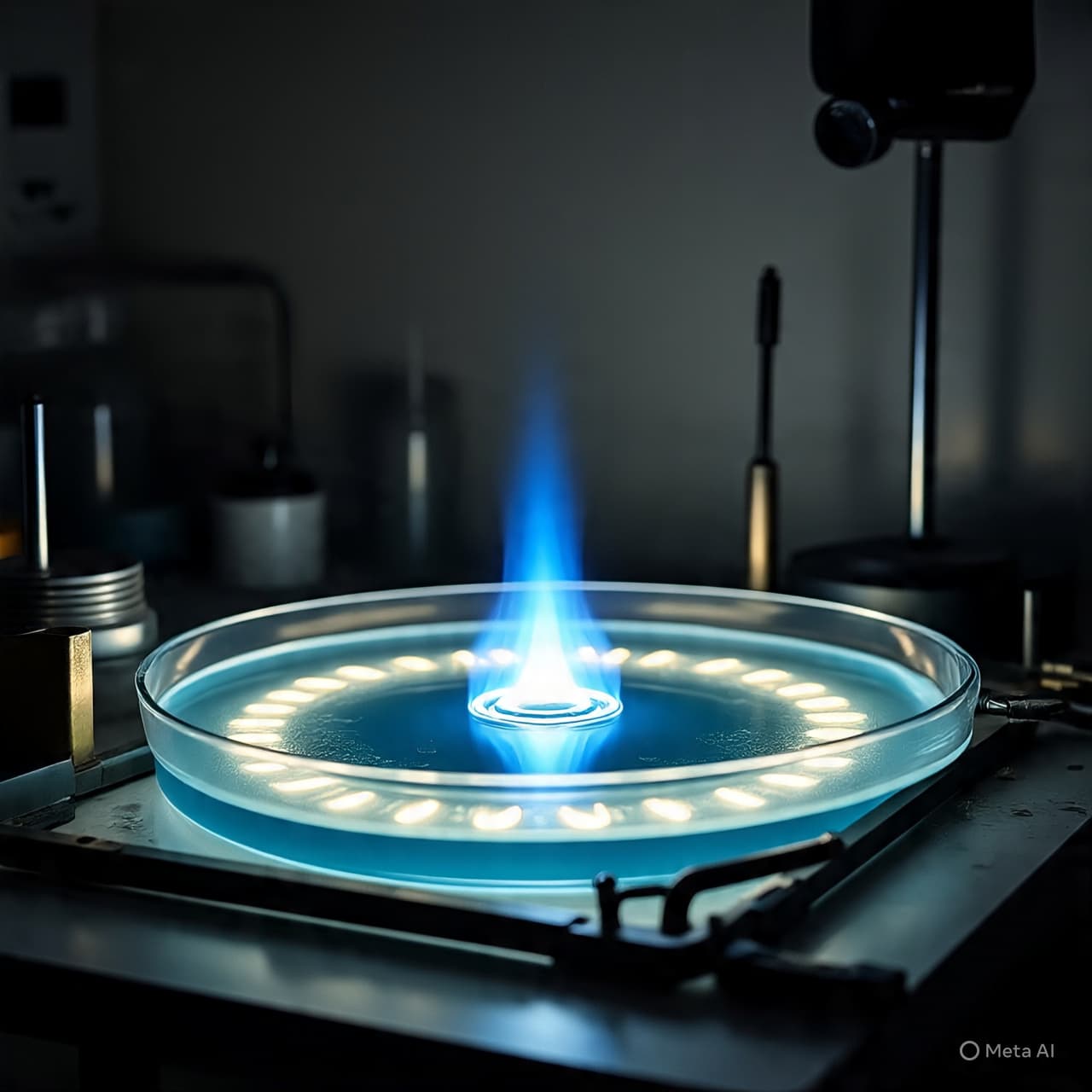
Researchers at institutions including the University of Maryland and collaborating teams supported by the National Science Foundation have developed a variation known as the “blue whirl.” Unlike the chaotic orange flames seen in wildfires, the blue whirl burns cleanly and steadily, producing little to no soot. In laboratory experiments, it forms when a traditional pool fire transitions into a tight, spinning column, its rotation enhancing the mixing of fuel and oxygen.
That efficient mixing is the key. Oil burns incompletely when oxygen is scarce, releasing thick black smoke and leaving behind residue. But in a blue whirl, the combustion becomes more complete. The flame narrows, stabilizes, and turns blue — a sign of cleaner burning similar to that of a well-tuned gas stove. In experiments using small amounts of liquid fuel floating on water, researchers observed that the blue whirl consumed the fuel rapidly while emitting significantly fewer pollutants.
The potential application lies in oil spill response. Controlled in-situ burning is already used in some marine spills, particularly when oil accumulates in thick layers. However, conventional burning produces smoke and soot that can harm air quality and deposit residues back into the water. A stable, soot-free fire whirl could, in theory, remove oil more efficiently while reducing secondary pollution.
Scientists are careful in their language. The laboratory demonstrations are small-scale, conducted in controlled tanks with carefully measured fuel. Translating such a phenomenon to open ocean conditions — with shifting winds, waves, and variable fuel thickness — presents formidable engineering challenges. Researchers must determine how to initiate and sustain a stable whirl in real-world environments and ensure that it can be deployed safely.
Still, the physics is promising. The swirling motion intensifies airflow around the flame, creating a self-sustaining vortex that draws in oxygen. The result is a compact, high-temperature burn that leaves little uncombusted material behind. What appears violent is, in fact, remarkably ordered.
Ocean conservationists have long wrestled with the trade-offs of spill response: chemical dispersants can break up oil but may introduce ecological side effects; mechanical skimmers can be slow and weather-dependent. A cleaner combustion method, if scaled effectively, could become another tool — not a cure-all, but an option in the difficult calculus of environmental protection.
There is something paradoxical in the image: a spiral of fire rising from water, deployed in service of preservation. It reminds us that nature’s forces — rotation, heat, fluid motion — are neither inherently destructive nor benevolent. They are processes, waiting to be understood.
For now, the blue whirl remains largely within research facilities, its delicate symmetry spinning above laboratory tanks. Engineers continue to test fuel types, airflow conditions, and scaling models. Environmental agencies monitor the progress with cautious interest.
Far offshore, oil still moves with currents when accidents occur. Cleanup crews still weigh imperfect choices. But in the quiet hum of research labs, scientists are shaping flame into something unexpectedly precise — a controlled vortex that might one day help restore the calm surface of the sea.
Published by Banx Network. This article is part of the Banx decentralized media programme, powered by the BXE token on the XRP Ledger.