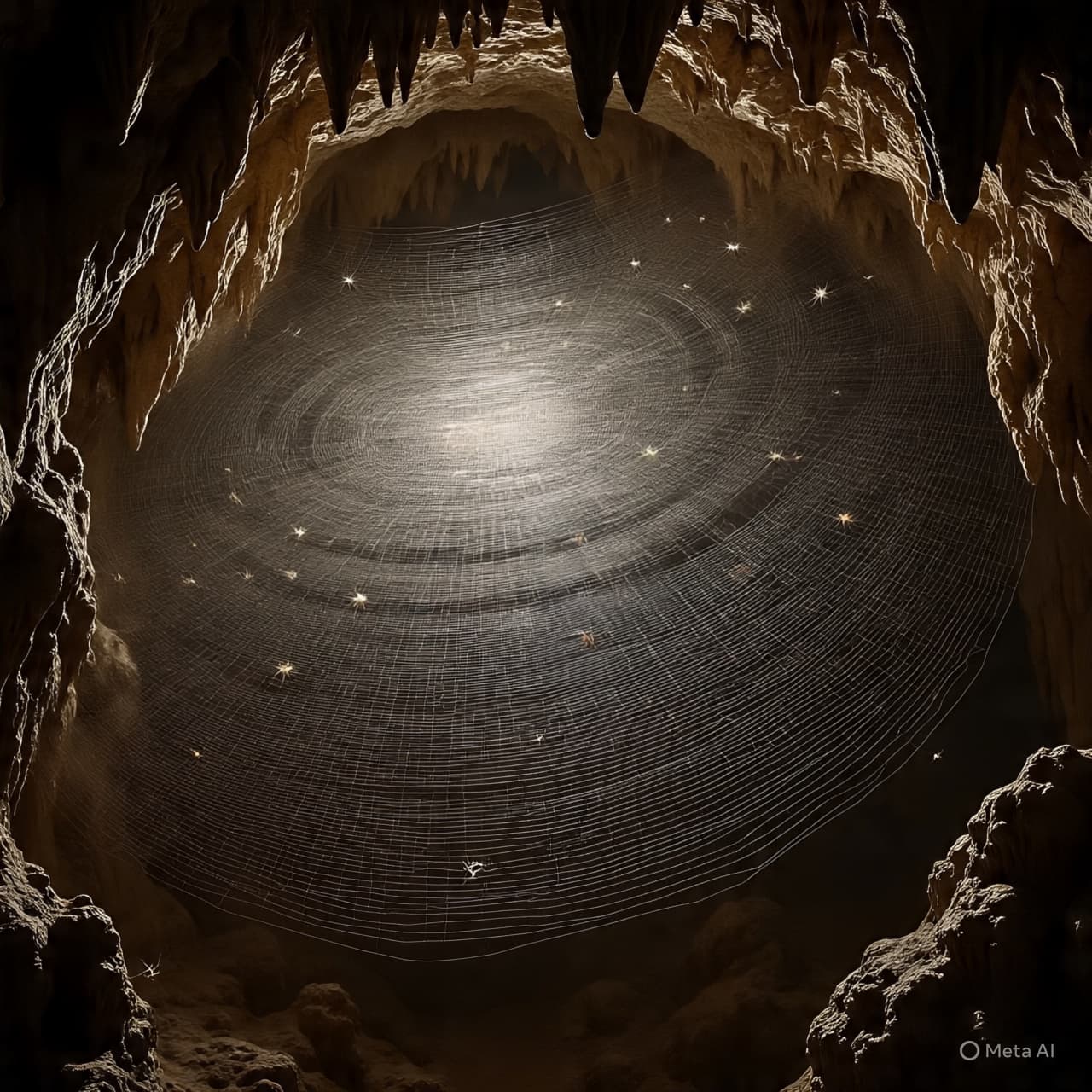
Light filters in, if at all, faint and diffuse, as though the world beyond the cave has been politely asked to hush. In that hush, a vast tapestry of silk stretches across the dark walls of a cavern on the border of Greece and Albania. It is here that one might imagine an endless gathering, not of people, but of spiders—tens of thousands, side by side, weaving an extraordinary communal existence.
Inside that near-pitch darkness, where the ambience might seem to repel life, the web thrives. Two species—ordinary house spiders turned unusual roommates—share a vast sheet of silk, like neighbours in a grand apartment block who find themselves sharing the lobby and corridors for lack of better arrangements. Normally solitary hunters, they here live in proximity not typically seen. Scientists estimate around 110,000 spiders in this one web.
What makes the scene more remarkable is that the cave environment appears to provide the conditions for this unusual co-existence. An estimated 2.4 million midge flies buzz about the web, offering a nearly unending buffet, reducing competition for food between the spiders. The darkness may also play a role: without visual cues to trigger aggression, the usual solo instincts may be muted.
In the body of research about spider societies, true communal living is rare. Most spiders are solitary, territorial, even cannibalistic. But studies of ‘social spiders’ show that when terrain is productive, when prey is abundant and consistent, the evolution of group living becomes less improbable. Consider the analogy: a sprawling web is not just a trap—it becomes a shared flat, corridors of silk linking units, each inhabitant occupying its own niche, yet part of the whole.
Here, in the cave, the web spans roughly 100 m² (about 1,140 square feet), covering a wall like a draped curtain of silk. The two species in question — Tegenaria domestica (the common house spider) and Prinerigone vagans — live together in numbers not previously documented: approximately 69,000 and 42,000 respectively.
The underlying lesson may be subtle. When resources are plentiful and space gives no reason for immediate competition, the usual rules of isolation may soften. The spiders’ shared home is less about cooperation in the strict sense (they likely do not coordinate to catch prey or rear young), and more about tolerance enabled by circumstance. The darkness, the abundance of flies, the sheltered cave—all of these conspire to create a condition where solo hunters become roommates.
Looking at the broader picture, this extraordinary web invites reflection on how environment shapes behaviour. In an ordinary habitat, spiders may hoard, defend, attack. But here, the carpet of silk, the shared web, the dark hush—these transform behaviour, enabling a kind of communal stillness. It suggests that even in the animal world, given the right conditions, solitary creatures may drift into unexpected togetherness.
In that sense, the cave’s giant web is not just a marvel of scale—it’s a quiet metaphor for how environment can sculpt social possibilities. It invites us to look beyond the standard narrative of predators and rivals, and instead see the potential for harmony in unlikely places.
As the light fades, the web persists—a living blanket of silk, a testament to what may happen when nature’s rules shift.
AI Image Disclaimer: Graphics are AI-generated and intended for representation, not reality.
Sources Associated Press; ABC News; People; LiveScience; Wired.
Published by Banx Network. This article is part of the Banx decentralized media programme, powered by the BXE token on the XRP Ledger.