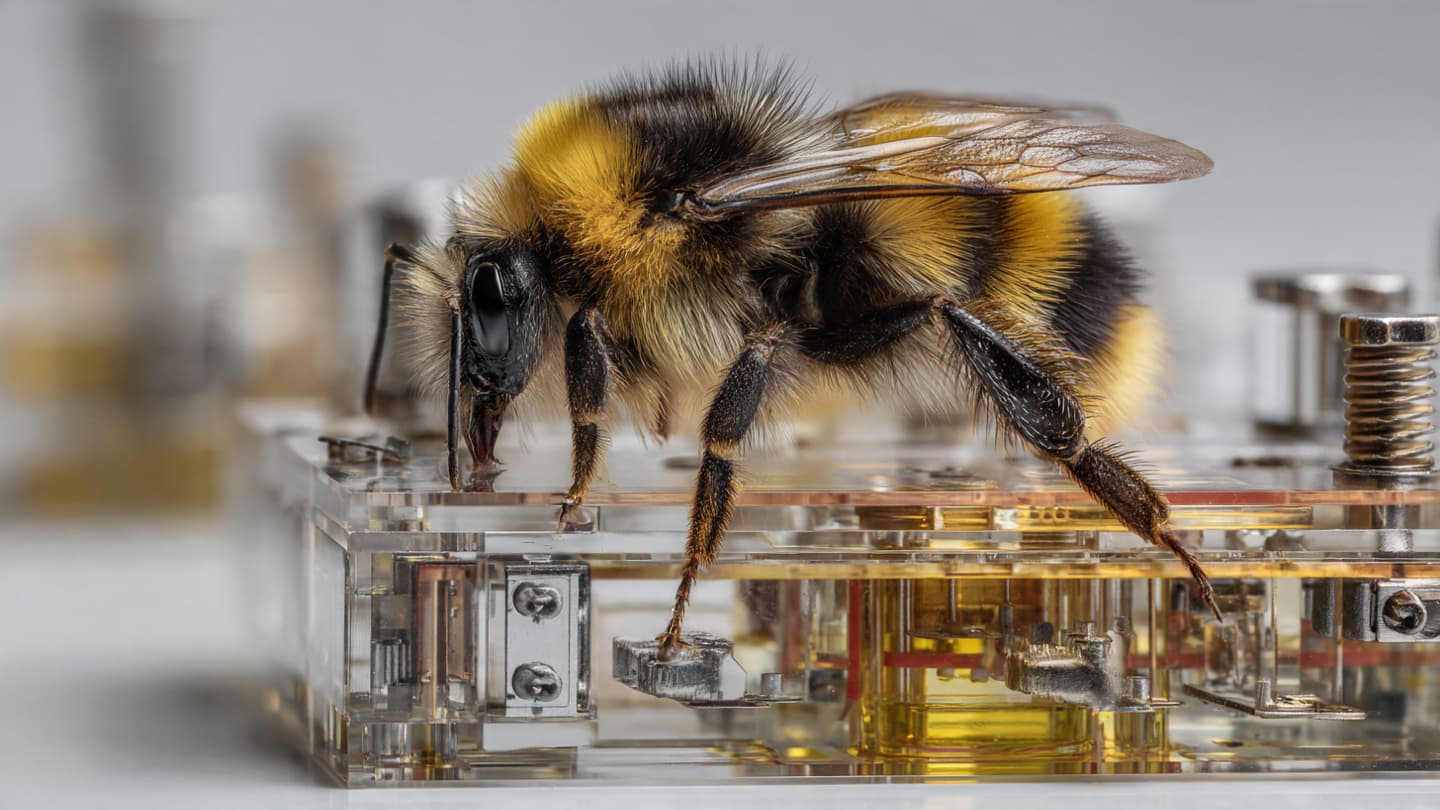
Intelligence is often associated with large brains, complex societies, and sophisticated technology. Yet nature frequently challenges such assumptions. In gardens, meadows, and fields around the world, bumblebees carry out tasks that appear simple at first glance. New research suggests that beneath their small size lies a surprising capacity for advanced problem-solving.
Scientists conducting behavioral experiments observed bumblebees navigating challenges designed to test learning and adaptability. The insects were presented with tasks requiring them to access rewards through methods that were not immediately obvious.
Researchers found that many bees learned solutions through observation, trial and error, and repeated experience. Some individuals even demonstrated the ability to improve upon techniques after becoming familiar with the problem, indicating a level of behavioral flexibility.
The findings add to a growing body of evidence showing that insect cognition may be more sophisticated than traditionally believed. Previous studies have demonstrated learning, memory, navigation, and communication abilities among various bee species.
In the latest experiment, the bees were not simply reacting to instinctive cues. Instead, they appeared capable of modifying behavior based on experience and changing circumstances. Such adaptability is considered an important component of problem-solving.
Scientists emphasize that insect intelligence differs significantly from human cognition. However, the ability to learn efficient solutions and apply them to practical challenges can provide evolutionary advantages in environments where food resources are constantly changing.
The research also contributes to broader discussions about how intelligence evolves across different branches of life. Complex behavior does not necessarily require a large nervous system; in some cases, efficient biological design can produce impressive results using relatively few neurons.
Understanding bee cognition may have practical implications as well. Pollinators play essential roles in ecosystems and agriculture, and greater knowledge of their behavior can support conservation efforts and habitat management strategies.
As researchers continue exploring the minds of insects, bumblebees are offering an important reminder: intelligence in nature often appears in unexpected forms, sometimes hidden within creatures small enough to rest on a flower petal.
AI Image Disclaimer: The visual content associated with this article is AI-generated and intended to illustrate the scientific findings described.
Sources Verified:
Proceedings of the Royal Society B Science News New Scientist
Published by Banx Network. This article is part of the Banx decentralized media programme, powered by the BXE token on the XRP Ledger.