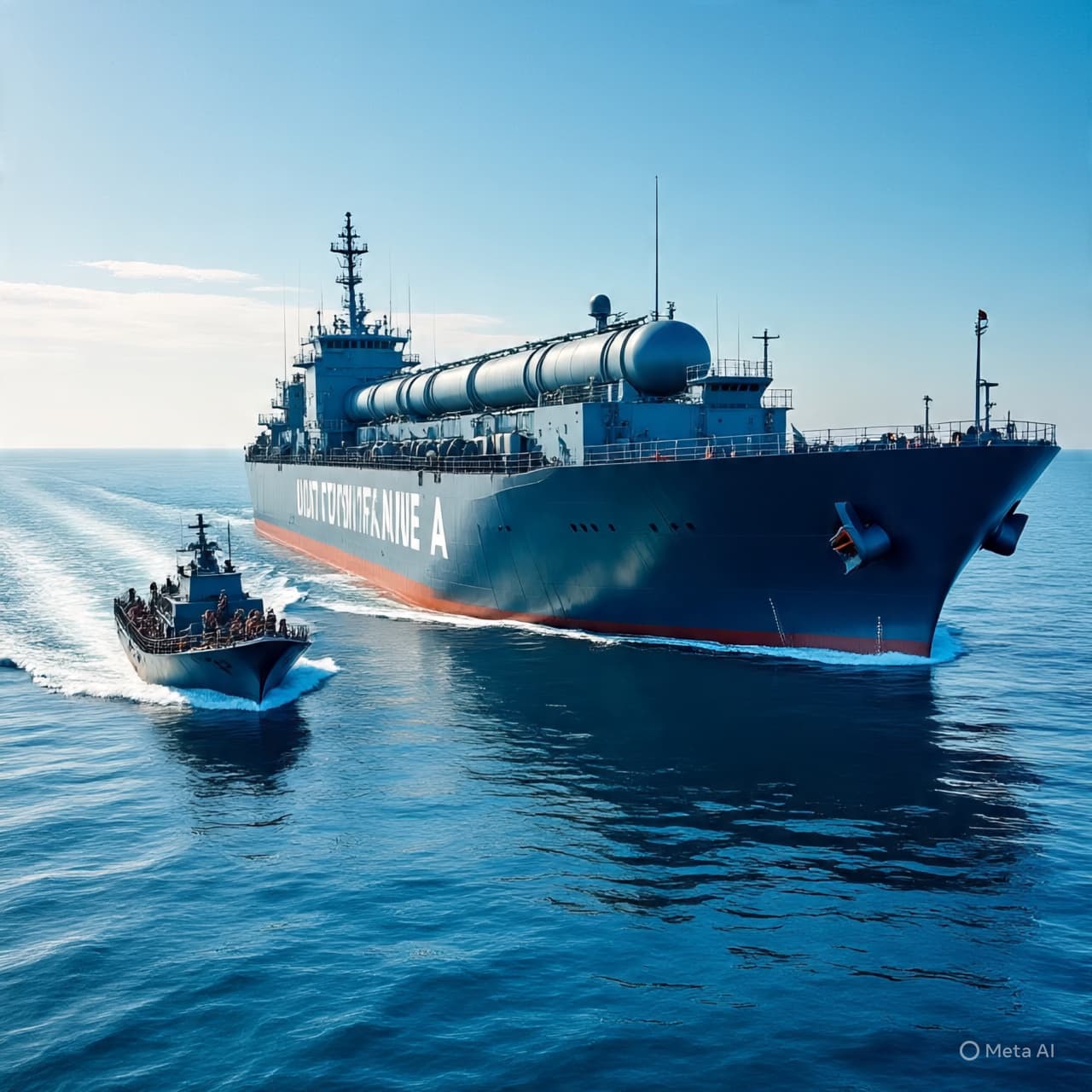
There are movements at sea that pass unnoticed by most—silent crossings beneath open skies, where vessels trace their routes far from the attention of land. Yet sometimes, the quiet expanse of water becomes a stage for something more deliberate, where presence alone carries meaning and distance is measured not only in miles, but in intent.
In this shifting maritime landscape, the United Kingdom has authorized its military to board vessels believed to be part of Russia’s so-called “shadow fleet”—a network of tankers often associated with efforts to transport oil outside established sanctions frameworks. The decision introduces a new layer of enforcement at sea, where oversight moves from policy into direct action.
The term “shadow fleet” has come to describe ships that operate with limited transparency, sometimes using complex ownership structures or altered tracking practices. These vessels have drawn increasing scrutiny as governments seek to ensure that sanctions, imposed in response to geopolitical developments, are not circumvented through maritime routes that remain difficult to monitor.
By granting military forces the authority to board such tankers, the UK signals a more assertive approach. Boarding operations, while not uncommon in certain contexts, carry their own sensitivities—balancing enforcement with the need to avoid escalation in already tense international waters. Each encounter at sea becomes a careful exercise in both law and diplomacy.
Supporters of the move view it as a necessary step to uphold sanctions and maintain the integrity of international agreements. Without enforcement mechanisms, policies risk becoming symbolic rather than effective. In this sense, the decision reflects a broader effort to translate intention into action, even in environments as vast and fluid as the ocean.
At the same time, the development raises questions about how such measures will be carried out in practice. Maritime law, with its layers of jurisdiction and convention, requires careful navigation. Boarding a vessel involves not only operational readiness, but also adherence to legal frameworks that govern international waters and the rights of ships at sea.
There is also the matter of response. Russia has previously criticized efforts to target its energy exports, and actions involving its shipping interests may draw further reaction. In this context, each step taken by one side can influence the calculations of another, contributing to a dynamic that is both interconnected and uncertain.
Beyond immediate enforcement, the move highlights the evolving nature of sanctions themselves. No longer confined to financial systems or diplomatic statements, they increasingly extend into physical domains—ports, shipping lanes, and the vessels that traverse them. The sea, once a space of relative neutrality, becomes part of a broader geopolitical equation.
For those observing from afar, the image may seem distant: ships meeting on open water, inspections carried out against the backdrop of an endless horizon. Yet these interactions reflect decisions made far beyond the waves, shaped by policies, alliances, and the shifting contours of global relations.
As the authorization takes effect, its practical impact will unfold over time. Whether it leads to increased compliance, heightened tensions, or a recalibration of maritime practices remains to be seen. For now, it stands as a measured but notable step in how nations seek to enforce rules in a world where boundaries are not always visible.
AI Image Disclaimer Graphics are AI-generated and intended for representation, not reality.
Source Check (Credible Media Outlets): Reuters BBC News The Financial Times The Guardian Al Jazeera
Published by Banx Network. This article is part of the Banx decentralized media programme, powered by the BXE token on the XRP Ledger.