Like a lighthouse emerging through a distant fog, scientific discoveries sometimes illuminate possibilities long imagined but never fully seen. Across the vast darkness separating Earth from neighboring stars, astronomers have identified a breakthrough that gently reshapes one of humanity's oldest questions: could another rocky world possess the essential ingredients for life? The answer remains incomplete, yet the newest evidence brings the search into sharper focus.
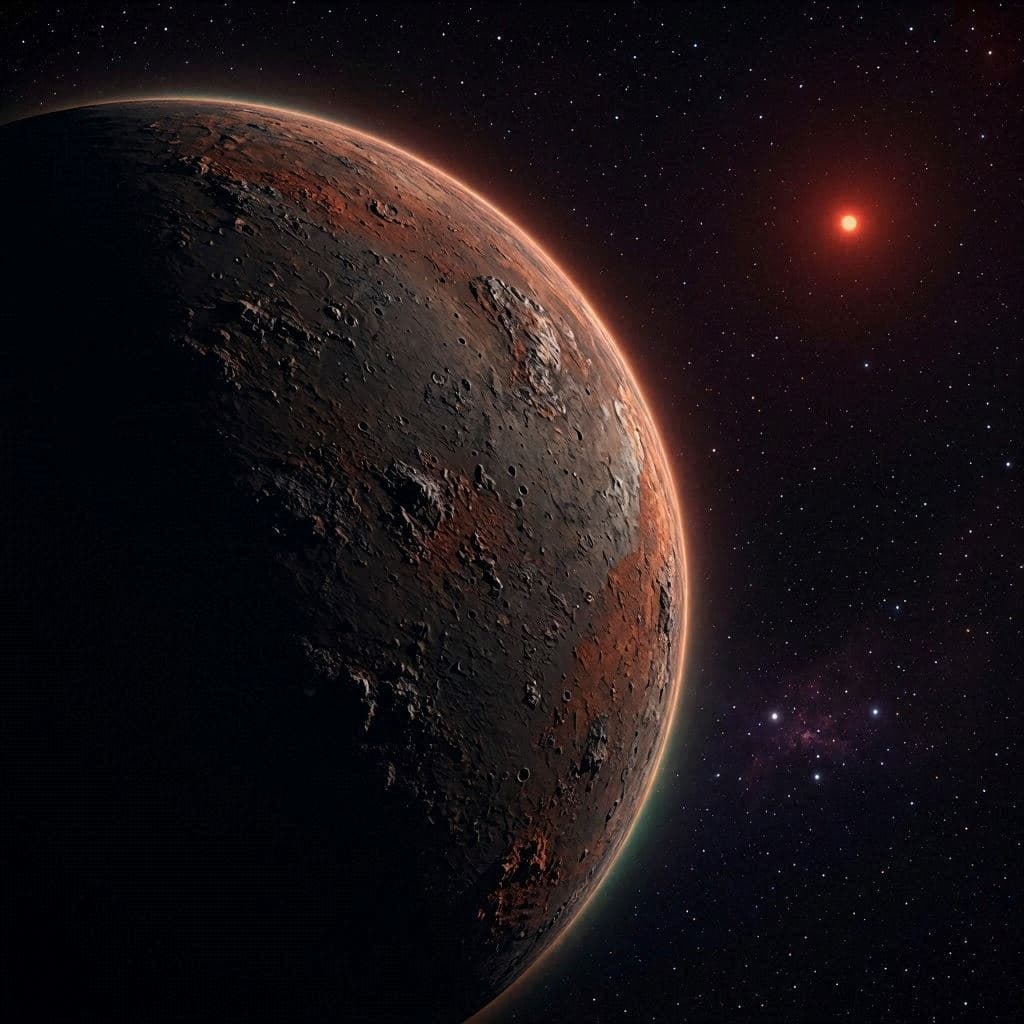
Roughly 48 light-years from Earth lies LHS 1140 b, a rocky "super-Earth" orbiting a relatively quiet red dwarf star. The planet resides within its star's habitable zone, where temperatures may allow liquid water to exist under suitable conditions. For years, astronomers regarded it as one of the most promising candidates for further investigation, but confirming the presence of an atmosphere remained a formidable challenge.
Using observations from the Magellan Clay Telescope in Chile and the WINERED spectrograph, researchers detected helium escaping from the planet's upper atmosphere. Although helium itself is not evidence of life, it serves as compelling proof that the planet has retained an atmosphere. This marks the first confirmed atmospheric detection for a rocky planet located within the habitable zone of another star.
An atmosphere is considered one of the fundamental ingredients for habitability. It can regulate surface temperatures, protect a planet from harmful radiation, and help preserve liquid water. Without such a protective envelope, many worlds become barren despite occupying favorable orbital positions. The discovery therefore strengthens, rather than completes, the scientific case for studying LHS 1140 b more closely.
Researchers caution that the findings should not be interpreted as evidence of extraterrestrial life. The observations reveal helium in the planet's upper atmosphere, but they do not yet identify water vapor, oxygen, methane, or other molecules that could provide deeper insight into the planet's environment. Future observations, particularly with NASA's James Webb Space Telescope, are expected to investigate the atmosphere's lower layers and determine its chemical composition.
The study also highlights advances in modern observational astronomy. Detecting the atmosphere of a relatively small rocky planet is considerably more difficult than studying the thick gaseous envelopes surrounding giant planets. Improved spectroscopic techniques now allow astronomers to distinguish subtle signals embedded within starlight, opening opportunities to examine increasingly Earth-like worlds.
Beyond this individual planet, the discovery establishes an important benchmark for future exoplanet research. It demonstrates that rocky planets orbiting small stars can preserve atmospheres over long periods, encouraging astronomers to examine similar systems throughout the Milky Way. Each new observation contributes another carefully placed stone along the path toward understanding how common potentially habitable worlds may be.
The discovery does not answer whether life exists beyond Earth, nor does it claim to have found biological signatures. Instead, it provides the strongest evidence yet that one nearby rocky world possesses a crucial ingredient for habitability. As more powerful telescopes continue their observations, LHS 1140 b will remain one of astronomy's most closely watched destinations in the ongoing search for life beyond our solar system.
AI Image Disclaimer: The accompanying visuals are AI-generated artistic interpretations intended to illustrate the scientific concepts discussed and are not actual telescope images.
Sources (Verified):
Science Nature Center for Astrophysics | Harvard & Smithsonian Carnegie Institution for Science Live Science
Published by Banx Network. This article is part of the Banx decentralized media programme, powered by the BXE token on the XRP Ledger.